
BBC Wildlife – December 2025
Summary
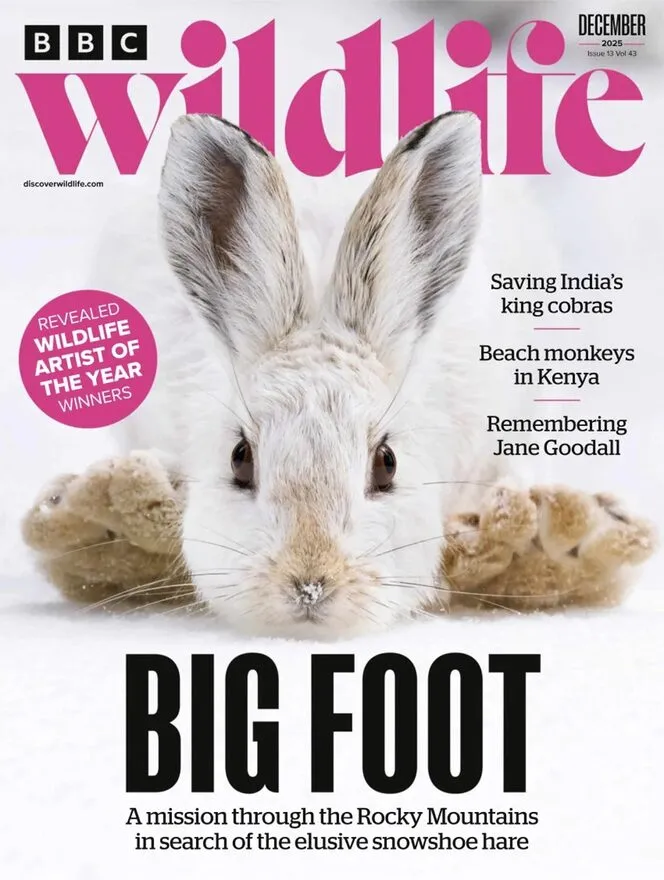
BBC Wildlife December 2025 leads with Deena Sveinsson's Colorado snowshoe hare portfolio on page 38, after eight years photographing a hare she calls Yvette in temperatures dropping well below freezing. Inside: a Jane Goodall tribute, the BBC Wildlife Artist of the Year 2025 winners, plus king-cobra rescue stories from India's Western Ghats.
BBC Wildlife December 2025 frames itself as a portfolio-and-memorial issue, opening with Deena Sveinsson's eight-year Colorado Rockies project following a single snowshoe hare she calls Yvette. Editor Paul McGuinness names the hare his new favourite, anchoring an issue that also marks Jane Goodall's October death with a long tribute by primatologist Ben Garrod. Ben Hoare's December nature hit-list, Mike Dilger's Patagonia puma column and a David Shepherd Wildlife Foundation Wildlife Artist of the Year 2025 portfolio round out the editorial mix.
Conservation features take two of the strongest slots. Beth Richardson walks Diani Beach Road, 30km south of Mombasa, where five primate species overlap with tourists. She reports fewer than 400 Angolan black-and-white colobus remain in Kenya and 55 monkeys are injured by traffic each year. Colobus Conservation's chain-ladder colobridges, used over 32,000 times each, and 12km of insulated powerlines won in a 2017 Kenya Power lobbying fight buy time. Skip the beach peanuts on your next Diani trip: feeding stations are why Sykes' monkeys now patrol pool sun-loungers.
Smaller pieces round out the issue. Neil Ansell writes a melancholic first-person essay on tracking Manx shearwaters on Rum and song-flighting greenshanks before his hearing fails entirely. Nick Baker explains why the Madagascar giraffe-necked weevil uses its elongated neck as both a mating joust and a leaf-folding tool. Ben Hoare selects nine wildlife books for Christmas, including Robert Macfarlane's Is a River Alive? and Yuvan Aves's Intertidal. Photo Club spotlights underwater shooter Isaac Szabo.
—————
Content Guide
▸ Cover Story
p.38 · Snow days
Deena Sveinsson's eight-year Colorado Rockies project follows a snowshoe hare she names Yvette, capturing white winter coats against powder, courtship chases and 16cm snowshoe feet used like natural snowshoes. The portfolio documents seasonal coat colour change, leveret numbers of 2-7 per litter and adult lifespan of up to five years. Read the caption on feet posture to identify hares in deep drifts this December, and check deciduous woodland edges in northern North America for forms – shallow depressions where hares shelter rather than burrow.
▸ Tribute
p.32 · Remembering Jane
Ben Garrod recounts meeting Jane Goodall while serving her soup as a Cambridge waiter, and frames her Gombe research as collaborative work with her mother Vanne, porter Rashidi and scouts Adolf and David. Garrod reminds readers that Goodall never worked alone and that earlier ape researchers George Schaller and Jill Donisthorpe paved the way. The piece includes four pull-quotes and a Roots & Shoots note: the programme runs in 60-plus countries. Use this as a 600-word primer before booking any Gombe-streamed lecture or Roots & Shoots event.
▸ Conservation
p.48 · Life's a beach
Beth Richardson walks Diani Beach Road, 30km south of Mombasa, where five primate species overlap with tourists. She reports that fewer than 400 Angolan black-and-white colobus remain in Kenya and that 55 monkeys a year are injured by traffic. Colobus Conservation's chain-ladder colobridges, used over 32,000 times each, and 12km of insulated powerlines won in a 2017 Kenya Power lobbying fight buy time. Skip the beach peanuts on your next Diani trip: feeding stations are why Sykes' monkeys now patrol pool sun-loungers.
p.60 · Living with the king
Photographer Luca Eberle rides shotgun as Ajay Giri, ARRS field director in Karnataka, removes king cobras from school roofs and gardens. Giri has rescued hundreds of snakes in 17 years without being bitten. The 4m, 8kg recapture in this issue carries a PIT tag and is released within metres of capture. India logs 40,000-60,000 snakebite deaths annually and no specific king-cobra antivenom exists; polyvalent antivenom varies regionally. Takeaway: if you spot a cobra in the Western Ghats, call ARRS, not the village healer, and never approach at ground level.
▸ Field Reports & Discoveries
p.24 · Mike Dilger's wildlife spectacles
Pumas in Patagonia: the Torres del Paine comeback. Mike Dilger explains that pumas have the widest distribution of any New World mammal, vying with leopards for the fourth-largest cat. The park's eastern triangle, between Laguna Armaga and the Sarmiento and Nordenskjöld lakes, is where trackers work; early starts and late finishes boost odds. Pumas succeed one in five hunts; surplus kills feed culpeo foxes and Andean condors. Book a December-May Torres del Paine tracking guide, not a generic vehicle tour, and learn the guanaco sentinel bleat – it pinpoints hidden cats.
p.98 · Tales from the Bush
Tamara MC walks Big Bend National Park's 7.5km Lost Mine Trail in autumn and finds herself surrounded by hundreds of male Texas brown tarantulas (Aphonopelma hentzi), each with 12cm legspans, on a once-in-a-lifetime mating march after 8-10 years underground. Females stay in burrows, tapping back or eating suitors; they live up to 40 years. Read this before any October-November West Texas hike – step high off trail edges at dusk, and skip horror-film assumptions. Their bite venom is weaker than a bee sting.
p.56 · A journey into sound
Neil Ansell's hearing is failing, so he spent a year crisscrossing the Highlands and islands by bus and ferry to record specific bird calls before they vanish for good. Targets: Manx shearwaters on Rum (100,000 pairs, a third of the world population), corncrakes on Hebridean machair, and greenshank song-flight on a remote lochan ridge. He hears the right notes and leaves the tent quickly so the memory stays perfect. Read this before planning a Scotland wildlife trip in May-June; camp at dawn on a known lek.
p.28 · Nick Baker's hidden world
Trachelophorus giraffa, the giraffe-necked weevil, lives only in Madagascar's eastern forests and measures 25mm at full stretch. Males have a neck 2-3x longer than females; they use it to joust on Dichaetanthera cordifolia leaves, watched by shorter-necked females. Females then bite along leaf veins, fold the leaf into a single-egg burrito and drop it from the canopy. Useful if you are planning a Madagascar trip: book a guide who knows the host plant by local name, walk slowly, and never knock branches or you will lose every weevil in sight.
▸ Reviews & Regulars
p.68 · The best books of 2025
Ben Hoare's gift list opens with Robert Macfarlane's Is a River Alive? (Hamish Hamilton, £25), where Macfarlane uses 'rivers who' to argue for legal personhood. Also reviewed: Sophie Pavelle's To Have or to Hold (Bloomsbury, £20), Michael Warren's The Cuckoo's Lea, Katie Stacey's No Paradise With Wolves, Yuvan Aves's Intertidal and Joe Harkness's Neurodivergent, by Nature. Three kids' titles round it out: Isabel Thomas's Frog (Bloomsbury, £12.99), Jules Howard's Choose Your Own Evolution (Nosy Crow, £14.99) and Jennifer N R Smith's Life (Thames & Hudson, £16.99). Order by 15 December for delivery.
p.70 · Visions of nature
The BBC Wildlife Artist of the Year 2025 winners, judged for the 17th year by David Shepherd Wildlife Foundation. Overall winner: Nicole Koleková's ceramic Beloved, depicting a monkey mother unable to release her dead child. Overall runner-up: Matthew Polluck's Waiting on the World to Change, a horn-less northern white rhino in ink, metallic paint and gold leaf. Category picks include Holly Budge's 96-elephants-a-day ivory sculpture and Sunghyun Chun's pencil snake at age 17. See davidshepherd.org for the full shortlist; entry for next year opens in spring.
p.8 · Wild Times
The news pages run 12 short items: oceanic manta rays diving past 1,200m off New Zealand (Murdoch University tag data); Sierra Nevada birds thriving 35 years after low-severity burns; the BBC's six-part Kingdom series narrated by David Attenborough in Zambia; Oxford's AI wildebeest count under 600,000; and the matador bug of Panama, which waves red hind-leg flags at praying mantids. Action item: scan birch and beech mast sites in southern England in December to catch bramblings joining chaffinches, and check apple trees and poplars for sticky mistletoe before the mistle thrushes eat them.
—————
Editor's Take
The strongest thing here is Deena Sveinsson's Colorado snowshoe portfolio – eight patient years turn a single hare called Yvette into an emotional anchor for the whole issue, and editor Paul McGuinness is right to put her on the cover. Ben Garrod's Jane Goodall tribute is also standout, but its real value is the corrective: Goodall never worked alone, and naming Vanne Goodall, Rashidi, Adolf and George Schaller respects her collaborators more than the legend ever did. The weakest slot is Visions of Nature, where the Wildlife Artist of the Year 2025 spread feels like filler after the heft of the cobra and colobus conservation features. Buy this issue for Sveinsson, Garrod and the king-cobra rescue protocols – it is for serious naturalists who want science, not collectors of pretty pictures.
Strengths
• Sveinsson's eight-year hare portfolio earns the cover photo
• Garrod's Jane Goodall tribute names her actual collaborators
• King-cobra piece prints real rescue protocol, not folklore
Weaknesses
• Visions of Nature spread reads as filler after serious conservation work
• Long ad clusters interrupt Dilger's Patagonia column
Verdict: Recommended — Strong photography and science writing, but the art and book-review pages feel padded.
