
Parrots – January 2026
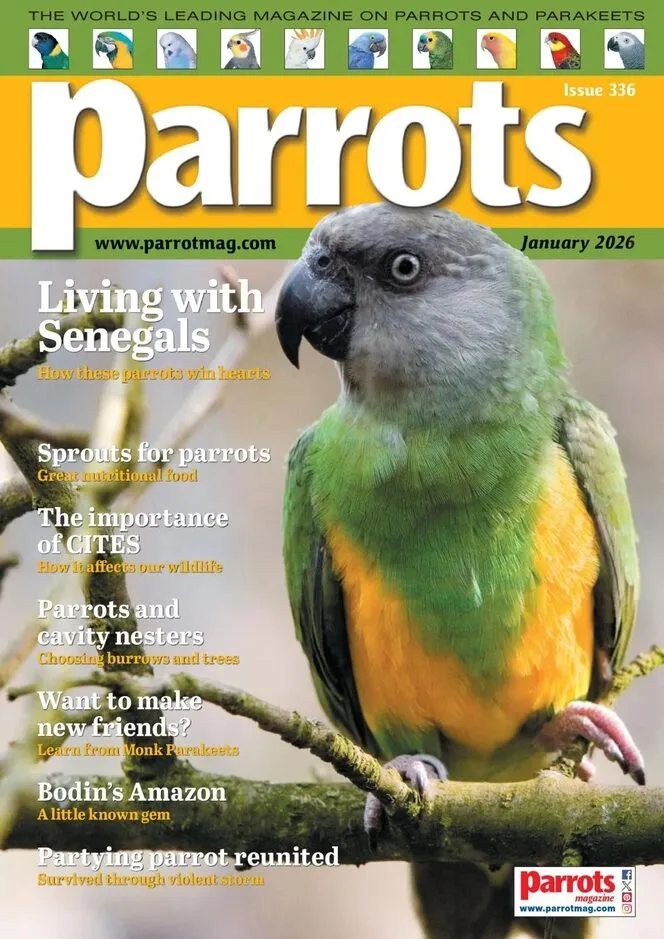
Summary
The January 2026 Parrots magazine — Issue 336 — opens with a 4-page profile of the Senegal parrot (Poicephalus senegalus) by Sonny Stollenmaier, follows it with Rosemary Low's CITES guide for African Greys and macaws, and threads through Monk Parakeet 'Testing the Waters' science from the University of Cincinnati, Loro Parque Fundación breeding logs, and Leslie Moran's anti-amyloidosis feeding plan.
Sonny Stollenmaier anchors this issue with 'Living with a Senegal parrot' — a 4-page keeper's-eye portrait ranking Senegal behaviour, diet, noise, cage costs, and the warning that imported birds rarely tame. Rosemary Low's CITES primer spells out Article 10 certificate rules for UK Annex A species including the Grey Parrot and Double Yellow-headed Amazon, and reminds buyers that violations carry up to seven years' prison time.
Two science features stand out. Mihai Andrei summarises a Biology Letters paper showing that wild-caught Monk Parakeets vet strangers with a 'Hover' technique before physical contact. David Waugh reports on Dr Carmela Española's 2025 Subic Watershed study of 104 cavities across 10 breeding species, recommending that large dead trees be protected as future Blue-naped Parrot nest sites. Eb Cravens lays out a 24-hour soak-and-serve routine for germinated seeds in Complete Psittacine.
Leslie Moran's Holistic Parrot column gives keepers a concrete anti-amyloidosis swap list — drop dyed seed mixes and peanuts, feed raw walnuts and broccoli for omega-3 balance. News pages follow Ivy the Alexandrine's 31-km reunion after a Gympie storm, plus the Twink cockatiel tragedy, Hoo Zoo's new aviary for one-eyed Monica the Grey, and a Bengaluru businessman electrocuted saving his macaw.
—————
Content Guide
▸ Cover Story
p.20 · Living with a Senegal parrot
Stollenmaier gives a 4-page keeper portrait of Poicephalus senegalus, ranking personality, noise, cage cost, and talking ability. He advises against imported Senegals (rarely tame as adults) and pushes hand-reared birds from responsible breeders, varied vegetables like kale and papaya, twice-weekly showers, and wide cages with varied-diameter natural branches. The piece ends with a quiet warning: an older Senegal that loses daily attention is hard to retame. Read it before buying.
▸ Species Care
p.24 · Bodin's Amazon: A little known gem
Merilee Hook profiles the Bodin's Amazon (Amazona a. bodini), a 34cm Festive Amazon subspecies with fewer than 200 birds in US aviculture and a wild range along the Orinoco-Rio Meta corridor. Hook covers pet suitability, talking ability, an almond-puzzle anecdote, weekly bathing, a sight-barrier rule for breeding aggression, and the 1980s first captive breeding by Mary McDonald in Texas. A practical rarity roadmap for serious keepers.
p.34 · Spotlight on species: Meyer's Parrot — A widely distributed African species
A field-and-aviary profile of Poicephalus meyeri, six subspecies ranging from Ethiopia to Namibia, 21cm long, with diagnostic yellow crown and red irides. Warwick Tarboton's Naboomspruit nest observations give a breeding timeline: pairs swap places five times per visit, eggs hatch 2-3 days apart, chicks are smoky grey down with pinkish beaks. Pure-bred subspecies stay a breeder problem because of availability.
▸ Behaviour & Enrichment
p.14 · Want to make new friends? Learn from Monk Parakeets
Mihai Andrei summarises a Biology Letters study by Claire O'Connell's University of Cincinnati team showing that wild-caught Monk Parakeets vet strangers with a low-risk 'Hover' phase before any physical contact. Birds that skip straight to grooming already had established trust. The takeaway for keepers: forcing two unfamiliar parrots into close quarters skips the safety stage and risks injury, so staged proximity beats cohabitation.
▸ Breeding & Conservation
p.10 · The importance of the annual breeding summary (News from Loro Parque)
Rafael Zamora Padrón, Scientific Director of Loro Parque Fundación, sets out the dates a serious breeder must log: courtship start, mating, first egg, chick hatch, nutrition changes, weather, and pair incompatibility. He argues that stable pairs repeat behaviour precisely, so a written summary lets a breeder tweak diet or feeder numbers weeks before next season. Short, useful, and free of fluff.
p.36 · How parrots relate to other cavity-nesters in Luzon, Philippines
David Waugh reports on Dr Carmela Española's 2025 Subic Watershed study of 104 cavities across 10 breeding species, including the Blue-naped Parrot and Guaiabero. Key data: Blue-naped Parrots used only tall trees (≥21.6m) with narrow entrances, fitting 63% of nests in woodpecker cavities, while 67% of parrot nests sat in disturbed forest. Recommendations include protecting dead snags and planting Parkia timoriana and Shorea contorta.
▸ Health & Nutrition
p.18 · Serving soaked and germinated seed for your birds (Complete Psittacine)
Eb Cravens argues that 24-hour soak-and-serve beats full sprouting for safety and cleanup. Use one seed type per container (safflower, buckwheat, barley, oat groats, canary, millet, quinoa, sesame), rinse at 4-6 hours and again at night, and never stir germinated grains (the tails bruise and rot). Skip beans — some stay toxic. A working routine for one-bird-can-breeders.
p.30 · The Holistic Parrot: Amyloidosis — nutrition, healing and hope
Leslie Moran cites peer-reviewed work showing phospholipid mixes from the University of Colorado, Boulder cut amyloid fibril formation by 76%, plus a 72-compound natural inhibitor list. The keeper takeaway is a swap chart: drop dyed seed mixes, peanuts, millet, sunflower, hemp, pistachios, cheese, bagels, pizza, bread, and processed treats; add raw walnuts, sprouted blends, broccoli, beetroot, and apple pieces. Next month: homeopathic first-aid remedies.
▸ Conservation & Regulation
p.26 · CITES: What you should know
Rosemary Low's plain-English UK guide covers the Article 10 certificate (Transaction Specific vs Specimen Specific) needed to sell any Annex A / CITES Appendix I bird, including Golden Conures and Grey Parrots (listed 2017). Sellers must show documentary evidence of legal acquisition, leg-ring or microchip marking; buyers risk criminal charges for skipping paperwork. APHA penalties reach unlimited fines and seven years' prison. Lists all Appendix I Amazons and macaws.
▸ News & Stories
p.12 · Christmas at Feathers Together
Catalina Tate reports on what the charity bills as the world's first 'Bring your parrot to meet Santa' event, held at Garden Feathers in Tyne & Wear the last weekend in November. Santa's flock of cockatiels, a Green-cheeked Conure, a Yellow-crowned Amazon, and an African Grey met 50+ visitors, including MP Kate Osborne and viral Umbrella Cockatoos Charlie Junior and Coconut. The event raised over £1,000.
p.17 · Alexandrine survives six days of wild storm
Jennifer Nichols tells Ivy's story: the Alexandrine parrot chewed out of her Gympie, Queensland aviary hours before a violent storm, survived 31 km over bushland and farms to Coondoo, and crashed a 50-person party at Maree Ussher's farm. Ussher enticed the bird back with a tiny beer can and Jatz biscuits. The takeaway for owners: microchip, aviary-reinforce, and lean on local Facebook groups — 10-20 strangers reached out within hours.
p.6 · Parrot News from around the world
A 12-page news round-up: Adele King (Twink) devastated after her 26-year-old cockatiel Timberlake died in panto rehearsals; Bentley the cockatoo's jacuzzi bath; one-eyed African Grey Monica's new Telford aviary at Hoo Zoo; Bandit the shouting cockatoo; Worksop macaws Percy and Polly stolen (police ref 25000710520); Bengaluru businessman electrocuted saving his macaw; Iowa Parrot Rescue's $12,000 feed-cost fundraiser; Phoenix the Sun Conure says no to Atlanta snow.
—————
Editor's Take
This January 2026 issue of Parrots magazine is strongest on practical keeper guidance. Sonny Stollenmaier's Senegal feature is candid on cost, time commitment, and the trap of imported stock. Rosemary Low's CITES explainer is the best single introduction to UK Article 10 paperwork anywhere in the parrot press this year. Leslie Moran's anti-amyloidosis feeding plan is bold, peer-cited, and genuinely actionable for keepers who cook for their birds. The Luzon cavity-nester study is dense but a rare conservation win for Blue-naped Parrot and Guaiabero. Weaker spots: the news pages lean on viral social-media clips (Sun Conure vs snow, electrocuted macaw) rather than reporting, and the Postbag and vet directory eat space a breeder profile could have used. Best for owners of small African parrots and CITES-conscious UK keepers.
Strengths
• Senegal parrot cover feature gives real keeper costs and time demands
• Rosemary Low's CITES explainer is the clearest UK Annex A guide in print
• Leslie Moran's amyloidosis swap list is peer-cited and immediately actionable
Weaknesses
• News pages lean on viral clips instead of original reporting
• Vet directory and Postbag eat space a breeder profile could fill
Verdict: Recommended — Strong on species care and CITES paperwork, weaker on news depth.
