
Irish Wildlife Magazine – Winter 2025-2026
Summary
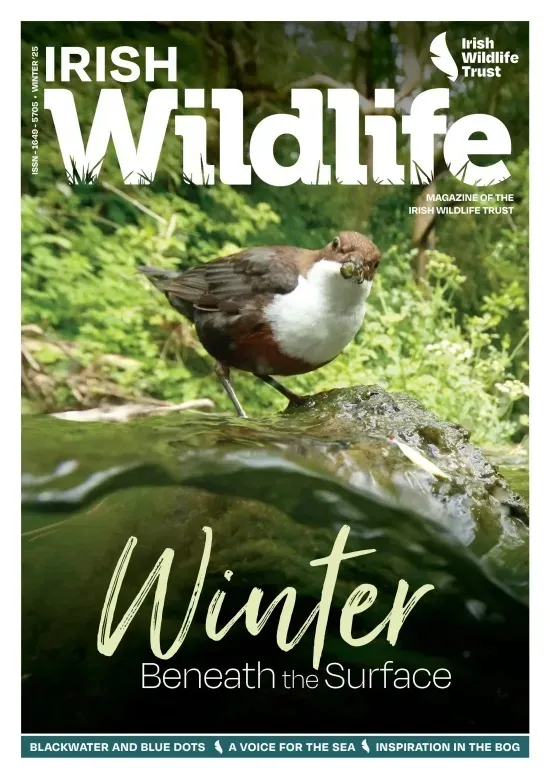
Winter 2025-2026 Irish Wildlife leads with the River Blackwater fish kill in County Cork – some 50,000 dead salmon, trout, lamprey and eels across 40km – and Billy Flynn's argument that fines in the thousands are no deterrent. Dipper on the cover; Blue Dot rivers inside.
Billy Flynn's cover feature on the River Blackwater fish kill anchors the issue: roughly 50,000 salmon, trout, lamprey and eels dead along 40km of County Cork river, first seen on 9 August 2025, with no point source ever identified despite 31 EPA-regulated sites, 20 commercial premises and 14 farm operations being checked. Flynn contrasts that failure with the Scotstown River in Monaghan, one of Ireland's handful of Blue Dot catchments, where farmers turned out on a wet day to discuss buffer zones.
Conservation reporting dominates the middle. Grace Carr covers EU Ocean Week in Brussels, the Irish-language 'Focal na Farraige' screening at the Irish Embassy and lobbying of Fisheries Commissioner Costas Kadis; Sinead Hogan details the IWT Monaghan Branch's Dromore River work – 4km of fencing, 3 solar drinkers, 1.8km of hedgerow, 8 attenuation ponds and a 3D catchment model that travels to conferences. Elsewhere: Manx Shearwater chicks confirmed breeding again on Rathlin Island, and 1.5m euros for native oyster reef restoration.
Regulars carry the field-guide value. Charlotte Salter-Townshend's West Cork rockpool walk gives you a bus route (Local Link 266), coordinates and tips on Common Limpets, Dog Whelks and Snakelock Anemones; Tim Clabon separates millipedes from centipedes; Anne Sundermann argues tar spot fungus counts as a free air-quality test on sycamore leaves; Dr Adam F. Smith reports 175 camera traps across nine Irish projects. Gordon D'Arcy marks Terryland Forest Park's 25th birthday with Brendan Smith.
—————
Content Guide
▸ Cover Story
p.22 · Blackwater and Blue Dots
Billy Flynn reconstructs the August 2025 River Blackwater disaster: around 50,000 salmon, trout, lamprey and eels dead over 40km of County Cork water, first reported on 9 August, with Inland Fisheries Ireland still finding casualties on 22 August. Investigators checked 31 EPA-regulated sites, 20 commercial premises and 14 farm operations and found no point source. Flynn's fix is blunt: fines of millions and suspended EPA licences for repeat breaches. Read it, then ask your local TD where the pollution-enforcement money went.
▸ Conservation & Campaigns
p.5 · IWT Strategy Update: People with Nature
Kieran Flood opens the issue by tying three articles together: Flynn on freshwater enforcement, Hogan on the Dromore catchment, and the argument that 'Communities for Nature' does the heavy lifting. Branch round-ups follow – Dublin's Phoenix Park deer rut in October, a Portmarnock fossil hunt with Aodhan O Goga in, rockpooling with Dr Amy Geraghty after Storm Claudia, and Green Drinks talks from the Gaelic Woodland Project, Hometree and the Dublin Bat Group. Useful if you want to know which IWT branch event to join next.
p.6 · Marginal Gains – Dromore River Catchment Update
Sinead Hogan, Candice Moen and Ross McDonald report from County Monaghan, where the IWT Monaghan Branch and Friends of the Dromore mapped the catchment as a biodiversity corridor with GIS researcher Dominic Robinson after finding national satellite datasets missed minor streams. Artist Mel Galley's modular 3D catchment model does the public-engagement work. Outputs since 2022: 4km of fencing, 3 solar drinkers, 2 acres of buffer zones, 1.8km of hedging, 4ha of woodland and 8 attenuation ponds. Phosphate is finally trending down at the Stranooden group water scheme.
p.9 · Focal na Farraige: A Voice for the Sea at Home and Abroad
Grace Carr files from EU Ocean Week in Brussels: a bilingual 'Focal na Farraige' screening at the Irish Embassy hosted with Conradh na Gaeilge, a meeting with Fisheries Commissioner Costas Kadis, and an MEP Isabella Lovin event on forage fish with Blue Marine Foundation and FishSec. Back home, the Marine Protected Area Bill has slipped again – no standalone MPA legislation, an amendment to the Maritime Area Planning Act instead, and management plans still years behind designation. Carr lists Fair Seas' three asks; use them when you write to your TD.
▸ Wildlife & Fieldcraft
p.12 · Exploring Rockpools in West Cork
Charlotte Salter-Townshend launches a new series with a usable guide to the Old Coast Guard Station at Castletownshend, County Cork (51.526290, -9.172967), plus Castlehaven Strand and Tragumna. She explains what to look for: Common Limpets returning to their home scar on a mucus trail, Dog Whelks boring through shells, Green Sea Urchins covering themselves in red dillisk, and Snakelock Anemones that sting. Practical notes cover Gut Weed being treacherous underfoot, arriving 1-2 hours before low tide, and the Local Link 266 bus from Skibbereen. Log your records with the National Biodiversity Data Centre.
p.26 · Millipedes – A Marching of Feet
Tim Clabon's Wildlife Questions page does the identification work: Diplopoda means double feet, two pairs per segment, against Chilopoda's single pair, so you can tell a millipede from a centipede at a glance. Ireland's commonest is the black or white-legged snake millipede Tachypodoiulus niger, a wall-climber that shows up indoors in spring; the blunt-tailed Cylindroiulus punctatus has a club-shaped telson. Around 65 species occur in Britain and Ireland, ten non-native in glasshouses, from the 60mm white-legged down to the 3mm Bristly Millipede on the coast.
p.28 · Tar Spot's Tale
Anne Sundermann turns the black blotches on sycamore and other Acer leaves into an air-quality instrument. Rhytisma acerinum needs clean air: Bevan and Greenhalgh found lesions per leaf area inversely correlated with sulphur dioxide, with tolerance around 90 ug/m3, so a heavy tar-spot year points to low pollution and retained leaf litter. Newer work implicates nitrogen dioxide and rainfall. Walk any Irish woodland lane this month, count blotches on fifty leaves, and you have a free, repeatable bioindicator. Eight references supplied.
p.30 · Hide and Seek in Ireland's Wild Places
Dr Adam F. Smith of UCD's Laboratory of Wildlife Ecology and Behaviour charts Ireland's branch of Snapshot Europe: from 20 pilot cameras in County Wicklow in 2021 to more than 175 cameras across nine projects in 2025, spanning Killarney National Park, Uragh Wood, the new Pairc Naisiunta na Mara, Wild Nephin, Connemara, Glengarriff and the Slieve Bloom Mountains. Sika deer make up 80-90% of Wicklow detections; Connemara and Wild Nephin are sheep-dominated. Smith's priority is data-led deer management to ease browsing pressure on regenerating native trees.
▸ Species Recovery
p.18 · Manx Shearwater Return to Rathlin Island
Predator-removal work paid off in September when ornithologists filmed Manx Shearwater chicks fledging by night from burrows on Rathlin Island, County Antrim – the first confirmed breeding in decades, after the species was lost to introduced Brown Rats and Ferrets. The RSPB NI-led LIFE Raft project, run with the Rathlin Development and Community Association, has had no confirmed ferret sightings since November 2023 and aims to be the first island in the world to eradicate them. The birds now head 11,000km to the South Atlantic in 21 days or less.
p.18 · Ecological Engineers: Building Resilience on Irish Coasts
Native Ostrea edulis reefs filter water, stabilise sediment and blunt storm erosion, and a 1.5m euro, five-year Marine Institute programme – BRICONS, led by UCD – is rebuilding them with ports, harbour authorities and community groups. NORRI is restoring reefs in Arklow Bay, where 40 million oysters were harvested in 1863 alone against roughly 2.1 million nationally today, and Galway Bay's Cuan Beo project has settled over 20 million juvenile oysters on deployed shell substrate since 2020. Arklow's lost 90km of reef is the detail that lands.
p.20 · Inspiration in the Bog
Helen Shaw of Tochar Stories reports from Kilteevan, County Roscommon, where the village's national school sits a few kilometres from Lough Ree SAC and the Cloonlarge Bog loop. In June, Kilteevan Tidy Towns chair Eileen Fahey spent a week with pupils on a butterfly and art project covering the Holly Blue and the Marsh Fritillary – Ireland's only protected butterfly – then artist Annie Holland helped them produce an end-of-term exhibition, badges and a postcard series. Tochar Wetlands Restoration is EU Just Transition funded and NPWS-managed.
▸ Regulars
p.15 · Where the City Meets the Wild
Marion Jammet's European Perspectives column cites research placing Ireland among the least nature-connected countries, then runs through urban fixes: Copenhagen's Cloudburst Management Plan after the 2011 thousand-year storm, Paris planting 170,000 trees by 2026 and the 4.5km Coulee verte Rene-Dumont, Milan's three million trees, Basel's mandatory green roofs at 5.71m2 per inhabitant, and the Dutch NK Tegelwippen paving-tile championship. Her warning is the useful part – counting trees misses soil compaction and allergies, so it is the right tree in the right place. Dublin City Council's plea to stop paving front gardens gets a mention.
p.32 · Terryland Forest Park – 25 Years On
Gordon D'Arcy interviews Brendan Smith, founding member and Tuatha chairperson, about Ireland's first urban native woodland. More than 150,000 trees have gone in since the 1990s, 30,000 of them through community 'Plantathons' with music and art alongside. President Michael D. Higgins marked the 25th anniversary on 6 June. Smith's figures make the case: 53 bird species, 12 butterflies, 6 bumblebees, 12 damselfly and dragonfly species, 6 bats, 10 other mammals. He is candid that recreation and wildlife are not balanced yet, and wants funded park rangers.
p.34 · Photo of the Month
Six reader frames from the IWT competition: a Stonechat by Aaron O'Hara, Humpbacks in Donegal Bay by Jamie Quirke, a Kingfisher by Martine Boer-Reid, Phoenix Park by Mark Cullen, an Irish Hare scratching its nose by Philip Smyth, and a Comma butterfly by Matt Smyth. It is a one-page gallery with no technical notes, so it works as a benchmark rather than a tutorial – the Donegal humpbacks and the hare are the frames with real character. Entry details sit on page 36, closing 1 February 2026.
—————
Editor's Take
Flynn's Blackwater piece and Sundermann's tar spot essay carry this issue: one names an institutional failure with numbers, the other hands you a field method you can use on any sycamore. The on-the-ground reporting from Monaghan – 3D catchment model, reedbed septic system, phosphate trends – is the most useful conservation writing here. The weaknesses are visible too. Both millipede plates were shot in Germany, and the Kilteevan school item is a photo spread with barely two paragraphs, which reads like filler between the features. Terryland's Q&A runs long and congratulatory, with President Higgins's June visit doing much of the work. This is for IWT members and Irish freshwater campaigners, not for a general wildlife-photography audience.
Strengths
• Blackwater investigation names the failure: no point source found, fines in the low thousands
• Dromore River piece is dense with numbers: 4km fencing, 1.8km hedging, 8 attenuation ponds
• Tar spot feature gives readers a free air-quality test on any sycamore leaf
Weaknesses
• Both millipede photographs were taken in Germany, not Ireland
• Kilteevan school item is a photo spread with barely two paragraphs of copy
Verdict: Recommended — Recommended: strong on-the-ground freshwater and catchment reporting, held back by thin photo-led items and stock imagery.
