
BBC Wildlife – September 2026
Summary
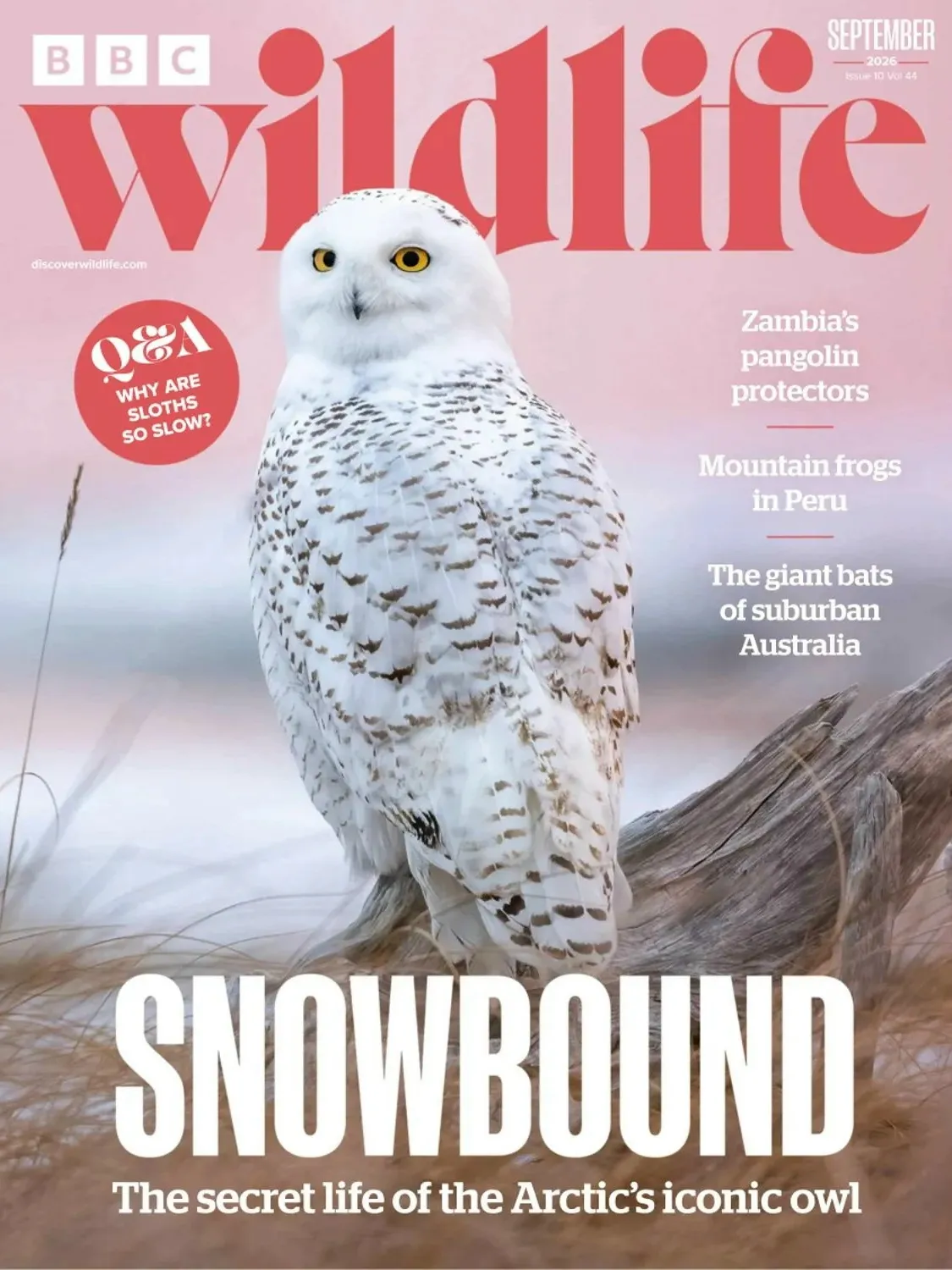
BBC Wildlife September 2026 (Issue 10, Vol 44) goes Snowbound with Pierre Borczuk's snowy owl on the cover, photographed on winter mornings on the beach dunes of New Hampshire and Massachusetts. Stephen Moss pays tribute to Bill Oddie, who has died aged 85.
Oddie's Britain Goes Wild became Springwatch, drawing millions and still running more than 20 years later, and Chris Packham said: "We've not only lost a Goodie, we've lost one of the besties." From November to February the snowy owls move south to those dunes, with the sun rising behind the camera in pastel skies.
Wild Times carries the year's most surprising science: dipterocarps in Malaysia Borneo, the world's tallest flowering trees reaching 100m, do not struggle to move water to their leaves as theory predicted, in work published in Science by University of Exeter researchers. Amy-Jane Beer talks to Lucy Lapwing at p60, Zambia's pangolin protectors run at p64, and Peru's frogs climb as glaciers retreat at p72.
—————
Content Guide
▸ Cover Story
p.52 · Snow patrol
Snowy owls move south from November to February, staying on beach dunes in New Hampshire and Massachusetts, where Pierre Borczuk photographed them on winter mornings with the sun rising behind him into pastel skies. Owls on coastal dunes in winter are easier to see than on the tundra. Give any wintering owl a wide berth and watch from the dune path.
▸ Tribute
p.16 · Bill Oddie tribute
Stephen Moss pays tribute to Bill Oddie, who has died aged 85. Oddie starred in the 1970s television comedy The Goodies, and his Britain Goes Wild series became Springwatch, drawing millions of viewers and still running more than 20 years on. Chris Packham said: "We've not only lost a Goodie, we've lost one of the besties." Watch one early Britain Goes Wild clip and see what became Springwatch.
▸ Wild Times
p.08 · Wild Times — dipterocarps in Malaysia Borneo
Dipterocarps in the rainforests of Malaysia Borneo are the world's tallest flowering trees, reaching 100m. Hornbills, proboscis monkeys and the Rajah birdwing butterfly depend on them. Researchers from the University of Exeter, publishing in Science, found that unlike the usual rule that taller trees struggle to move water from roots to leaves, dipterocarps do not. Read the Science paper before repeating any rule about tree height.
Mangrove Photographer award
Evan Cooper won this year's Mangrove Photographer award in the Other Species category for a juvenile green nurse shark in Bahamian mangroves at sunset, where the roots shelter crustaceans, fish and turtles and young sharks hide from predators such as tiger sharks. Mangrove roots are nurseries, not just scenery. Support one mangrove protection project before booking a coastal trip.
▸ Features
p.42 · Meet the megabats — Australia's incredible flying foxes
Australia's flying foxes get a feature, the megabats of the title. Flying foxes pollinate and seed more forest than most birds. Check local roost protection rules before you visit one.
p.60 · "One of my favourite species is the human"
Amy-Jane Beer talks to Lucy Lapwing in this interview, the issue's most unusual conversation piece. A human-focused nature interview changes the usual frame. Ask yourself the same question before reading the answer.
p.64 · The protectors — Zambia's pangolin rescue
Zambia's pangolin rescue centre is reported here. Pangolins are the most trafficked mammal and the least photographed. Check what a rescue does with confiscated animals before you donate.
p.72 · Top of the hops — Peru's frogs and retreating glaciers
Peru's frogs are moving upslope as glaciers retreat. Altitude shifts are the clearest climate signal in the tropics. Follow one species' range map and watch it climb.
▸ Columns and Regulars
p.32 · Mike Dilger's wildlife spectacles — waders
Mike Dilger covers the aerial displays of waders. Wader flocks are the easiest spectacle to see on a British estuary. Visit one estuary at high tide this month and watch the flock lift.
p.36 · Nick Baker's hidden world — fire ants and parasitic flies
Nick Baker looks at the life cycle of parasitic flies attacking fire ants. Parasites shape more behaviour than predators do. Watch one ant trail for five minutes and count what follows it.
p.81 · Q&A
The Q&A asks why sloths are so slow and what a forked tongue is for. Questions like these are what readers actually argue about. Answer both before you read the page.
p.88 · Species guide — jaguarundi
The species guide covers the jaguarundi. Small cats get less attention than the big five. Learn the jaguarundi's range before you see one in a photograph.
—————
Editor's Take
Stephen Moss's Bill Oddie tribute is the strongest page in BBC Wildlife September 2026, because 85 years, The Goodies, the Britain Goes Wild to Springwatch line and Packham's "lost one of the besties" give a life its shape. Pierre Borczuk's snowy owls on New Hampshire and Massachusetts dunes from November to February make the cover specific, and the Borneo dipterocarp finding — 100m trees that break the water-transport rule, published in Science — is the best science item. Weakest is the middle of the magazine, where the megabats, pangolin and Peru frog features are announced with little detail, and the Amazon boat advertising runs long. Buy this for the Oddie tribute and the dipterocarp science.
Strengths
• Oddie tribute gives 85 years and a Packham quote
• Snowy owl cover names two states and months
• Dipterocarps reach 100m and break a textbook rule
• Evan Cooper's mangrove shark image is credited
Weaknesses
• Megabat, pangolin and frog features lack detail
• Amazon boat advertising runs long
Verdict: Recommended — the tribute and the tree science earn the issue.
