
Watercolor Artist – Fall 2026
Summary
Laurin McCracken took his first watercolor lesson at 60 and began painting in 2001, and Watercolor Artist Fall 2026 opens by handing him the Watercolor USA Honor Society 2026 Lifetime Achievement Award, presented on May 29 at the Spiva Center for the Arts in Joplin, Missouri.
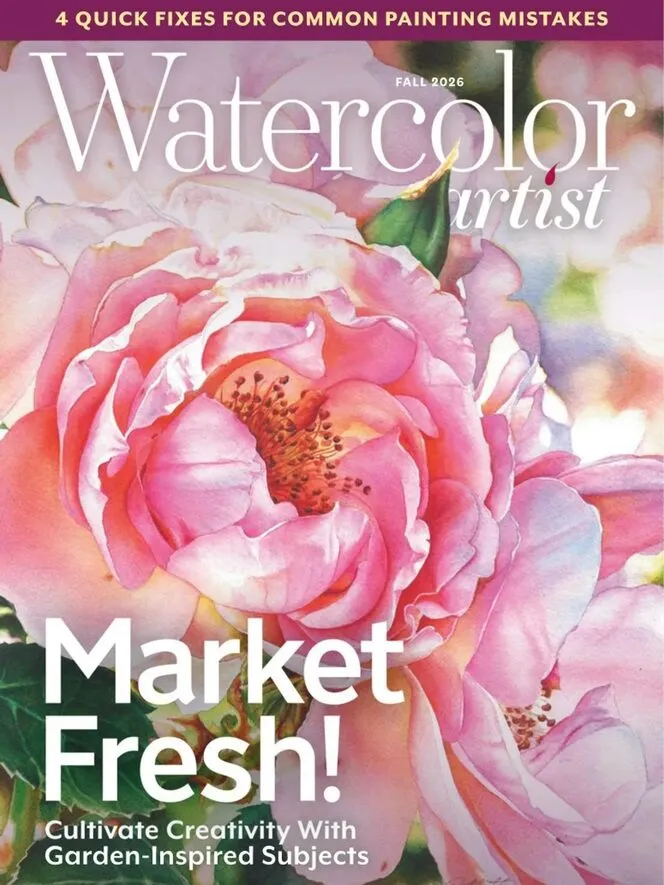
The issue builds around garden and market subjects. Ruth Rodgers reports on Debbie Friis-Pettitt's limited palette and the unconventional aid behind her detailed work, including cover painting A Rose in Winter No. 2, watercolor on paper, 18×24. McKenzie Graham covers Ann Smiga Greene's negative-painting approach to natural geometry, Ani Kodjabasheva follows Paula Fiebich's process for large-scale florals, and Michael Chesley Johnson visits John Warren Oakes's daily woodland practice.
Columns carry the teaching load. Anne Hevener's Burning Question at page 76 supplies the cover promise of four fixes for common painting mistakes, Lois and Morgaine Davidson demonstrate anemones step by step, and Thomas W Schaller, Missy Dunaway and Jerry N Weiss write on curiosity, numbers-based projects and the value of the preparatory study. Splash Into Fall gathers autumn work from finalists in this year's The Best of Watercolor.
—————
Content Guide
▸ Cover Story
p.20 · A COLORFUL JOURNEY
Ruth Rodgers reports on how Debbie Friis-Pettitt builds her highly detailed paintings from a limited palette plus one unconventional aid, the practice behind cover work A Rose in Winter No. 2, watercolor on paper at 18×24. Friis-Pettitt's own line, quoted in the issue, is that artists have always used whatever works. The piece is about method rather than mystique. Anyone hesitating over tools they think are unorthodox can settle the question here.
p.76 · BURNING QUESTION
Anne Hevener collects expert fixes for the trouble spots that wreck a watercolor mid-painting, the four quick fixes advertised on the cover. Each problem is matched to a remedy rather than a warning. It is the most directly useful page in the issue for anyone with a stalled painting on the board. Try one fix on a study before touching the piece you care about.
▸ Artist Features
p.28 · CULTIVATING THE FERTILE MIND
McKenzie Graham examines how Ann Smiga Greene treats the geometry found in nature as the structural base of her organic paintings. Greene favours negative painting and a process that builds toward an outcome she has not predetermined, with shape and colour doing most of the work in her more abstracted pieces. The article is useful on letting a painting resolve late. Set up one study with no planned ending and work Greene's way.
p.36 · SCALING UP THE SUBTLE
Ani Kodjabasheva follows Paula Fiebich's multipronged process for large-scale florals and still lifes, where planning and preparation sit alongside improvisation and a willingness to try something untested. The reporting explains how she keeps subtle passages alive at a size that usually flattens them. Scale, not subject, is the real topic. Painters moving up a sheet size will find her sequencing worth copying.
p.44 area · SPLASH INTO FALL
See page 52 entry below; the autumn showcase begins immediately after the flower and vegetable features and shares their market-garden framing.
p.52 · SPLASH INTO FALL
Christina Richards compiles a handpicked harvest of autumnal work from finalists in this year's The Best of Watercolor competition. It functions as a survey of what currently wins in watermedia competitions rather than a technique piece. Reading it alongside the Happenings competition listings makes it more useful. Note which approaches recur across the finalists before you choose an entry for your own submission.
p.62 · DEDICATED TO THE NATURAL WORLD
Michael Chesley Johnson profiles John Warren Oakes, who explores woodland subjects through a daily painting practice. The emphasis falls on frequency: what a painter learns by returning to the same terrain repeatedly. It makes a practical argument for volume over the occasional ambitious sheet. Commit to a small daily sheet of one nearby subject and Oakes's logic starts working.
▸ Techniques And Columns
p.70 · WATERCOLOR ESSENTIALS
Lois and Morgaine Davidson bring anemones to life in a full step-by-step demonstration. The sequence is built to be followed at the desk, stage by stage, rather than admired. Flowers are the vehicle for handling soft edges and layered colour. Set up anemones, or any similar bloom, and paint along with the stages as printed.
p.8 · ANATOMY OF A PAINTING
Jerry N Weiss argues that the study made for a finished work has merit of its own. He treats preparatory sheets as complete statements rather than rehearsals, which reframes what most painters throw away. It is a short column with a long implication for how you store your work. Pull one old study out of the drawer and judge it as a finished piece.
p.10 · BRIGHT IDEAS
Missy Dunaway shows how numbers-based projects add up to success, using counted, structured assignments to keep output consistent. The column is about designing your own constraints rather than waiting for inspiration. It suits anyone whose practice collapses without a deadline. Pick a number, define the series, and start the count this week.
p.14 · CREATIVITY WORKSHOP
Thomas W Schaller makes the case for leaning into curiosity as the engine of artistic growth. He writes as a painter about the questions that keep a studio practice moving rather than about technique. The column pairs neatly with Greene's undetermined-outcome method at page 28. Write down the one question your current work refuses to answer and paint toward it.
p.80 · PAINTING SPOT
Carolyn Lord finds her subject in a California garden, closing the issue with a location piece that matches its market-fresh theme. She describes the delight of a specific place rather than a generic garden. It is a quiet argument for painting what is ten minutes from your door. Choose a nearby garden and go back to it until it yields something.
▸ News And Regulars
p.3 · EDITOR'S NOTE
Anne Hevener frames the issue around subjects that grow, noting more than 400,000 flower species worldwide and quoting Manet's remark that a painter can say all he wants with fruit or flowers. She then routes readers to Fiebich at 36, Greene at 28, Romani at 44 and Friis-Pettitt at 20. It works as a map of the issue. Read it first and you will know which feature to start with.
p.4 · HAPPENINGS
Christina Richards leads with Laurin McCracken receiving the Watercolor USA Honor Society 2026 Lifetime Achievement Award at the Watercolor USA 2026 opening reception on May 29 at the Spiva Center for the Arts in Joplin, Missouri. The Fort Worth painter studied at Auburn, took degrees at Rice and Princeton, holds signature membership in more than a dozen societies, and led the Honor Society from 2016 through 2020. He took his first watercolor lesson at 60. Anyone who thinks they started late should read his dates.
—————
Editor's Take
The four artist features are the reason to buy this issue: Rodgers on Friis-Pettitt's limited palette, Graham on Greene's negative painting, Kodjabasheva on Fiebich's large-scale sequencing and Dvorak on Romani's use of contrast and value all report process rather than biography, and Hevener's Burning Question delivers the cover promise without padding. The weakness is range. Every feature in the issue points at flowers, fruit or vegetables, so figure, urban and marine painters get almost nothing, and Splash Into Fall is a competition gallery filling twelve pages where instruction would serve better. Golden Peak's Artists Network membership pitch, with its 850-plus videos and digital archive, recurs through the front section. Best suited to botanical and still-life painters wanting studio-ready method.
Strengths
• Four process-led features naming palette, technique and scale decisions
• Davidson anemones demonstration and Burning Question fixes are immediately usable
• McCracken's Honor Society award profile documents a late start with dates and institutions
Weaknesses
• Every feature circles flowers, fruit and vegetables; no figure or landscape counterweight
• Repeated Artists Network membership promotion crowds the front columns
Verdict: Recommended — strong process reporting on four painters, provided garden and still-life subjects suit your current work.
