
Vintage Guitar – August 2026
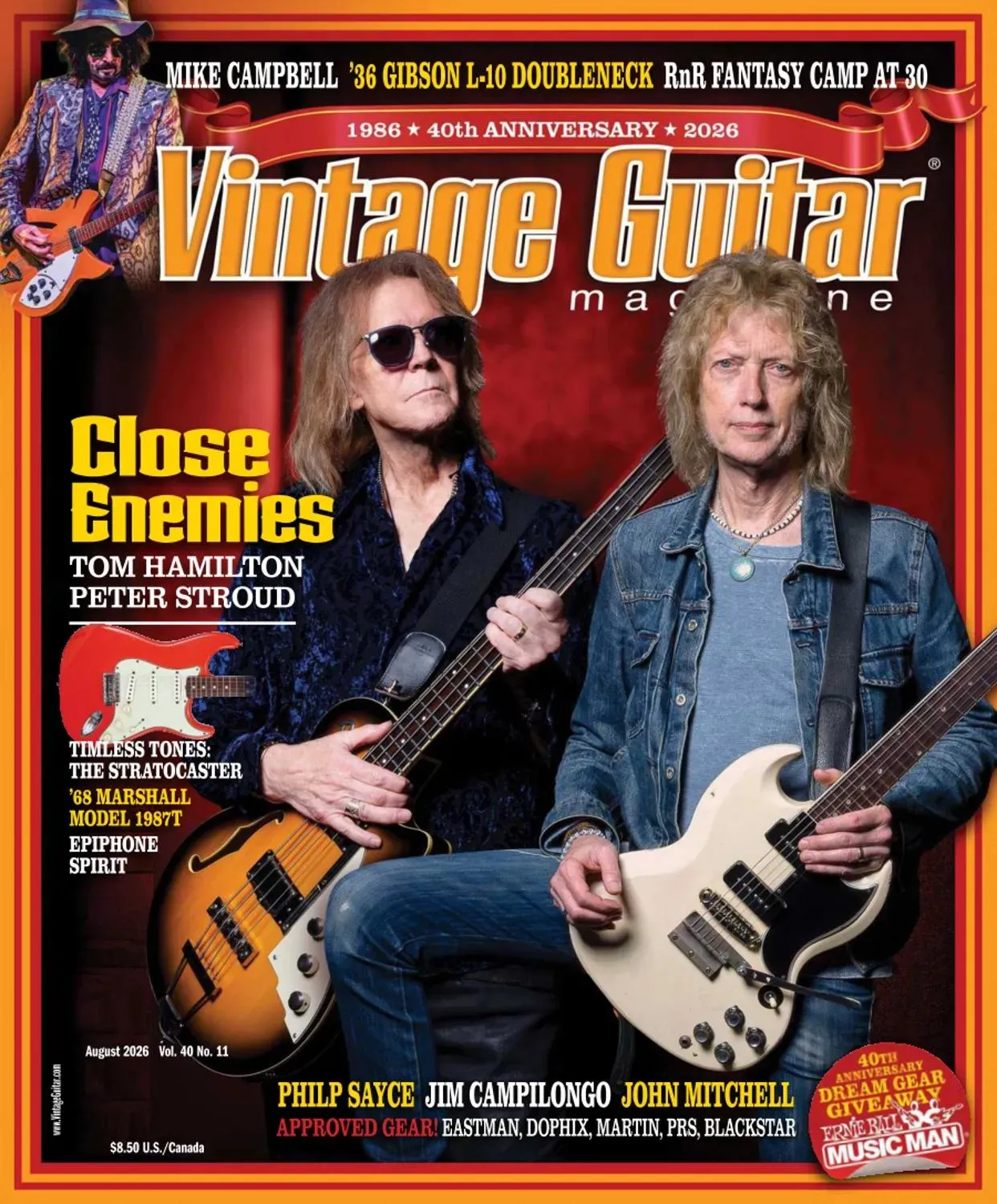
Summary
A 1936 Gibson L-10 doubleneck built for teacher and music-shop owner Art Pruneau fronts Vintage Guitar August 2026, Vol. 40 No. 11, the magazine's 40th-anniversary year, alongside Mike Campbell and the Close Enemies partnership of bassist Tom Hamilton and guitarist Peter Stroud.
Mike Meiers opens the features with part three of Timeless Tones, arguing for the Stratocaster as the most adaptable instrument Leo Fender built. Dave Hunter takes apart the Marshall Model 1987T Tremolo 50 and the revered plexi run of 1966 to 1969, Michael Wright explains where the Epiphone Spirit sat once the Gibson rivalry was settled in the early eighties, Ward Meeker documents the Pruneau L-10 doubleneck, and Bret Adams reports on Close Enemies at page 52.
First Fret and the departments handle the trade. News and Notes covers the MIM's Hedges exhibit and the renaming of a New York street as Jimi Hendrix Way, David Fishof discusses three decades of Rock 'n' Roll Fantasy Camp, Dan Erlewine continues his '59 P-Bass rescue, and the Price Guide, Showcase, Readers Gallery and a 40th-anniversary giveaway close the issue.
—————
Content Guide
▸ Cover Story
p.34 · CLASSICS
Ward Meeker documents a 1936 Gibson L-10 doubleneck built for teacher and music-shop owner Art Pruneau, calling it another enigmatic example of the form. The reporting works from the instrument outward: who ordered it, who played it, and why so little written record survives. It is the strongest archival piece in the issue. Check the provenance questions Meeker asks before you believe any doubleneck's backstory at a show.
p.52 · MUSICAL EXPLORATION
Bret Adams covers Close Enemies, the all-star group led by bassist Tom Hamilton and guitarist Peter Stroud, with Ross Halfin's cover session behind it. Hamilton and Stroud talk about the rig and repertoire decisions a project band has to make quickly. It is a gear-literate interview rather than a promotional puff. Note Stroud's amplifier thinking if you play with a second guitarist.
▸ Instruments And Amps
p.24 · TIMELESS TONES, PART III
Mike Meiers continues the series with the Stratocaster, following Leo Fender's double-cutaway design from funk through pop-punk into modern pop. The argument is that the instrument adapts to genres it was never designed for, and Meiers names the records that prove it. Part two covered the Telecaster, so the pairing is deliberate. Take one Strat and one style you never play, and test the claim in an afternoon.
p.28 · CREAM MACHINE
Dave Hunter examines the Marshall Model 1987T Tremolo 50 and explains why the plexi models of 1966 to 1969 sit above every other Marshall in collector regard. He separates the tremolo circuit's real behaviour from the mythology attached to the era. The writing is technical but readable for anyone who owns a valve amp. Compare the tremolo settings he describes against whatever pedal you currently use for the same job.
p.32 · THE EPIPHONE SPIRIT
Michael Wright picks up the story in the early eighties, once the long duel between Gibson and Epiphone had been settled, and asks what the Spirit was actually for. He treats an overlooked model as a business decision as much as an instrument. The piece is useful pricing context for a guitar still trading cheaply. Read it before dismissing an eighties Epiphone on a used wall.
p.38 · VINTAGE GUITAR PRICE GUIDE
The Price Guide department remains the reason many readers subscribe, tracking values across the instruments covered elsewhere in the issue. It is reference material rather than reading, and it sets the baseline for every dealer conversation. Used alongside this issue's auction results, it sharpens what you should offer. Look up any model you are considering before you walk into a shop.
▸ Players And Interviews
p.14 · MIKE CAMPBELL
The First Fret interview, headlined Mission Statement and shot by Corey Kelly, covers Campbell's current work with The Dirty Knobs, whose new record also appears in the VG Hit List at page 62. Campbell talks about writing and instrument choices rather than Heartbreakers nostalgia. It is short but specific. Read it with the Hit List review for the fuller picture of the album.
p.18 · PHILIP SAYCE
Titled Alive and Unfettered, this First Fret piece catches Sayce on the back of a release also covered in the issue's review pages. He discusses tone and attack as a touring blues-rock player. The overlap between interview and review is handled without repetition. Line up both pages before you buy the record.
p.20 · LUCA BENEDETTI
New York Groove introduces Benedetti as a session and sideman guitarist working the city's scene. The piece concentrates on how a working player builds a reliable sound across other people's records. It is the kind of profile that rewards readers who are not chasing famous names. Note his approach to playing supportively rather than loudly.
p.21 · JOHN MITCHELL
Asia Adventure covers Mitchell's work with Asia, a band whose latest release also lands in the VG Hit List at page 62. The interview treats joining a legacy act as a technical problem: honouring recorded parts while sounding like yourself. Anyone hired into an established band will recognise the tension. Read it before your next covers gig.
p.22 · DAVID FISHOF
Rockin' Camp Counselor has Fishof marking 30 years of Rock 'n' Roll Fantasy Camp, a milestone the cover also flags. Fishof explains the machinery behind putting amateurs on stage with professionals. It is more candid about the business than most anniversary interviews. Check the camp dates if the idea has ever tempted you.
▸ Workshop And Reviews
p.46 · DAN'S GUITAR RX
Dan Erlewine continues The Ugly, The Bad, and The Good with part two of a '59 P-Bass disaster, working through repairs on a bass someone had already ruined. His photographs and sequence make the damage legible to non-luthiers. The column doubles as a warning about cheap refinishing. Apply his inspection order the next time you assess a modified instrument.
p.66 · VG APPROVED GEAR
The review panel takes on the Eastman Fullertone Offset '62, Dophix Magnifico, Martin DE Retro Plus Granadillo, PRS S2 Vela HHT and Blackstar Beam Mini. Coverage spans guitars, a pedal and an amp, so the page serves players rather than collectors only. Verdicts are stated plainly. Shortlist from this page rather than from manufacturer copy.
p.63 · CHECK THIS ACTION
Dan Forte's Regal Indeed reflects again on B.B. King, using his own long acquaintance with the material. Forte writes as a critic who has heard the catalogue develop rather than as an archivist. The column supplies listening direction, not just tribute. Pick the records he names and hear the phrasing he describes.
—————
Editor's Take
Ward Meeker's Pruneau L-10 doubleneck and Dave Hunter's dissection of the Marshall 1987T are the issue's high points, both built on documented objects rather than nostalgia, and Michael Wright's Epiphone Spirit history does real service to a model most dealers ignore. The First Fret run is efficient, with Mike Campbell, Philip Sayce and John Mitchell all cross-referenced to reviews later in the issue. The weakness is commercial density: Heritage Auctions, Well Strung Guitars and Dave's Guitar Shop take repeated display pages, and the Showcase and Gearin' Up! pages read as trade listings. Timeless Tones part three, at a third instalment on Fender's core catalogue, is starting to repeat familiar ground. Best for collectors and gear buyers who use the Price Guide monthly.
Strengths
• Art Pruneau's 1936 L-10 doubleneck documented as an object, with provenance questions intact
• Dave Hunter separates 1966-69 plexi mythology from the 1987T's actual circuit behaviour
• Interviews at pages 14, 18 and 21 cross-reference directly to the VG Hit List reviews
Weaknesses
• Heritage Auctions, Well Strung Guitars and Dave's Guitar Shop dominate repeated display pages
• Timeless Tones part three retreads Fender ground covered by the previous instalment
Verdict: Recommended — the L-10 and Marshall features plus the Price Guide outweigh a heavy load of dealer advertising.
