
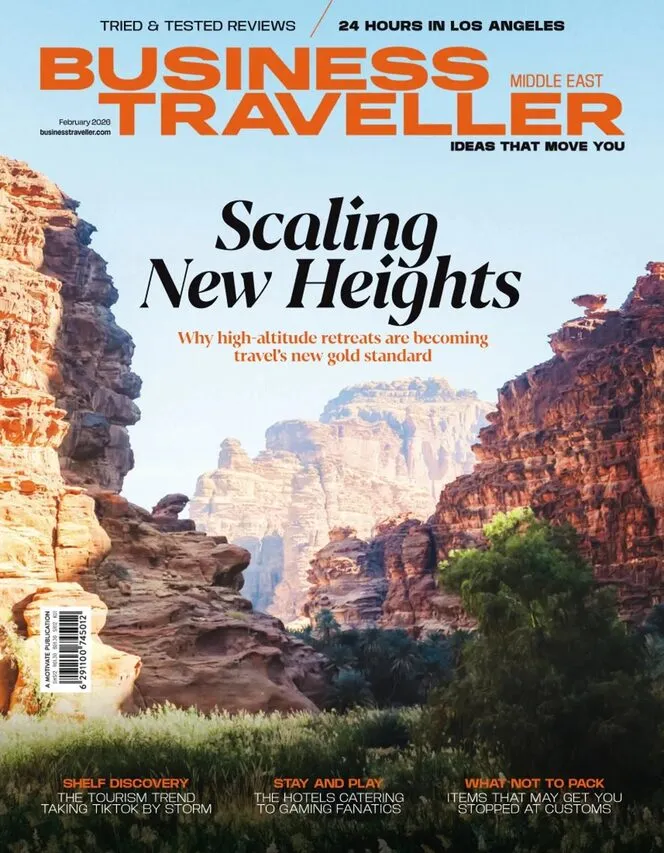
Business Traveller Middle East – February 2026
Summary
High-altitude retreats are travel's new gold standard, and the February 2026 Business Traveller Middle East sends readers to mountain escapes in Kyrgyzstan, Bhutan, and Switzerland in a cover story that redefines corporate wellness travel.
The cover story (p.34) argues that altitude — above 2,500 metres — changes how executives think and recover, citing a study from the University of Geneva that cognitive function improves measurably after 72 hours above 2,000 metres. Grocery-store tourism has taken over social media (p.40), and next-gen airport technologies (p.42) track biometric boarding and RFID baggage. The first 3D-printed hotel is taking shape, and the feature on p.44 examines what 3D printing could mean for hospitality construction costs. The origins of Bluetooth are traced to a Viking town in Denmark (p.48), and three Australian cities are compared for business travel (p.54).
Business Traveller Middle East Awards return is the hot ticket in Dispatch. Los Angeles gets 24 hours treatment, and the Explore section helps readers avoid packing unlikely contraband at airport security. IndiGo Stretch+ business class, Hyde Johannesburg, and SANA Dubai are reviewed.
—————
Content Guide
▸ Cover Story / Features
p.34 · A New Perspective
High-altitude retreats as the new gold standard for corporate reset. The piece identifies 12 retreats above 2,000 metres, with pricing and accessibility from Dubai flight connections. Takeaway: the Kyrgyzstan retreat at Jyrgalan Valley costs $800 per week including accommodation, meals, and guided hikes — the cheapest altitude retreat in the list and visa-free for UAE passport holders.
p.40 · Shelf Discovery
Grocery-store tourism is booming on social media. Supermarkets in Japan, Italy, and Thailand have become tourist attractions in their own right. The article profiles Eataly's Dubai expansion and the new Dean & Deluca in Riyadh. Takeaway: the "Supermarket Safari" tour in Bangkok costs $45 and includes tastings at five markets plus a cooking demo — a unique client entertainment option.
p.42 · Airports Upgraded
Next-gen technologies reshaping air travel from curb to gate: biometric boarding, RFID bag tags, and autonomous security screening lanes. Specific airports with live deployments are named. Takeaway: Dubai International's Biometric Tunnel processes passengers in 15 seconds flat — register at one of 20 enrolment kiosks in Terminal 3 before your next trip.
p.48 · Searching for Bluetooth
The technology's origins trace back to Harald Bluetooth, a 10th-century Viking king who united Danish tribes. The article follows the connection from Jelling, Denmark, to modern wireless protocols. Takeaway: the Bluetooth museum in Jelling is free and includes a working exhibit of the first-ever Bluetooth device, housed in the same building as a co-working space.
p.54 · Trio Down Under
Sydney, Melbourne, and Brisbane compared for business travel across 12 metrics including flight time from Dubai, hotel costs per night, and co-working availability. Melbourne wins on overall value. Takeaway: Melbourne's "Business Ready" programme reimburses up to $500 per visitor for co-working costs — register online before departure.
▸ Insight
p.15 · Gilda Perez-Alvarado, Orient Express CEO
The CEO discusses the transformation of Orient Express into a luxury hotel brand. Properties in Venice, Rome, and Riyadh are on the books. Takeaway: Orient Express's loyalty programme will launch in early 2027 — early registrants on the website get double points for the first six months.
p.22 · Diana Rysbaeva, Founder of SHI Hospitality
The frequent flyer, who divides her time between London, Dubai, and Bishkek, shares her packing strategy for extreme climate changes. Takeaway: Rysbaeva uses a down jacket that compresses to the size of a water bottle — the same jacket works for Kyrgyzstan's -20C and airport air conditioning.
▸ Reviews
p.61 · IndiGo Stretch+ Business Class
The review of IndiGo's premium product on the Delhi-Dubai route. Seat pitch, meal service, and entertainment options are rated. Takeaway: IndiGo Stretch+ rows 1 and 2 exit first — book these for quick connections at Delhi's congested T3.
p.63 · Hyde Johannesburg Rosebank
A review of this Johannesburg property in the Rosebank business district. The rooftop bar and meeting facilities are evaluated. Takeaway: Hyde's "Work & Stay" package at $150 per night includes 100MBps wifi and a $20 daily credit for the on-site restaurant.
▸ Regulars
p.07 · Hot Ticket: Business Traveller Middle East Awards
The 2026 awards programme is now open for entries. Categories include Best Airline, Best Hotel, and Best Lounge. Takeaway: entries close on June 30, 2026 — submit via the Business Traveller website for free registration to the winners' ceremony in October.
p.23 · 24 Hours in Los Angeles
A curated guide covering the Arts District's gallery openings, the new SoFi Stadium touring experience, and the Santa Monica co-working beach clubs. Takeaway: the LA Metro's new K Line connects LAX to Crenshaw in 25 minutes at $1.75 — avoid the 405 freeway entirely.
—————
Editor's Take
The February issue has the most interesting cover story concept of any Business Traveller Middle East edition this year — altitude as a cognitive-performance tool for executives. The science citation gives it credibility, and the retreat recommendations are specific and priced. The Bluetooth-origins feature is a delightful oddity that makes for a memorable read. Weaknesses: the grocery-store tourism feature is light and feels like social-media content stretched to four pages. The "Airports Upgraded" piece covers technology that is already two years old in some markets (biometric boarding launched at Dubai in 2024). The 24 Hours in LA guide is aimed at Middle Eastern travellers who rarely go to Los Angeles for business — a niche readership. Best suited for executives who plan corporate retreats and travellers curious about aviation and technology history.
Strengths
• Altitude-retreat concept backed by University of Geneva study
• Bluetooth-origins feature is genuinely original journalism
• Three Australian cities comparison with 12-metric data
Weaknesses
• Grocery-store tourism feature lacks analytical depth
• Airport technology coverage is behind the current deployment curve
Verdict: Recommended — The altitude-retreat cover story is genuinely new thinking; buy it for that feature.
