
Magnetics Business Technology – May-June 2026
Summary
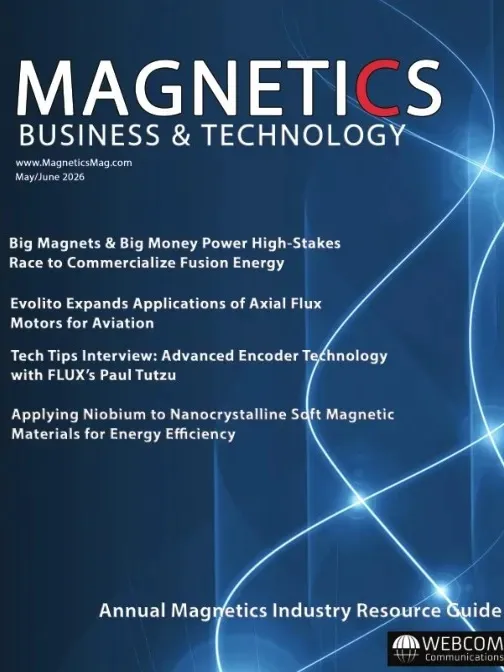
$60 billion. That is the capital needed to bring General Fusion's LM26 to commercial reality, as David Webster reports in the May/June 2026 Magnetics Business & Technology. This issue tracks the high-stakes race to commercialize fusion energy—where big magnets meet even bigger money. Cover story "Big Magnets & Big Money Power High-Stakes Race to Commercialize Fusion Energy" leads a lineup focused entirely on how electromagnetic technology is reshaping energy, aviation, and materials science.
Evolito expands axial flux motor applications for aviation on page 10, pushing electric flight closer to viability. Paul Tutzu of FLUX walks through advanced encoder technology in the Tech Tips Interview on page 20, offering hands-on guidance for precision measurement. The 2026-2027 Magnetics Industry Resource Guide starts on page 34—a 16-page directory of suppliers, laboratories and consulting services. Dr. Stan Trout contributes a piece on applying niobium to nanocrystalline soft magnetic materials for energy efficiency on page 50, bridging materials science and real-world power savings.
Three regular departments frame the issue: Editor's Choice, spotlighting Leonardo DRS's new naval propulsion facility in Charleston, South Carolina; DEPARTMENTS, covering product releases and industry briefs; and the annual Resource Guide, which alone makes this issue worth keeping on the shelf for procurement and R&D professionals. The magazine closes with product spotlights on fluxgate magnetometers, magnetic field cameras and precision teslameters from Bartington, SENIS and METROLAB.
—————
Content Guide
▸ Cover Story / Energy
p.– · Big Magnets & Big Money Power High-Stakes Race to Commercialize Fusion Energy
David Webster contrasts General Fusion's LM26 demonstrator with Helion's non-superconducting electromagnetic approach. General Fusion targets scientific breakeven by late 2027; Helion claims it can deliver net electricity to the grid by 2029. Both depend on magnets that operate at extreme scale and field strength. A chart compares capital outlay, timeline and technology readiness across seven fusion ventures. Use the comparison to evaluate which technology pathway best aligns with your company's R&D investment horizon.
▸ Aviation / Components
p.10 · Evolito Expands Applications of Axial Flux Motors for Aviation
Evolito's axial flux motors now target eVTOL, regional commuter aircraft and drone platforms. The article explains how axial flux geometry delivers higher torque density than radial flux equivalents, cutting motor weight by 30%. A case study shows integration into a 19-passenger hybrid-electric prototype. Check whether axial flux can reduce weight in your own electric propulsion projects.
▸ Sensors / Testing
p.20 · Tech Tips Interview: Advanced Encoder Technology with FLUX's Paul Tutzu
Paul Tutzu explains how modern encoders improve position feedback in servo motors used for magnetic measurement systems. He covers resolution trade-offs, environmental sealing and signal integrity at high RPM. The interview includes a decision matrix linking encoder type (optical, magnetic, capacitive) to application speed and accuracy requirements. Match your encoder spec to your actual thermal and vibration conditions before signing off on a sensor vendor.
▸ Reference / Directory
p.34 · 2026-2027 Magnetics Industry Resource Guide
Sixteen pages listing suppliers of magnetic materials, test equipment, custom coil winding, shielding and consulting. Each entry includes contact information and specialty focus areas. Flag the "Custom Sensor Design Service" entry from Bartington Instruments if you need a non-standard fluxgate configuration.
▸ Materials / Efficiency
p.50 · Applying Niobium to Nanocrystalline Soft Magnetic Materials for Energy Efficiency
Adding niobium refines grain structure in nanocrystalline alloys, reducing core loss by up to 40% in high-frequency transformers. The article presents experimental data showing permeability stability up to 200 kHz. A side-by-side comparison with conventional ferrite cores quantifies efficiency gains in kW-scale power supplies. Test a niobium-doped nanocrystalline core in your next 100+ kHz converter design.
—————
Editor's Take
This is a narrow-audience trade playbook, and it knows exactly who it serves. The fusion cover story is the strongest piece—well-reported, with concrete timetables and real dollar figures. The Evolito and Tutzu interviews deliver usable engineering data. Weakest area: the front section is cluttered with repeated product promotional spreads that add no editorial value. The Resource Guide makes the issue indispensable for anyone who sources magnetic components, but casual readers will find little beyond page 50. If you design, buy or specify magnetic materials or test equipment, buy this issue. If not, skip it.
Strengths
• Fusion story names real companies, timelines and capital figures
• Paul Tutzu interview gives practical encoder selection criteria
• Annual Resource Guide is a standalone reference value
Weaknesses
• Repeated product promotion spreads dilute editorial density
• No coverage of automation, software or simulation trends
Verdict: Selective read — Indispensable for magnetics specialists; too niche for a general engineering audience.
