
Business Today – 29 March 2026
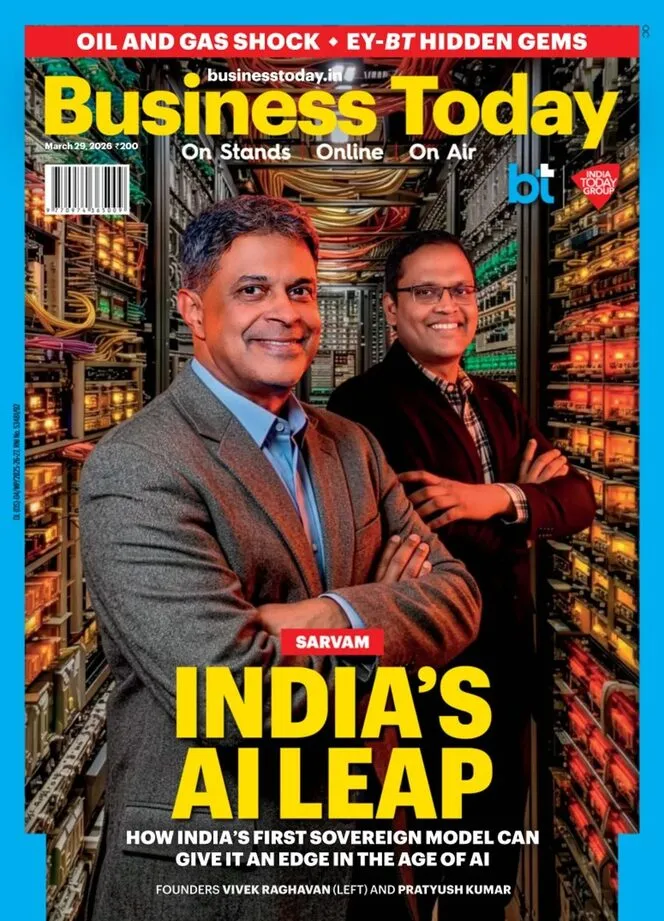
Summary
Sarvam AI founders Vivek Raghavan and Pratyush Kumar built India's first sovereign large language model with 5 million dollars — less than one percent of what OpenAI spends per training run. Business Today's March 29, 2026 issue (Vol 35 No 7) places "India's AI Leap" at the centre of a national technology strategy debate. Joseph Anantharaju, Co-Chairman of Happiest Minds, argues IT stocks have been oversold on AI fears. The issue also tracks the West Asia conflict's economic fallout and India's data centre boom in Tier II towns.
The cover story walks through how Sarvam's model was trained on 14 Indian languages and runs on locally assembled GPU clusters, reducing dependence on foreign cloud infrastructure. A semiconductor feature reports that Indian companies are shifting their chip playbook from design-only to fabrication partnerships. The Geopolitics section maps what a prolonged Hormuz closure would cost India's trade.
Regular columns The Point and BT Interview anchor the front half. The Tech section profiles the shift of hyperscale data centres from Mumbai and Chennai to cities like Nagpur and Indore.
—————
Content Guide
▸ Cover Story / Technology & AI
p.24 · India's AI Leap
Sarvam AI's founders reveal that their model was trained for 42 days on 1,024 locally assembled GPUs, costing 5 million dollars — a fraction of Meta's Llama 3 budget. The model handles 14 Indian languages and is already deployed by two public-sector banks for local-language customer service. CTOs evaluating sovereign AI options should study Sarvam's cost-per-token benchmark compared to GPT-4o.
▸ Interviews / IT
p.20 · IT Stocks Hit More Than They Deserve
Happiest Minds Co-Chairman Joseph Anantharaju says the market is mispricing Indian IT's ability to adapt. His firm's automation tools have reduced manual testing hours by 35 percent for a top US bank client, proving that AI threat can be turned into a product opportunity. IT services buyers can use his margin-protection argument in vendor negotiations.
▸ Geopolitics / Energy
p.10 · In Dire Straits
A prolonged West Asian conflict could shave 0.8 percentage points off India's GDP growth, according to the article's model. India sources 85 percent of its crude oil from the region, and the government's strategic petroleum reserve covers only 13 days of consumption. Supply chain planners should benchmark their own fuel-cost buffers against the 13-day national reserve figure.
▸ Technology / Infrastructure
p.38 · The Data Centre Evolution
AI workloads are pushing GPU density requirements beyond what Mumbai's power grid can reliably supply. Tier II cities — Nagpur, Indore, Jaipur — now account for 28 percent of new data centre capacity, up from 9 percent in 2024. The piece names the three largest operators expanding outside metros. Infrastructure investors can use this as a site-selection checklist.
▸ Industry / Semiconductors
p.0 · The Sovereign Circuit
Indian semiconductor companies are shifting from fabless design to joint fabrication ventures, with 3 assembly-and-test facilities announced in Gujarat and Assam. The article reports that government incentives cover 50 percent of capex for chip packaging units. Electronics manufacturers can map the incentive timeline against their own component sourcing plans.
▸ Markets / Economy
p.8 · India's GDP Revamp
MoSPI's decision to change the base year for GDP and CPI calculations from 2011-12 to 2022-23 could revise India's average growth rate by 40-60 basis points. The article explains how the new consumption basket will tilt toward digital services and away from traditional goods. Economists and analysts should prepare for the statistical revision's impact on historical comparables.
—————
Editor's Take
The Sarvam AI cover story is the standout — it answers a question every Indian tech executive is asking ("can we build our own model?") with hard cost and performance data instead of nationalist rhetoric. The Tier II data centre piece is a genuine scoop for infrastructure investors. The interview with Joseph Anantharaju is rare in that it challenges the consensus without sounding defensive. The weak link is the Semiconductor page, which is too brief to do justice to a sector undergoing its biggest policy shift in decades. The issue also lacks a personal investing column, which regular subscribers will notice.
Strengths
• Sarvam AI cost data gives readers a real benchmark
• Tier II data centre shift is a well-sourced infrastructure story
• Anantharaju interview provides a credible contrarian IT services view
Weaknesses
• Semiconductor feature too short for the subject's importance
• No personal finance or investing section this issue
Verdict: Essential — The Sarvam AI deep-dive alone justifies the cover price; the data centre evolution piece is a bonus for infrastructure followers.
