
British Vogue – March 2026
Summary
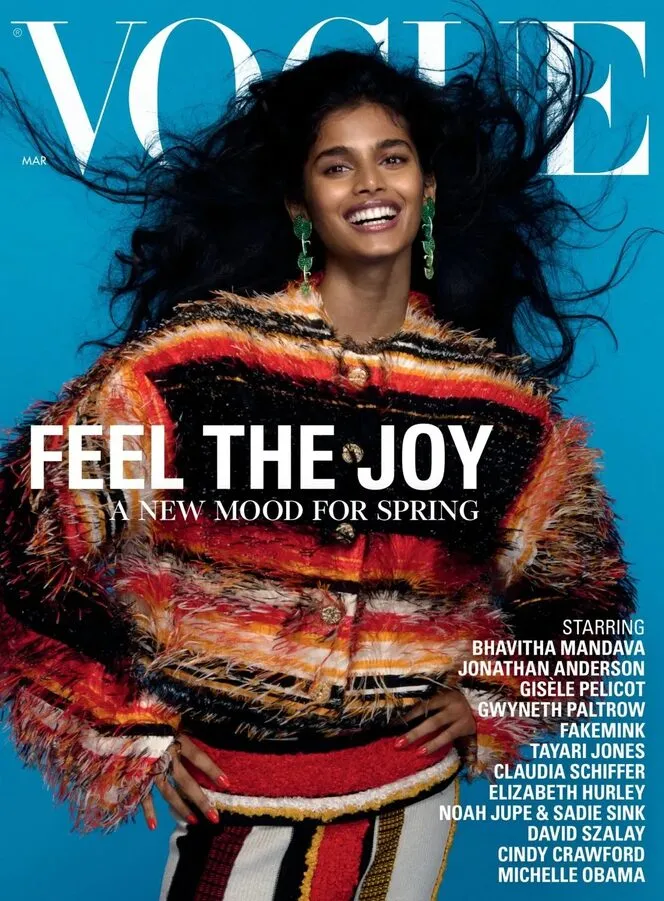
Bhavitha Mandava, discovered on a New York subway at 26, fronts British Vogue's March 2026 "Feel The Joy" issue in Chanel fringe and silk—the first Indian model to open a Chanel Metiers d'Art show. Inside, Jonathan Anderson shares his Dior vision, Gisele Pelicot speaks in Paris, Sadie Sink and Noah Jupe star in Robert Icke's Romeo and Juliet, and Michelle Obama answers Vogue Asks.
—————
Chioma Nnadi's March issue is built around spring optimism without ignoring the world's weight. Chioma Nnadi profiles Bhavitha Mandava, the Hyderabad-born NYU graduate who was scouted on the subway in 2024 and within weeks walked for Bottega Veneta. When Matthieu Blazy moved to Chanel, Mandava moved with him—and in December became the first Indian model to open Chanel's Metiers d'Art 2026 show in a converted Manhattan subway station. Nathan Heller interviews Jonathan Anderson, the first designer since Christian Dior himself to oversee all product lines at the house. Gaby Wood meets Gisele Pelicot in Paris for an essay on shame and resilience. Riann Phillip covers Sadie Sink and Noah Jupe in Robert Icke's Romeo and Juliet, opening next month in the West End. Beauty covers eyeliner's enduring power, foundation's changing face, the sea moss wellness boom, and a travel special. Michelle Obama closes the issue with a Vogue Asks Q&A.
—————
Regular columns include Editor's Eye by Chioma Nnadi, In Vogue (Iris Lasnet on fashion, family and farming; Bag Drop on everlasting allure; In The Loop with Hermes chain choker), Vogue Scene, Viewpoint (A Good Cry: how emotion reappeared on the runways; Retail Therapy: a fashion editor's cancer treatment wardrobe; Post Modern: the return of letter writing), Arts & Culture (Faux Real: Fakemink is Britain's next rap star), and a Tribute to Valentino Garavani. Beauty runs Draw The Line (eyeliner), Period Pieces (olfactive time travel), Director's Cut (foundation evolution), Moss Mode (sea moss), and the Travel Special. Fashion features a Seize The Day nine-to-five rethink and Change Of Pace shoe portfolio. Practical take: the cover look products are all named with prices—Chanel Sublimage L'Essence de Teint at £140 and Rouge Coco Flash at £42 are buyable entry points to the brand.
—————
Content Guide
▸ Cover Story / Fashion & Features
p.150 · The Future Is Bright
Chioma Nnadi profiles Bhavitha Mandava, the Hyderabad-born model discovered on a New York subway in 2024 at age 26. An NYU graduate, she walked for Bottega Veneta within weeks and, when Matthieu Blazy moved to Chanel, became the first Indian model to open a Chanel Metiers d'Art show—in a converted Manhattan subway station. Photographed by Oliver Hadlee Pearch and styled by Julia Sarr-Jamois. Cover look: Chanel fringe jacket and silk knit skirt, Chopard earrings. Use her story as proof that late entry into modelling (26 is considered late) can be an advantage: maturity reads as confidence on camera.
p.164 · A New Look
Nathan Heller interviews Jonathan Anderson, the first designer to oversee all Dior product lines since Christian Dior himself. Portrait by Annie Leibovitz, fashion photographs by Stef Mitchell, styling by Alex Harrington. The feature examines how Anderson approaches the house's heritage while bringing his own conceptual rigor. Strategic takeaway: Anderson's method of honouring brand codes while shifting silhouette proportion is a masterclass in creative direction.
p.192 · No Shame
Gaby Wood meets Gisele Pelicot in Paris. The feature covers her story of survival and resilience after a highly publicised trial. Photographed by Annemarieke van Drimmelen and styled by Kate Phelan. Emotional anchor: Pelicot's refusal to be defined by what was done to her reframes shame as a social construct she declines to carry.
p.206 · Crazy In Love
Riann Phillip profiles Sadie Sink and Noah Jupe as they star in Robert Icke's radical new Romeo and Juliet, opening next month in the West End. Jupe (The Night Manager, Hamnet) and Sink (Stranger Things) ask: what if everything had gone to plan? Photographed by Polly Brown. Theatre takeaway: Icke's premise—removing the miscommunication that kills the lovers—turns a tragedy into a thought experiment about fate.
▸ Beauty & Wellness
p.115 · Draw The Line
Sumayya Vally on eyeliner's enduring power, from ancient kohl to graphic cat-eye to 2026's blurred liner trend. The feature tracks the cosmetic's cultural and technical evolution. Practical tip: tightlining (applying liner to the upper waterline) creates the illusion of fuller lashes without a visible line.
p.117 · Director's Cut
Funmi Fetto on the changing face of foundation. The article covers formulation advances (skin-caring ingredients, flexible coverage), shade-range expansions, and the shift from full-coverage to skin-like finishes. Buying advice: choose foundation by finish (dewy, satin, matte) rather than coverage level—finish determines how it wears through the day.
p.120 · Moss Mode
Keshia Sakarah on why sea moss is more than a wellness fad. The feature examines the seaweed's nutrient profile (92 of 102 minerals humans need), its traditional use in Caribbean and Irish communities, and the commercialisation risk. Balanced take: sea moss is a useful mineral supplement but not a cure-all—check for heavy-metal testing in any brand you buy.
▸ Viewpoint
p.96 · A Good Cry
Maya Singer explores how emotion reappeared on the runways. After seasons of austere minimalism and intellectual fashion, designers are programming shows to elicit joy, catharsis and even tears. Cultural observation: the return of feeling to fashion signals a broader shift from performance to authenticity in luxury marketing.
p.103 · Retail Therapy
Emma Davidson writes about what a fashion editor wears for cancer treatment. The essay is specific about garment choices: loose knits for port access, silk scarves for hair loss, comfortable shoes for hospital corridors. Real-world value: it is a practical guide to dressing for medical treatment that does not sacrifice dignity.
p.106 · Post Modern
Tayari Jones on the return of letter writing. The novelist argues that the handwritten letter, long presumed dead, is being revived by a generation seeking presence over performance. Writing prompt: Jones suggests composing one letter per month as a discipline in sustained attention.
▸ Arts & Culture
p.98 · Faux Real
Julia Hobbs profiles Fakemink, Britain's next rap star. The feature covers the artist's rise, sound and style. Fakemink's visual identity—mixing high fashion with street references—mirrors the genre's current direction. Music discovery: listen to Fakemink if you want to hear where UK rap is heading before it hits the mainstream playlists.
p.90 · Grazie Mille
A tribute to Italian designer Valentino Garavani, who defined red-carpet dressing for six decades. The feature reflects on his legacy, from the signature Valentino red to the celebrity clients who made him a household name. Historical note: Garavani's 2007 retrospective at the V&A remains one of the most visited fashion exhibitions in London.
▸ Vogue Asks
p.256 · What Would Michelle Obama Do?
Michelle Obama answers the Vogue Asks questionnaire. While the full Q&A text is not available for extraction, the feature sits in a proud tradition of the column asking influential women about their habits, reading and life philosophies. Curatorial note: Obama's inclusion signals British Vogue's continued investment in political and cultural heft beyond fashion.
—————
Editor's Take
The March "Feel The Joy" issue is a strong transitional season opener—lighter than January's drama, more focused than April's vintage theme. The Bhavitha Mandava cover is a smart bet: a genuine discovery story (subway scout to Chanel opener in 18 months) that aligns with Vogue's diversity narrative without feeling performative. The Jonathan Anderson/Dior interview lands at the right moment, six months into his tenure, with real access (Annie Leibovitz portrait, multiple fashion pages). The strongest editorial surprise is Emma Davidson's "Retail Therapy"—a fashion editor's cancer treatment wardrobe essay that is specific, useful and unsparing. Weaknesses: the beauty section, while well-intentioned, stretches "Moss Mode" and "Period Pieces" across single pages that read as SEO plays rather than genuine service. The Valentino Garavani tribute, at one page, feels rushed for a designer of his stature. Ad pages are weighted toward Chanel (cover, multiple fashion features), which creates brand dominance within a single issue. For readers who want one issue that captures spring's emotional tone without ignoring the world, this is it.
Strengths
• Bhavitha Mandava cover story is a genuine industry-insider narrative
• Jonathan Anderson/Dior feature has real access and strategic depth
• Emma Davidson's cancer-treatment wardrobe essay is the issue's emotional core
Weaknesses
• Valentino Garavani tribute is too short for the designer's legacy
• Beauty section has single-page SEO-feeling filler (Moss Mode, Period Pieces)
Verdict: Recommended — A well-calibrated spring issue with one great cover narrative and one genuinely moving personal essay.
