
The Ultimate Health Guide for Women – 2nd Edition – 21 May 2026
Summary
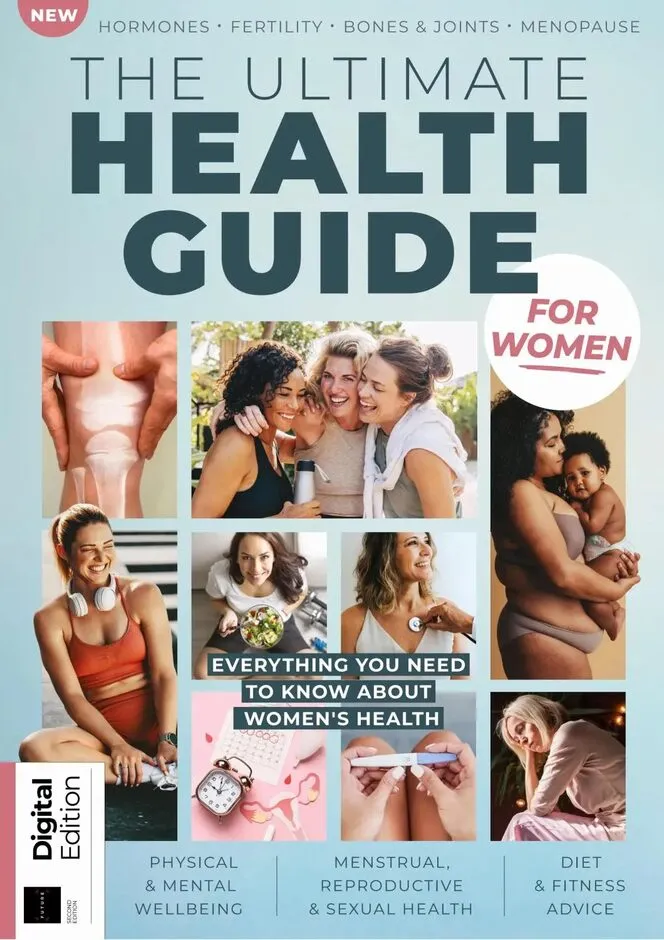
The Ultimate Health Guide for Women 2nd Edition (21 May 2026) is a 128-page reference work that covers female anatomy, hormone function, menstruation, contraception, pregnancy, menopause, and gynaecological cancers in a single volume. Published as a digital edition, the guide positions itself as a comprehensive starting point for women who want to understand their bodies from puberty through post-menopause without needing a medical degree.
The guide opens with female anatomy basics (p.8) and puberty (p.10), then moves through essential hormones (p.16) — oestrogen, progesterone, testosterone, and their ratios across the life span. "What Is Good Health?" (p.22) addresses the distinction between absence of disease and functional wellness. Health conditions (p.28) covers PCOS, endometriosis, thyroid disorders, and autoimmune conditions in women at higher prevalence rates. The fitness section (p.34) provides exercise guidelines adapted for each life stage, and the diet-and-nutrition chapter (p.40) addresses iron, calcium, and B-vitamin needs specific to women.
The second half of the guide covers menstrual cycle mechanics (p.50), ovulation (p.58), contraception options (p.60), conception (p.62), pregnancy (p.66), labour and birth (p.72), and postpartum health (p.76). Sexual health (p.80), intimacy and libido (p.84), and female health concerns (p.88) are followed by detailed sections on gynaecological cancers (p.94), bladder and bowel health (p.100), breast health (p.104), and common procedures (p.110). The final chapters address menopause (p.118), post-menopausal heart health (p.124), bone and joint health (p.126), and dementia (p.128). The guide also covers inclusive healthcare (p.116) — a short but notable section on LGBTQ+ affirming care.
—————
Content Guide
p.16 · A Guide to Essential Hormones
Explains oestrogen, progesterone, and testosterone's roles across the menstrual cycle, with a chart showing how ratios shift from menarche to menopause. The chapter includes a symptom tracker readers can bring to their GP. Useful for any woman who has been told her symptoms are "normal" without investigation.
p.50 · Your Menstrual Cycle Explained
A 4-page breakdown of the follicular, ovulatory, and luteal phases, with corresponding energy and mood patterns. The chapter advises readers to align high-intensity exercise with the follicular phase and restorative movement with the luteal phase. Athletes and fitness enthusiasts get a practical cycle-syncing template.
p.66 · A Guide to Pregnancy
Covers nutrition, exercise, and common discomforts trimester by trimester, with a medication-safety table. The chapter includes a list of foods to avoid beyond the standard sushi-and-soft-cheese warnings. Expectant parents looking for a single, non-alarmist reference will find this balanced.
p.94 · Gynaecological Cancers
Reviews ovarian, cervical, uterine, and vulvar cancers with symptom checklists and screening guidelines. The cervical cancer section explains HPV testing versus Pap smear protocols updated through 2026. The chapter normalises self-advocacy for women whose symptoms are dismissed.
p.118 · Facing Menopause
Covers perimenopause markers, hormone therapy options, and non-hormonal symptom management. A table compares systemic HT, vaginal oestrogen, and emerging therapies like fezolinetant for hot flushes. Women approaching menopause will find the treatment-decision framework especially useful.
—————
Editor's Take
This is a solid, no-surprises reference guide — it covers everything a general reader needs and skips the wellness-industry hype. The cycle-syncing and menopause-treatment chapters are the strongest, offering practical frameworks rather than vague advice. The weakness is that the guide is too compressed: 128 pages for the entire female life span means each topic gets only 4-6 pages. The inclusive healthcare section (p.116) is just 2 pages — barely a gesture. Also, the fitness and nutrition chapters offer generic advice that doesn't differ substantially from what any general-health book provides. For a reader who knows nothing about her own body, this is an excellent starting point. For a reader seeking depth on any single topic, it will frustrate.
Strengths
• Cycle-syncing framework is practical and evidence-grounded
• Menopause treatment table covers HT and newer options
• Single-volume covers the full female life span
Weaknesses
• 128 pages means each topic is only 4-6 pages deep
• Inclusive healthcare section is token-length
Verdict: Selective read — A reliable beginner's reference for women's health, but too shallow for readers who already know the basics of their own anatomy.
