
WellBeing Special Report – Muscle Growth and Development
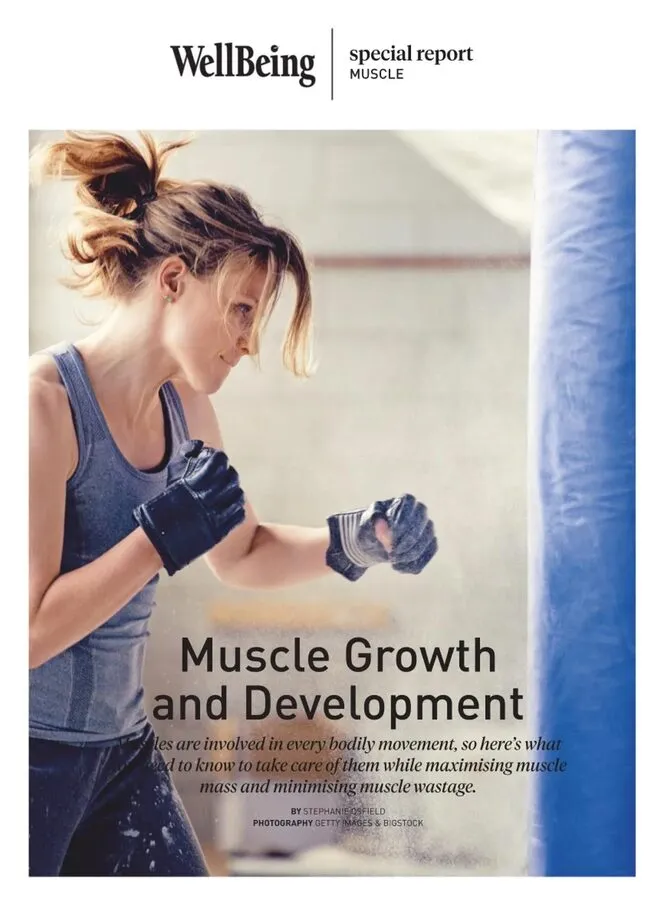
Summary
WellBeing Special Report: Muscle Growth and Development explains how muscles are built at the cellular level, what fuels them, what breaks them down, and how to move strategically for strength. The report covers muscle fibre types, protein timing, the stress-muscle connection and the risks of rapid weight loss on lean mass.
Key Topics
▸ Muscle composition — Three types: skeletal (bone-attached), smooth (organs) and cardiac (heart). Two key proteins: myosin and actin. Fast-twitch fibres produce power but fatigue quickly; slow-twitch fibres have more endurance.
▸ Feeding muscle — Glucose from carbohydrates (rye bread, fruit, rice, corn) as fuel. Protein with all nine essential amino acids is pivotal; aim for a palmful at each meal from chicken, eggs or legumes. Post-exercise: protein plus carbohydrate within one hour increases protein uptake in cells.
▸ Muscle stealers — Chronic stress (cortisol drives breakdown); rapid weight loss (up to 60% muscle loss to 40% fat loss in severe restriction); severe kilojoule restriction; chronic dieting causing sarcopenia.
▸ Training principles — Different exercise types stimulate different fibres. Genetics determines baseline fibre-type ratio. Under chronic stress, choose slow-moving exercise (yoga, tai chi) to counter cortisol. To lose fat while preserving muscle, reduce weight as slowly as possible.
What You'll Learn
• Post-exercise protein-and-carb window: within 60 minutes for optimal muscle repair
• Rapid weight loss can sacrifice 60% lean mass — slow reduction is safer
• Stress elevates cortisol, which directly breaks down muscle tissue
• Palm-sized protein portion per meal is a sufficient visual guide
Editor's Take
This report delivers solid foundational nutrition and physiology for readers new to muscle science and does so without the bro-science that plagues men's fitness content. The "muscle stealers" section is the most valuable, particularly the cortisol-stress link and the 60% muscle loss statistic from rapid dieting. The weakness: the content is truncated just as it reaches the training section, so specific exercises and programming are missing. The report also does not address women-specific muscle concerns such as the effect of menstrual cycle phases on muscle protein synthesis. This suits beginners who want to understand the why before the how.
Strengths
• Clear explanation of fast-twitch versus slow-twitch fibre differences
• Palm-portion protein guide is visual and practical
• Muscle-stealers section connects stress, cortisol and sarcopenia
Weaknesses
• Training section truncated before specific exercises appear
• No women-specific guidance on cycle-phase effects on muscle building
Verdict: Selective read — Solid on nutrition and physiology fundamentals, but incomplete on the training side for those ready to act.
