
Todays Dietitian – June-July 2025
Summary
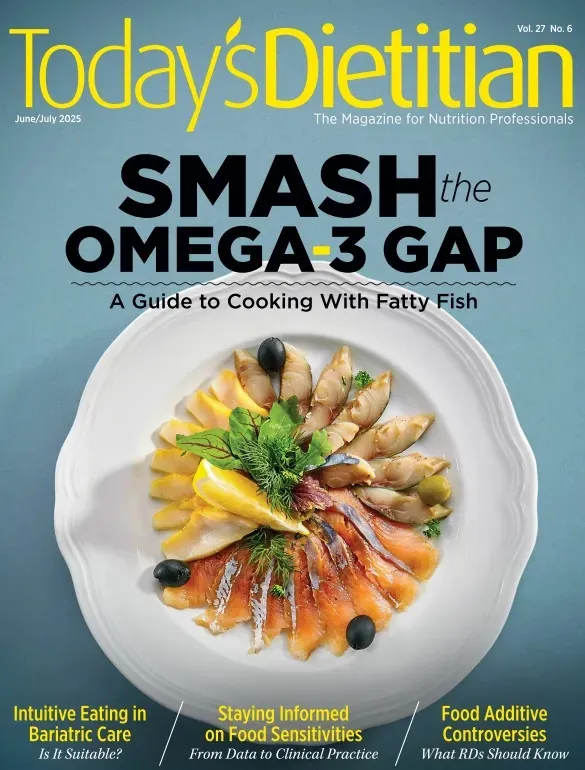
Today's Dietitian Vol. 27 No. 6 opens the summer with "SMASH the Omega-3 Gap — A Guide to Cooking With Fatty Fish" (p.18), a feature that tackles the fact that 95% of Americans fall short of the 250mg daily EPA/DHA target. The June/July 2025 issue also interrogates intuitive eating in bariatric care, translates emerging food-sensitivity science into clinic-ready protocols, and offers a CPE Monthly on hyperhomocysteinemia that bridges the gap between lab values and MNT.
"Intuitive Eating in Bariatric Care" (p.26) asks a question many RDs hesitate to ask: can IE principles coexist with the structured eating required after gastric sleeve or bypass? The article presents outcomes data from three post-op programs that have piloted hybrid models. "Staying Informed on Food Sensitivities" (p.32) cuts through the IgG-testing hype and offers a symptom-guided elimination protocol that saves patients money on unvalidated panels. The CPE instalment on hyperhomocysteinemia (p.36) links elevated homocysteine to B-vitamin status, MTHFR variants, and cardiovascular risk — a classic clinical topic that gets a genuinely updated treatment. Regulars include "Focus on Fitness," "Clinical Nutrition," "Research Brief," and "Culinary Corner."
The "Bookshelf" department (p.8) reviews four summer cookbooks pitched at dietitians, and "Get to Know …" (p.46) profiles an RD who runs supermarket tours for SNAP-eligible families. The "Datebook" (p.49) lists FNCE and state-association deadlines for the coming academic year. For RDs who want a single issue that covers omega-3 science, bariatric IE ethics, and a usable elimination framework for food sensitivities, this is a strong mid-year offering.
—————
Content Guide
▸ Cover Story / Clinical Practice
p.18 · SMASH the Omega-3 Gap
A 8-page guide that goes beyond supplement recommendations to show RDs how to counsel patients on preparing sardines, mackerel, anchovies, salmon, and herring. The article includes taste-tolerance strategies for omega-3-averse clients and a weekly meal grid that hits 500mg EPA/DHA with three 150g servings. Practitioners leave with a reproducible handout that explains why fish oil pills aren't a substitute for whole-food consumption.
p.26 · Intuitive Eating in Bariatric Care
Three RDs who run post-op programs share their hybrid protocols that honour hunger cues within the mechanical constraints of a sleeve or bypass. Outcome data from 12-month follow-ups show comparable weight loss and higher diet satisfaction scores versus traditional meal plans. The nuanced answer: IE works after bariatric surgery when both practitioner and patient acknowledge biological limits.
p.36 · CPE Monthly: Managing Hyperhomocysteinemia
This 2-CE course updates the B-vitamin intervention protocols with new evidence on the optimal ratio of methylfolate, methylcobalamin, and betaine. A decision tree for MTHFR variant carriers is included. RDs finish with a laboratory-interpretation guide they can apply to their next cardiovascular or geriatric case.
▸ Food Sensitivities
p.32 · Staying Informed on Food Sensitivities
A sharp critique of IgG food-panel testing, paired with a low-cost elimination protocol that uses symptom journals and 4-week reintroduction windows. The authors list seven conditions for which elimination diets have evidence — IBS, migraine, eczema, and eosinophilic oesophagitis among them. Patients save hundreds of dollars by skipping the mail-order panels.
▸ Regulars
p.10 · Clinical Nutrition — Preventing Exertional Heat Illness
A summer-specific column reviewing hyponatremia risks, pre-hydration protocols, and sodium-loading strategies for active patients. The advice targets endurance athletes but scales down to any client exercising in high heat. A quick-reference electrolyte chart is included.
p.50 · Culinary Corner — No-Cook Summer Meals
Five recipes that require zero stove or oven use, targeting RDs who counsel patients with limited kitchen access. Each dish meets a low-sodium, high-fibre criteria. Prep times stay under 10 minutes, and the ingredient lists rely on canned and shelf-stable staples.
—————
Editor's Take
A competent mid-year issue with one standout feature — the bariatric IE article — that genuinely pushes clinical thinking forward. The omega-3 piece is thorough but covers ground most RDs already know (fish is good, supplements are second-best). The food-sensitivity article is the second-best piece here: it saves patients from wasting money on IgG tests and gives RDs a defensible protocol. The CPE on hyperhomocysteinemia is the kind of solid-but-unexciting update the field needs. Weaknesses: the summer cookbook reviews in Bookshelf feel like padded pages, and "Focus on Fitness" offers generic heat-illness advice any RD could draft. The issue doesn't take many risks, but it delivers what working clinicians need — usable protocols, CE credit, and a sensible summer frame.
Strengths
• Bariatric IE article is genuinely novel and evidence-supported
• Food-sensitivity piece saves patients from costly IgG testing
• CPE topic fills a real lab-to-clinic gap
Weaknesses
• Bookshelf department reads like filler content
• Focus on Fitness advice is too basic for practising RDs
Verdict: Recommended — A safe, solid issue elevated by the bariatric IE debate and the sensible elimination protocol for food sensitivities.
