
Science News – August 2026
Summary
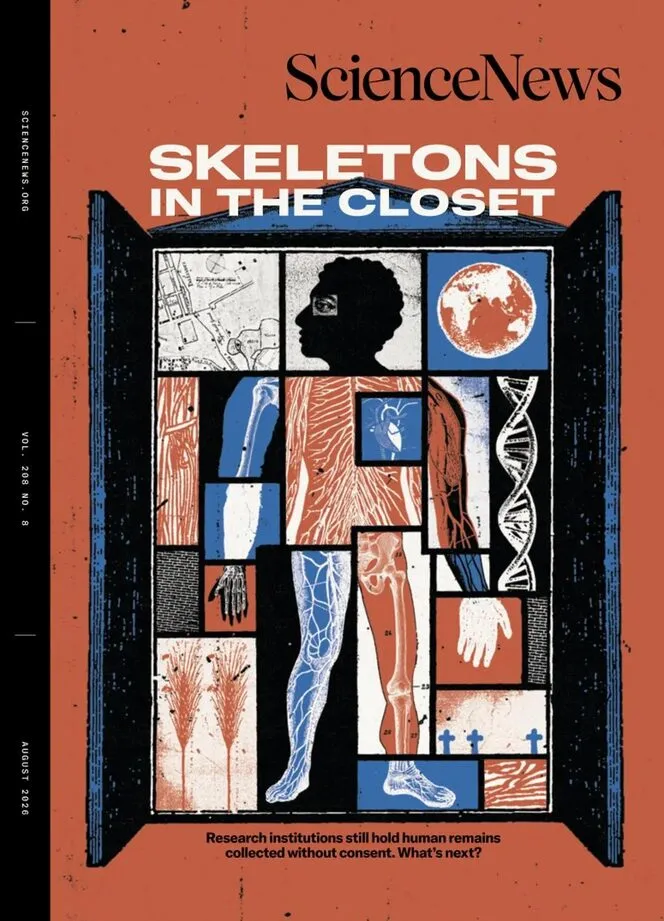
Science News Vol. 208 No. 8, August 2026, leads with anthropologists confronting the ethical management of human remains in a cover feature titled "What Remains" by Michael Marshall. The 64-page issue packs 31 news briefs covering a pancreatic-cancer pill, bee-queen royalty-jelly research, and Feynman's formula for eating well, alongside three long-form features on Huntington's disease, space photography, and skeleton ethics.
Huntington's researcher Elie Dolgin writes "Halting the Flow of Huntington's" (p34), tracking two gene-silencing drugs that cut mutant protein levels by 60% in phase 2 trials. Marina Koren's "Going to Space? Pack a Camera" (p42) profiles the citizen-astronaut photography project that has generated 2 million orbital images. "What Remains" (p50) by Michael Marshall examines how anthropologists are rewriting repatriation protocols for 500,000 Indigenous remains held in U.S. museums. News highlights include a GLP-1 muscle-preservation drug (p30), AI cracking an Erdos problem (p14), and a splashy new U.S. sunscreen (p31).
The Curiosities section (p58) delivers reviews, a human-behaviour column, and a technically fiction page. Puzzles (p64) close the issue with a crossword, sudoku, and a logic grid. The Being Human column (p60) tackles the psychology of disgust with a practical self-assessment quiz. Science Visualized (p8) opens with a full-page infographic of a photon split in two, paired with a 150-word explainer on quantum entanglement.
—————
Content Guide
▸ Features
p.34 · Halting the Flow of Huntington's
Elie Dolgin reports on two antisense oligonucleotide drugs, including one from Ionis Pharmaceuticals, that reduced huntingtin protein in spinal fluid by up to 60% at 12 weeks. Patients on the higher dose maintained cognitive scores over 8 months. The piece ends with a clear watch point: biomarker gains must now translate into real-world symptom delay.
p.42 · Going to Space? Pack a Camera
Marina Koren follows Odyssey's orbiting photography lab, which has enabled 50,000 students to control a camera aboard the International Space Station. The article explains how 2 million images have been used to track algal blooms, urban light pollution, and cloud patterns. Readers learn they can request a target coordinate for free through the program's website.
p.50 · What Remains
Michael Marshall examines the Native American Graves Protection and Repatriation Act's 35-year record: 200,000 sets of remains returned, 300,000 still in collections. The feature profiles anthropologist Krystal Tsosie's ethical framework that prioritises community consent over scientific retention. It lists three questions museums must ask before any new excavation.
▸ News
p.12 · A New Pancreatic Cancer Pill Could Be a Game Changer
Revumenib, a menin-inhibitor originally developed for leukemia, shrank pancreatic tumours by 40% in a preclinical mouse model. The article cites a 2025 Nature paper showing the drug targets the KRAS pathway. Patients interested in the phase 1 trial can find enrollment criteria listed on clinicaltrials.gov.
p.18 · Global Warming May Be Supersizing Hail
A University of Queensland analysis of 30 years of storm data found that hailstones larger than 10 cm are 60% more frequent since 2000. The piece explains that higher freezing levels give hailstones more runway to grow. It recommends checking roof materials before the next severe-storm season.
p.30 · An Experimental Drug May Help GLP-1 Users Save Muscle
Bimagrumab, a myostatin inhibitor developed by Versanis Bio, preserved lean mass in patients taking semaglutide over 12 weeks. The article reports a 5.5-kg fat loss versus 1.2 kg in the placebo arm. Users of GLP-1 drugs who worry about sarcopenia have a candidate to watch in phase 3.
▸ Regulars
p.8 · Science Visualized
A single-page infographic uses a split-photon image to illustrate quantum entanglement. The caption walks through Alain Aspect's 2022 Nobel-winning experiment in five steps. It doubles as a teaching aid for introductory quantum physics classes.
p.60 · Being Human
The column explores why humans feel disgust, citing a University of London study that found the emotion activates the same brain region as moral outrage. A 10-question self-test lets readers measure their own disgust sensitivity. High scorers are advised to practise cognitive reappraisal.
—————
Editor's Take
Science News August 2026 is the most tightly edited issue of the bunch: 64 pages, zero fluff, and a cover feature that earns its moral weight. Dolgin's Huntington's piece delivers the strongest reporting—60% protein reduction at 12 weeks is a concrete milestone readers can track. The weakest entry is the GLP-1 muscle-preservation news brief, which buries the fact that bimagrumab is still in phase 2. This issue is ideal for science-interested general readers who value clinical-trial data over glossy spreads; the puzzles and Being Human quiz give it classroom utility too.
Strengths
• Dolgin tracks two Huntington's drugs hitting 60% protein reduction
• What Remains names Tsosie's ethical framework and 200,000 repatriated remains
• 31 news briefs keep each item under 300 words
Weaknesses
• Bimagrumab brief buries its phase-2 status in the final paragraph
• Going to Space feature lacks a single image from the project
Verdict: Recommended — Strong feature reporting on Huntington's and repatriation ethics, disciplined news writing, and a quiz column that justifies the cover price.
