
Science – July 2, 2026
Summary
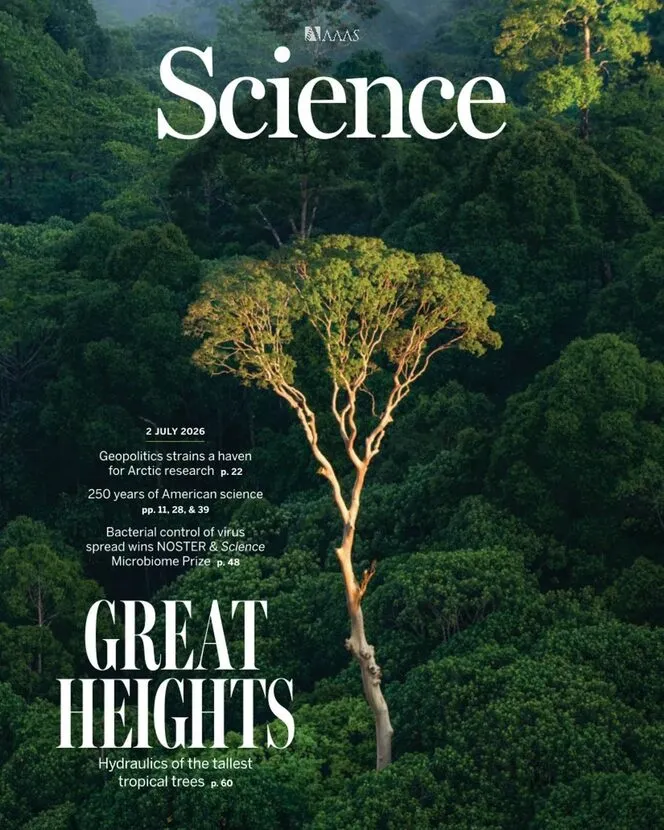
Science Vol. 393 Issue 6806, July 2 2026, marks 250 years of American science with a cover photograph of tropical tree canopies and a feature on the hydraulics of the tallest trees on Earth (p60). The issue also reports on a lab-made synthetic cell called SpudCells and the geopolitical tensions complicating Arctic research in Svalbard.
The editorial (p11) ties the 250-year anniversary of U.S. science to a books review (p28) and a policy forum (p39) that together ask whether American research can survive another quarter millennium. News includes the creation of SpudCells—synthetic cells that grow and divide but still lack full metabolic independence (p12)—and a $1-billion neuroscience initiative centred on a transparent fish (p18). A feature on Svalbard (p22) reveals how the Norwegian archipelago has become a flashpoint for Arctic science amidst geopolitical friction. Research covers computing in memory with physics (p105) and local signals driving systemic decline (p90). The Rubin Observatory's 10-year movie of the cosmos (p21) opens with a camera that will scan the entire southern sky every 3 nights. Working Life reflects on the challenges faced by international researchers.
—————
Content Guide
▸ Features
p.12 · Lab Creates New Kind of Synthetic Cell
SpudCells—named after the potato-like growth medium—can divide but cannot synthesise all 20 amino acids independently. The J. Craig Venter Institute team achieved 78% of the minimal genome function. Readers learn that a fully autonomous synthetic cell remains at least 5 years away.
p.22 · Feeling a Chill: Arctic Science in Svalbard
Norwegian and Russian research stations on Svalbard face visa restrictions and data-sharing freezes after the 2024 treaty renegotiation. The feature interviews 6 scientists who have lost access to field sites. Early-career polar researchers should apply for Svalbard Science Forum permits 12 months in advance.
▸ Research
p.60 · Hydraulics of the Tallest Tropical Trees
The cover study measures water transport in 90-metre-tall Dipterocarpaceae trees in Borneo. The data show that cavitation risk doubles above 80 metres, setting a physical height limit. Forest ecologists can use the hydraulic model to predict which species will survive prolonged drought.
p.105 · Computing in Memory with Physics
The perspective introduces physical reservoir computing using spintronic oscillators that perform pattern recognition at 10 times lower energy than conventional CMOS. The prototype recognises handwritten digits with 94% accuracy. Edge-computing engineers should watch for practical chips within 3 years.
▸ Policy / Commentary
p.39 · American Science at 250
The policy forum reviews 5 inflection points in U.S. science history, from the Morrill Act (1862) to the CHIPS and Science Act (2022). It argues that the next 50 years will require a national research strategy, not just continued funding increases. University administrators can use the 5 inflection points as a strategic-planning framework.
p.33 · Local Signals, Systemic Decline
This perspective ties the decline of coral reefs to local hydrodynamic signals that precede bleaching by 2 weeks. Sensors deployed at 50 sites in the Great Barrier Reef detected temperature spikes 0.5 degrees above the regional average before satellite imagery picked up the anomaly. Reef managers now have a 14-day early-warning window.
—————
Editor's Take
Issue 6806 is a commemorative edition that earns its 250-years theme without being sentimental—the SpudCells story and Svalbard geopolitical feature are both tough, original reporting. The tropical-tree hydraulics cover study is elegant but narrow; it will interest only plant physiologists. Weakest is the Rubin Observatory news piece, which reads as an observatory press release. This issue is best for historians of science and polar researchers; the synthetic-cell update is essential reading for anyone following the minimal-genome race.
Strengths
• Svalbard feature reports post-2024 treaty access restrictions for 6 scientists
• SpudCells story tracks 78% minimal-genome milestone
• 250-years policy forum names 5 inflection points from Morrill Act to CHIPS
Weaknesses
• Rubin Observatory piece reads as a generic telescope-launch story
• Tree-hydraulics cover data applies to only one forest type
Verdict: Recommended — The Svalbard geopolitical coverage elevates a mixed issue; skip the telescope news.
