
New Scientist USA – September 5, 2026
Summary
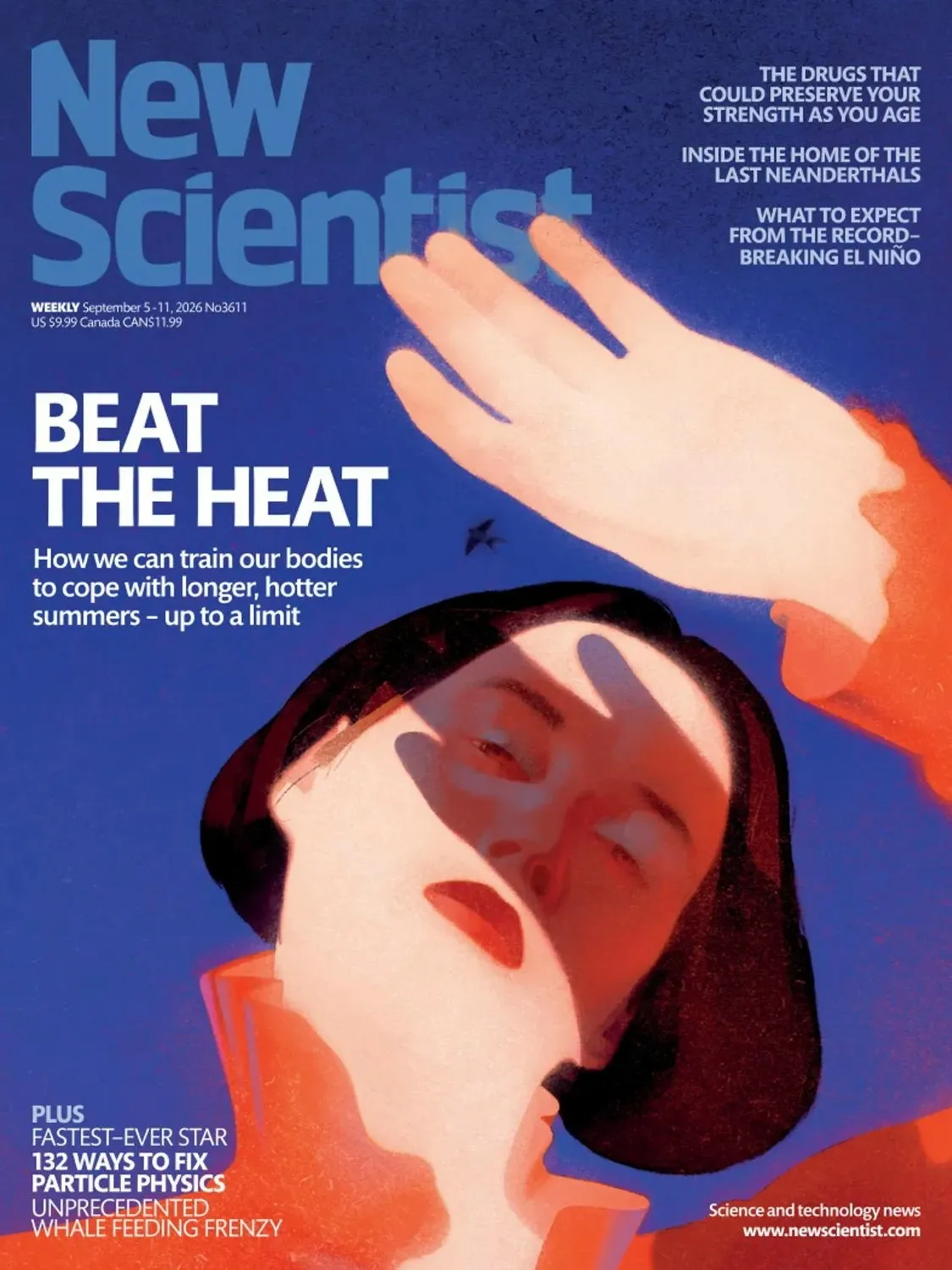
New Scientist USA No. 3611, September 5-11 2026, priced at US $9.99, leads with "Beat the Heat" — how to train our bodies to cope with longer, hotter summers, up to a physiological limit. The issue also reports on a nanoparticle drug that regenerates nerve cells in Alzheimer's disease, Ukraine's advanced prosthetics industry born from war, and the record-breaking El Nino that could push 2027 to a new global temperature record.
The cover story (p30) by Graham Lawton examines heat-acclimation protocols used by athletes and military personnel, including 90-minute sauna sessions post-exercise. Alzheimer's treatment (p6) features a nanoparticle that delivered BDNF across the blood-brain barrier in mice, resulting in 40% new neuron growth in the hippocampus. Ukraine's prosthetics feature (p36) reports that 3 clinics in Kyiv have fitted 2,000 patients with bionic limbs since 2023. The final Neanderthal cave (p40) explores the 50,000-year-old Gibraltar site that may hold answers about their extinction. News includes an exercise patch delivering workout benefits without exertion (p10), dice discovered that solve a decade-long maths problem (p14), and the fastest-ever star spotted (p8).
—————
Content Guide
▸ Cover Story
p.30 · The Heat Is On: Beat the Heat
Heat-acclimation protocols include 90-minute post-exercise sauna sessions at 85 degrees Celsius for 10 days straight, which increases plasma volume by 7%. The article warns that above 35 degrees wet-bulb temperature, the human body cannot cool itself. Outdoor workers in hot climates should start acclimation 2 weeks before heat season.
▸ Features
p.36 · Ukraine's Growing Industry: War-Grade Prosthetics
Since 2023, 3 Kyiv clinics have fitted 2,000 patients with myoelectric bionic limbs costing 5,000 dollars per unit—a fraction of the 50,000-dollar US equivalent. The feature profiles a 28-year-old soldier who regained grip function after 6 months of physiotherapy. Defence ministries can study Ukraine's procurement model for cost benchmarks.
p.40 · Neanderthals' Downfall: Inside the Cave
Gibraltar's Vanguard Cave contains 50,000-year-old Neanderthal remains alongside tools and butchered animal bones. The article suggests a population of fewer than 100 individuals in the area at extinction. Archaeologists can use the site's sediment DNA as a baseline for Neanderthal population modelling.
▸ News
p.6 · Budding Nerve Cells: Nanoparticle Drug Holds Hope for Alzheimer's
A lipid nanoparticle carrying BDNF (brain-derived neurotrophic factor) crossed the blood-brain barrier in mice and stimulated 40% new neuron growth in the hippocampus over 8 weeks. Human trials are planned for 2028. Patients with early-stage Alzheimer's should monitor clinical trial registries.
p.10 · Not Breaking a Sweat: Exercise Patch
A transdermal patch released a drug combination (AICAR and GW501516) that increased endurance in mice by 30% without exercise. The technology is 5 years from human testing. The patch's developer, a University of Texas team, warns it is not a substitute for exercise.
p.14 · A Roll of the Dice: Decade-Long Maths Problem Solved
Physicists at the University of Bristol discovered that 23-sided dice can generate true random numbers in quantum systems. The finding solves a 2016 conjecture about the minimum number of sides needed for quantum randomness. Cryptographers should watch for quantum-dice hardware prototypes.
▸ Regulars
p.18 · Thirsty Work: How Much Water Do We Need?
Helen Thomson reviews the evidence and finds that the 8-glasses-a-day rule has no scientific basis. Actual requirements range from 1.5 to 3.0 litres depending on body weight and activity. The article recommends checking urine colour as a hydration guide.
p.24 · Book of the Week: Snow Leopard Secrets
A review of "Ghost of the Mountains" describes the first GPS tracking study of snow leopards in the Altai Mountains, revealing a home range of 200 square kilometres per individual.
—————
Editor's Take
New Scientist September 5 is the strongest New Scientist issue in the batch—the heat-acclimation cover story is immediately useful for anyone living through hotter summers, and Ukraine's prosthetics feature is original war-zone reporting with hard cost data. The nanoparticle Alzheimer's story is genuinely exciting (40% neuron growth in mice). Weakest is the Neanderthal piece, which describes a well-known Gibraltar site without new data. This issue is essential for outdoor workers, athletes, and anyone concerned about heat adaptation; the prosthetics cost data (5,000 vs 50,000 dollars) is a policy-relevant number.
Strengths
• Heat-acclimation protocol: 90-minute sauna at 85 degrees for 10 days
• Ukraine prosthetics: 2,000 patients fitted at 5,000 dollars each
• Nanoparticle BDNF delivery yields 40% hippocampal neuron growth
Weaknesses
• Neanderthal cave piece rehashes known Gibraltar data
• Exercise patch is 5 years from human testing
Verdict: Essential — The heat cover and Ukraine prosthetics feature deliver original, usable information; the best New Scientist issue in this batch.
