
National Geographic Traveller The Collection – Indian Ocean 2026
Summary
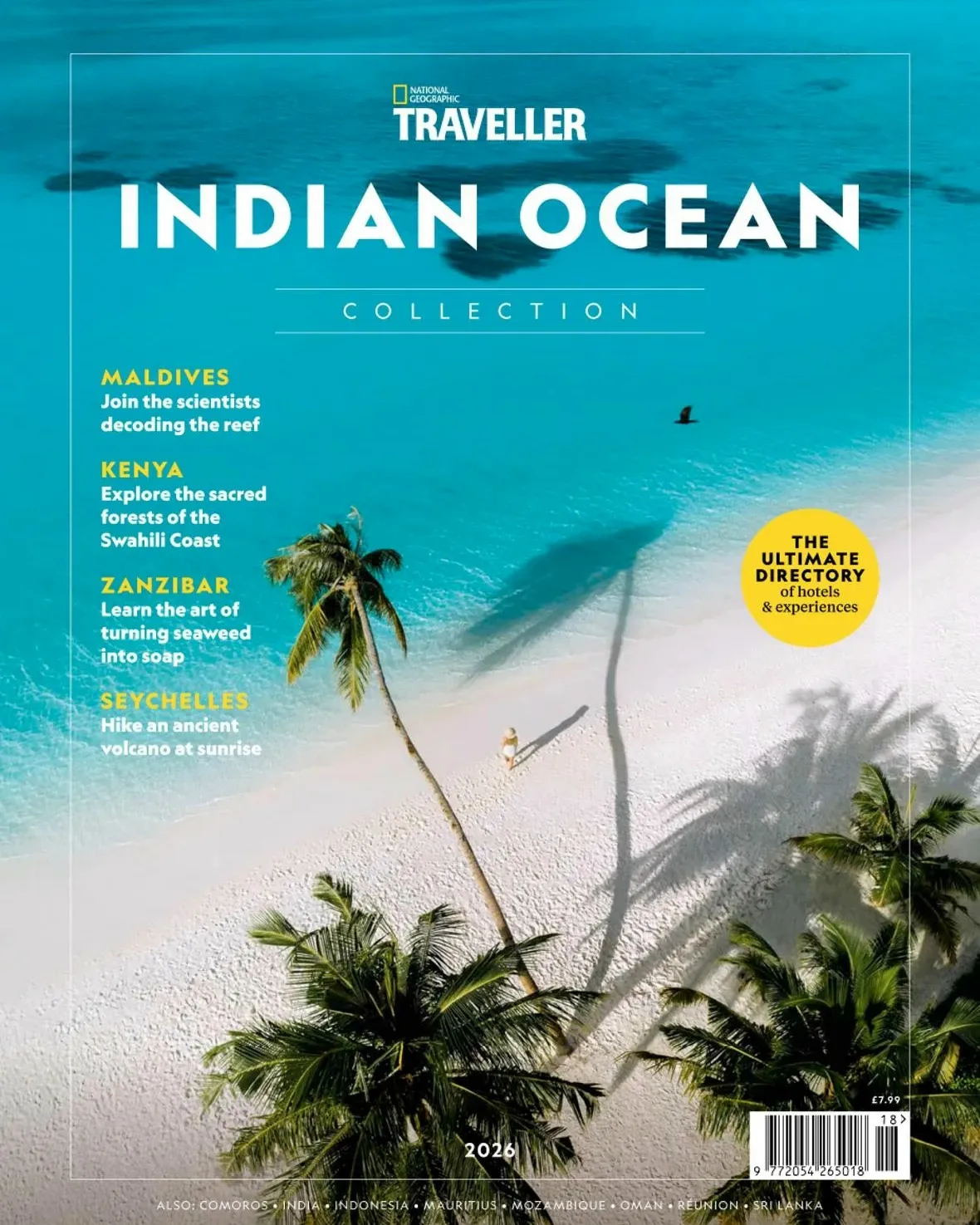
National Geographic Traveller's Indian Ocean Collection 2026 (£7.99, one-shot directory) packages seven editorial features — AI-powered coral mapping in the Maldives, Zanzibar's Mwani Mamas seaweed farmers, Kenya's sacred forests, ancient spice routes and a next-generation wellness frontier — with a paid directory of hotels and experiences running from page 38 onward. The cover highlights Maldives, Kenya, Zanzibar and Seychelles.
Editor Charlotte Wigram-Evans opens with a letter framing the collection as a guide to places that reward a second look. New Horizons (p.6) surveys remote archipelagos and wild coastlines. Sacred Shores (p.10) explores ancient Swahili forests and reefs. Reading the Reef (p.16) documents an AI-powered coral-mapping conservation project in the Maldives. The Mwani Mamas (p.22) profiles women hand-farming seaweed on Zanzibar's east coast. The Next Wellness Frontier (p.28) covers lunar rituals and biomarker science. Greater Than Gold (p.34) traces the spice routes that made the Indian Ocean the world's richest trading ground. The Directory (p.38) collects paid hotel and tour listings.
The editorial-to-advertising ratio follows the Collection series template: roughly 32 editorial pages against a 100-plus-page directory. Featured operators include properties in the Maldives, Seychelles, Mauritius, Sri Lanka and South Africa, each with contact details, key activities and practical notes.
—————
Content Guide
▸ Features
p.6 · New Horizons
Remote archipelagos, wild coastlines and cultures that reward a second look — a survey of emerging Indian Ocean destinations beyond the postcard resorts. The section highlights the Mentawai Islands in Indonesia as a surfer alternative to Bali. Book the Mentawai for April to June for consistent swell and empty lineups.
p.10 · Sacred Shores
Ancient forests, thriving reefs and centuries-old Swahili traditions along Kenya's coastline. The Kaya forests — sacred groves of the Mijikenda people — are UNESCO-listed and require a local elder's permission to enter. Arrange your visit through the Kenya Forest Service at least two weeks ahead.
p.16 · Reading the Reef
Inside the AI-powered coral-mapping project transforming conservation in the Maldives. Researchers use underwater drones and machine learning to track bleaching events across 26 atolls. The project publishes quarterly open-access data — download it to identify which resort house reefs are still healthy before you book.
p.22 · The Mwani Mamas
Women hand-farming seaweed on Zanzibar's east coast have built a cooperative that sells directly to international cosmetics companies. The farm visits include a hands-on harvesting session. Buy your seaweed soap from the cooperative's own shop in Jambiani rather than from Stone Town resellers — the farmers keep a higher share.
p.28 · The Next Wellness Frontier
Lunar rituals, biomarker blood testing and circadian-light therapy are stepping beyond the standard spa menu at several Indian Ocean retreats. The Six Senses Laamu in the Maldives now offers a biomarker panel that measures 40 metrics from a single finger-prick test.
p.34 · Greater Than Gold
Follow the ancient spice routes — cinnamon from Sri Lanka, cloves from Zanzibar, pepper from Kerala — that made the Indian Ocean the world's richest trading ground. The article maps five port cities where the spice trade shaped local architecture and cuisine. Visit the Mace Spice Market in Stone Town at 6 a.m. for the wholesale auction.
▸ The Directory
p.38 · The Directory
Paid listings of hotels, resorts and experience providers across the Indian Ocean. Properties range from Maldivian overwater villas to Kenyan beach lodges and Seychelles hilltop retreats. Each entry includes direct booking contacts, room rates where available, and a key-activities box. The hotel maps in this section are organised by price band (Luxury / Mid-Range / Budget) — use the colour tabs on the page edge to navigate.
—————
Editor's Take
The Indian Ocean Collection follows the same template as its Latin America sibling — a thin editorial shell around a dense advertising core. The editorial is genuinely good: Reading the Reef's AI-coral-mapping angle (p.16) and The Mwani Mamas' cooperative profile (p.22) are well-reported stories you won't find in standard travel magazines. Greater Than Gold's spice-route map (p.34) is the issue's most useful feature. But the editorial content runs only 32 pages before the directory takes over. If you are actively planning an Indian Ocean trip and need a binder of lodge contact details, this saves research time. If you want narrative travel writing, buy the regular monthly.
Strengths
• Reading the Reef profiles AI-powered coral-mapping with open-access data
• The Mwani Mamas cooperative sells directly from its own Jambiani shop
• Spice-route map gives 6 a.m. market timing for Zanzibar's wholesale auction
Weaknesses
• Editorial runs only 32 pages before the paid directory dominates
• No month or issue number on the cover — undated shelf product
Verdict: Selective read — Worth it for the Indian Ocean hotel directory; the editorial is a bonus rather than the draw. (19 words)
