
Scientific American – September 2026
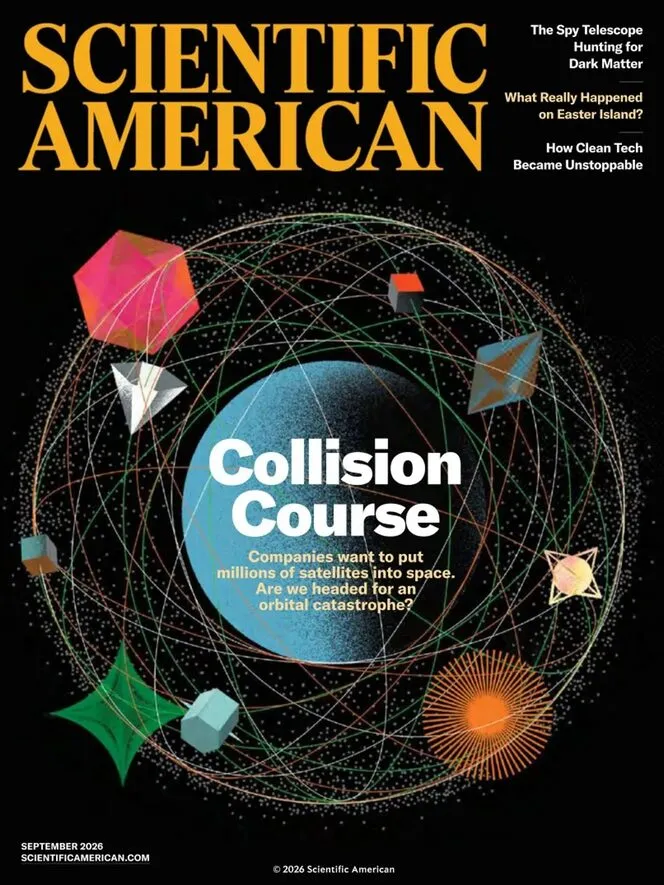
Summary
Scientific American's September 2026 issue (Vol. 335 No. 2) warns that the race to fill low-Earth orbit with up to 2 million satellites could trigger an orbital catastrophe, illustrated by Brian Stauffer's cover art. Jonathan O'Callaghan reports on the battle for the night sky as companies plan mega-constellations that threaten astronomy, the atmosphere, and orbital safety. Michael Marshall overturns the long-held narrative of Easter Island's ecocide with new evidence pointing to European contact as the real culprit.
O'Callaghan's space-policy feature on page 26 details how 15,000 active satellites could balloon to 2 million within a decade, and why existing space-law frameworks cannot manage the collision risk or light pollution. On page 32, Michael Marshall re-examines the Rapanui collapse narrative and argues that rats, not the islanders themselves, drove deforestation — and that introduced diseases killed far more people than resource wars. Ingrid Wickelgren's "Wired for Story" on page 48 reveals how the brain's default-mode network processes narrative as a survival mechanism.
Stephanie Pappas explains why solar power, at its current cost of roughly $25 per megawatt-hour, is now the cheapest energy source in history. Alex Pasternack profiles two US solid-state battery companies betting against China's battery dominance. The Advances section covers deep-sea fossils, pigeon edge-of-chaos behaviour, and bee-sized drones. Phil Plait warns that astronomers are missing huge parts of the universe.
—————
Content Guide
▸ Space Policy / Archaeology / Neuroscience / Energy / Advances / Regulars
p.26 · Battle for the Night Sky
Jonathan O'Callaghan reports on the dangerous race to fill Earth orbit with satellites. The FCC has received applications for nearly 2 million new satellites. Astronomers calculate that at full deployment, every second exposure from a ground-based telescope will be crossed by a satellite trail.
p.32 · Who Broke Easter Island?
Michael Marshall presents new evidence that Pacific rats, not Rapanui people, ate the island's palm seeds, and that European-introduced diseases caused the population crash. The claim that the islanders committed ecocide, he argues, is a colonial narrative that blames the victims.
p.40 · Spying on the Universe
A former US National Reconnaissance Office surveillance telescope — donated to NASA — is now hunting for dark matter and dark energy from its orbit. The telescope's 2.4-metre mirror, originally built to photograph Soviet installations, can resolve objects 100 times fainter than Hubble's deep fields.
p.48 · Wired for Story
Ingrid Wickelgren explains how the brain's default-mode network uses narrative to compress experience into memory. fMRI studies show that when people hear a story, their brain activity synchronises across listeners. To make a scientific finding memorable, wrap it in a causal sequence.
p.56 · Why Solar Is Taking Over the World
Stephanie Pappas documents how solar photovoltaic costs have fallen 90 percent since 2010, making it the cheapest electricity source in history at roughly $25/MWh. China now manufactures 80 percent of the world's solar cells.
p.66 · Hard Cell
Alex Pasternack follows two US solid-state battery companies — QuantumScape and Factorial — as they race to scale production. Both aim to deliver batteries with 400 watt-hours per kilogram by 2028, potentially doubling EV range.
p.72 · Big Bets in Green Tech
Andrea Thompson, Meghan Bartels, Cody Cottier, and Dan Vergano profile ambitious clean-energy projects: fusion reactors, carbon-sucking concrete, and hydrogen-powered steel mills. Start with the concrete project — it traps CO2 during curing and has already been used in a California sidewalk.
p.94 · Graphic Science: What to Do If You Get a Tick Bite
A step-by-step visual guide: grasp the tick with fine-tipped tweezers as close to the skin as possible, pull upward without twisting, and clean the bite area with rubbing alcohol. Save the tick in a sealed bag for species identification.
—————
Editor's Take
The orbit-collision cover story is urgent journalism — O'Callaghan translates a policy failure into concrete risk, and the satellite numbers are staggering. Easter Island revisionism is equally strong: Marshall dismantles a myth that has persisted in both academic and popular writing for decades. The Investments section (green tech, solid-state batteries) is where the issue drags: both pieces are well-reported but read more like industry newsletters than Scientific American features. Best suited for readers who want science-policy journalism over gadget coverage.
Strengths
• Battle for the Night Sky quantifies satellite risk with real FCC data
• Easter Island piece decisively overturns a pop-science icon
• Solar economics feature is refreshingly numbers-driven
Weaknesses
• Green-tech roundup overlaps with the battery feature
• No full-length Advances story despite rich source material
Verdict: Essential — Two cover-worthy features in one issue; buy for the orbital-debris reporting.
