
Science – July 16, 2026
Summary
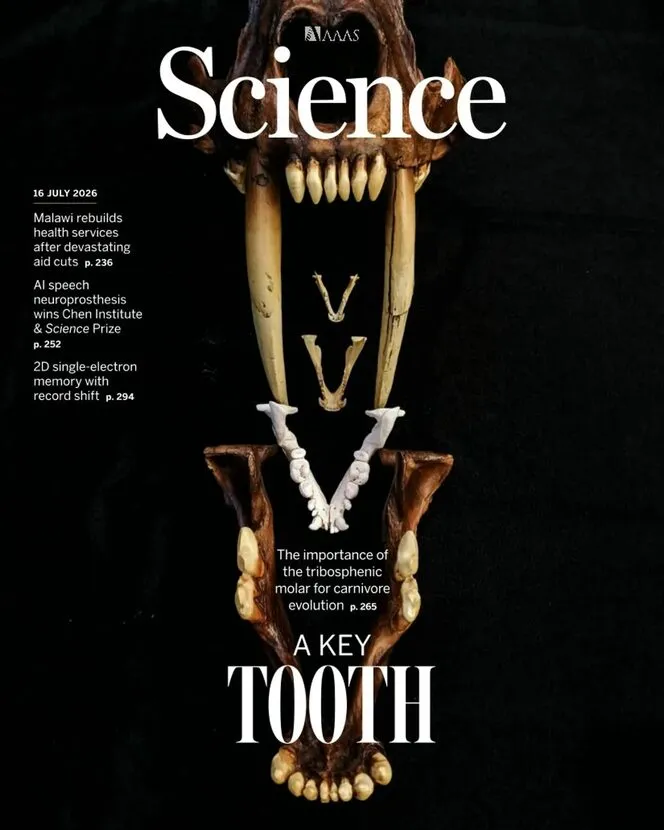
Science Vol. 393 Issue 6808, July 16 2026, opens with an image of a mammalian tooth and a cover study on performance trade-offs that define a fundamental dental dichotomy in mammals (p265). The issue also reports on NSF's $1-billion gamble on economically targeted research, a ban on research collaborations with China, and an uncertain path for health care in Malawi after USAID.
The cover study by N. Chatar et al. reveals that sharp, slicing teeth cannot also be grinding teeth—the physical trade-off is encoded in enamel microstructure. News includes the Arctic gray whale boom turning into a bust (p226), a Scandinavian radar array probing aurora mysteries (p230), and a tree-killing beetle spreading to urban forests globally (p233). Perspectives cover lymph nodes becoming optional in cancer treatment (p242) and tidying up aging organs (p244). Research spans quantum engineering with single-electron memory (p294), perovskite solar cells with spatiotemporally homogeneous crystallisation (p287), and the drying of the Aral Sea reshaping Central Asia's carbon inventory (p300). The Working Life essay (p326) asks what tears can say about academic culture.
—————
Content Guide
▸ Cover Story
p.265 · Performance Trade-offs Define a Fundamental Dental Dichotomy in Mammals
N. Chatar et al. use 3D shape analysis on 200 mammal species and find that tooth sharpness and tooth durability are inversely correlated—an animal cannot optimise both. The ratio is governed by enamel prism decussation angle. Evolutionary biologists can apply the model to any fossil with a single intact molar.
▸ Features
p.236 · An Uncertain Path
C. Offord reports on Malawi's healthcare system after USAID's funding freeze—clinics in 4 districts have run out of antiretroviral drugs. The feature profiles a nurse who now treats 200 patients per week with half the previous supply. Global-health funders should note that 6 months of disruption erased 5 years of HIV-prevention gains.
p.228 · In a Billion-Dollar Gamble, NSF Bets on Research with an Economic Payoff
J. Mervis reports on NSF's new Directorate for Technology, Innovation and Partnerships, which has funded 50 industry-aligned projects at 2 million dollars each. Critics argue it undermines basic research. University researchers can apply for the next round by September 2026.
▸ Research
p.287 · Spatiotemporally Homogeneous Crystallisation for Ambient Scalable Perovskite Photovoltaics
B. Gao et al. achieve 24.2% efficiency on a 25-square-centimetre module by controlling crystallisation speed. The process works at 25 Celsius and 40% humidity. Manufacturers can use existing slot-die coating equipment without modification.
p.294 · Robust Single-Electron Memory with Quantum States Manipulation
C. Liu et al. demonstrate a single-electron transistor that retains its charge state for 10 hours at 4 Kelvin. The device uses a silicon quantum dot 5 nanometres in diameter. Cryogenic-computing researchers now have a building block for quantum-classical interfaces.
p.300 · Drying of the Aral Sea Reshapes the Anthropogenic Carbon Inventory of Central Asia
R. Marce et al. calculate that the exposed seabed has released 50 million tonnes of carbon since 2000—equivalent to 3% of global fossil-fuel emissions in a single year. The team recommends revegetating 20% of the dry seabed with salt-tolerant plants to sequester carbon.
—————
Editor's Take
Issue 6808's dental dichotomy cover story is a textbook example of how simple physical constraints explain complex evolution—accessible to any biology undergraduate. The Malawi health-care feature is the most urgent reporting in the issue; the USAID funding-freeze story has not been covered this well elsewhere. Weakest is the NSF economic-payoff story, which reads like a press release with one opposition quote tacked on. This issue is for evolutionary biologists and global-health readers; the Aral Sea carbon data should be cited by every central-Asian climate policymaker.
Strengths
• Malawi feature shows USAID freeze erased 5 years of HIV gains in 6 months
• Dental dichotomy model applies to any mammal fossil with one intact molar
• Aral Sea carbon release quantified at 50 million tonnes since 2000
Weaknesses
• NSF economic-payoff story lacks critical voices beyond one quote
• Single-electron memory device only operates at 4 Kelvin
Verdict: Recommended — The Malawi reporting and dental evolution paper make this a standout issue for global-health and biology readers.
