
Science – August 13, 2026
Summary
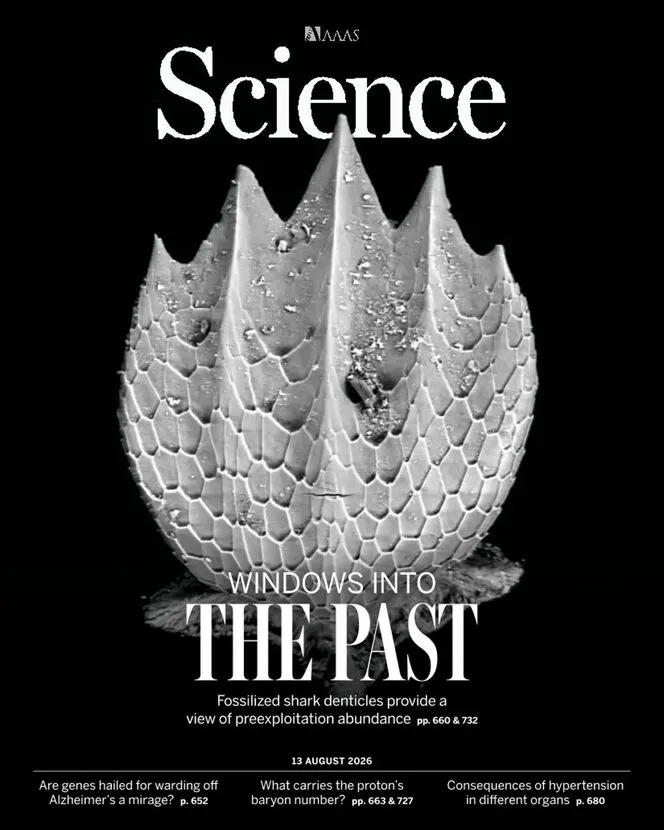
Science Vol. 393 Issue 6812, August 13 2026, features fossilised shark denticles on its cover, revealing that pre-exploitation shark numbers in the Pacific were 20 times higher than in the Caribbean—and Caribbean populations have since crashed by 75% (p732). The issue also reports on strong evidence for the long-elusive glueball particle (p647) and a democracy tax in support of science (p641).
The cover study (p732) by E. M. Dillon et al. uses shark denticles preserved in Panama's ocean sediments to establish a pre-human baseline. Physics researchers at the Beijing Spectrometer found the strongest signature yet of a glueball—a particle made entirely of gluons—at 2.4 gigaelectronvolts (p647). The editorial (p641) argues charitable donations to science should be viewed as a democracy tax. News covers planned satellite constellations risking runaway debris (p642), a mismatched Ebola vaccine rollout (p649), and tau protein wreaking havoc in brain-cell energy factories (p651). A feature (p652) explores the tension between medical realism and optimism. The Working Life column (p738) discusses writing the hard way.
—————
Content Guide
▸ Cover Story
p.732 · Fossil Denticles Reveal How Ocean Productivity Shapes Shark Baselines
E. M. Dillon et al. analyse 10,000 fossilised denticles from Panama's sediments spanning 5,000 years. Pacific coral reefs supported 20 times more sharks than Caribbean reefs before human impact. Caribbean populations have declined 75%. Marine protected area managers can use denticle sampling as a low-cost baseline tool.
p.660 · The Scales of Strain on Sharks
The perspective (p660) by P. D. Roopnarine connects the denticle data to modern fisheries management. It argues that restoration targets should aim for 50% of pre-exploitation biomass, not the current 10% standard. National fishery agencies now have a quantitative restoration benchmark.
▸ Research
p.647 · Physicists Find Strong Evidence for Elusive Glueball
The BESIII Collaboration at Beijing's Electron Positron Collider detected a resonance at 2.4 GeV that matches lattice QCD predictions for the lightest glueball. The signal has a statistical significance of 5.1 sigma. Particle physicists should update the Particle Data Group listings for scalar mesons.
p.684 · A Joint Geophysical-Geochemical Deep-Mantle Zoning Map Beneath East Africa and the Indian Ocean
X. Bao et al. combine seismic tomography and geochemical data to reveal 3 distinct mantle domains beneath the African superplume. The map shows a 200-kilometre-wide channel connecting the Afar plume to the Comoros hotspot. Geologists can now test mantle-flow models against these boundaries.
p.696 · Forest Canopy Decline Under Elevated CO2 During the Paleocene-Eocene Thermal Maximum
R. E. Dunn et al. analyse fossil leaves from Wyoming's PETM record. Canopy height decreased by 30% despite a doubling of atmospheric CO2. The finding challenges the assumption that CO2 fertilisation always increases forest biomass.
▸ News
p.642 · Planned Satellite Constellations Risk Runaway Debris
H. Richter reports that megaconstellations with 50,000 satellites could increase collision rates by 300%. The FCC has received no collision-avoidance plans for 80% of proposed constellations. Satellite operators should publish conjuncture-analysis data within 30 days of any manoeuvre.
p.649 · Mismatched Ebola Vaccine May Soon Be Rolled Out Widely
The Ervebo vaccine, originally developed for Zaire ebolavirus, shows 70% cross-protection against Sudan ebolavirus in primate models. WHO has prequalified the vaccine for emergency use in Uganda and South Sudan. Clinicians in outbreak zones should stock Ervebo regardless of the circulating strain.
—————
Editor's Take
Issue 6812's shark-denticle cover study is a landmark in marine conservation—the 20-to-1 Pacific-Caribbean ratio and 75% crash are concrete numbers that policymakers cannot ignore. The glueball evidence at 5.1 sigma is the strongest particle-physics result this year. Weakest is the feature on medical realism versus optimism, which reads as a magazine think-piece without actionable data. This issue is essential for marine biologists, particle physicists, and climate paleontologists; the satellite debris piece is a must-read for space-policy readers.
Strengths
• Shark denticle study establishes pre-human baseline at 20-to-1 Pacific ratio
• Glueball detection at 5.1 sigma is the year's best particle-physics result
• PETM canopy decline challenges CO2 fertilisation orthodoxy
Weaknesses
• Medical realism feature offers no data beyond anecdote
• Satellite debris piece buries its 300% collision-increase figure
Verdict: Essential — The shark-denticle and glueball papers are both cite-worthy; marine and particle physicists will each find their cover.
