
The Economic Times Wealth – August 10, 2026
Summary
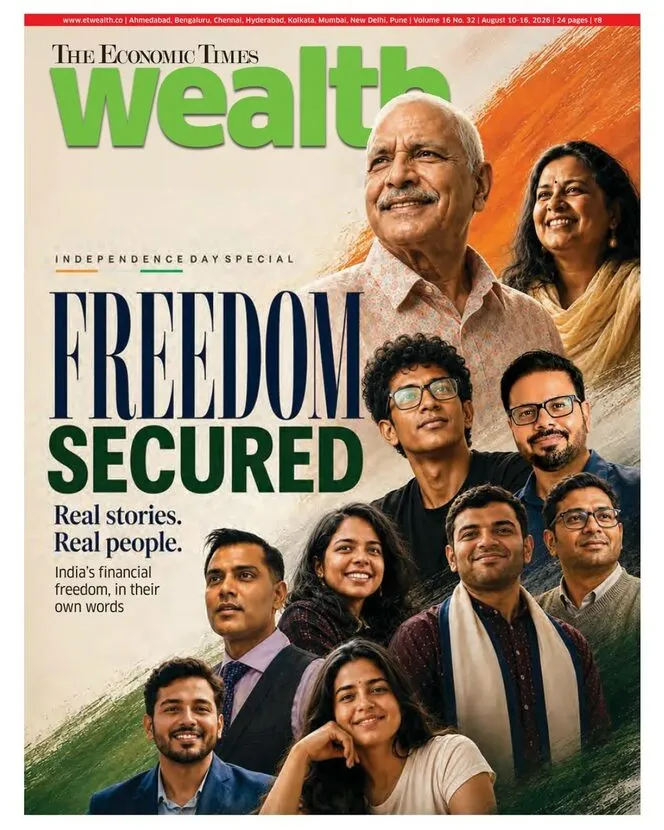
"Gold, LIC, SIPs and crypto — how India learnt to invest" — The Economic Times Wealth 10-16 August 2026 (Volume 16 No. 32) publishes its Independence Day special, profiling seven Indian investors across three generations to reveal how wealth-building has shifted from gold-and-fixed-deposit conservatism to goal-based, product-diverse portfolios. Abhinav Kaul reports (p2).
The cover story (p2) profiles investors from their 20s to their 60s, tracking how each generation approaches risk, asset allocation and financial goals. The early starter (Ravi Nagrani, 42) uses aggressive equity allocation. The careful saver (Pratap Kumar, 67) still prefers fixed deposits and gold. The sandwich generation juggles children's education, parent healthcare and retirement simultaneously. The late bloomer (Navneet Gupta, 39) started investing at 35 and is playing catch-up through SIPs.
Regular sections cover personal finance, investment strategy and goal planning. The issue targets readers at every life stage wanting to benchmark their own approach against real investor stories.
—————
Content Guide
▸ Cover Story / Investment / Retirement / Personal Finance
p2 · Gold, LIC, SIPs and crypto: How India learnt to invest
Abhinav Kaul profiles seven real investors named with their ages, occupations and portfolio breakdowns. The article traces the evolution from 60% gold-and-FD portfolios (the 60+ generation) to 70% equity-and-alternative portfolios (the under-30 generation). Anyone unsure whether their asset allocation matches their age can use the life-stage portfolio benchmarks printed in a sidebar.
p2 — The careful saver
Pratap Kumar, 67, retired teacher with 60% in fixed deposits, 25% in gold, 15% in PPF. The article shows his annual return of 6.2% and calculates what it would have been with 30% equity allocation. Conservative investors should read the simulation that shows how even 20% equity over 10 years would have improved Kumar's retirement corpus.
p2 — The early starter
Ravi Nagrani, 42, IT professional with 70% in equities (direct stocks and mutual funds), 15% in EPF, 10% in real estate, 5% in crypto. His portfolio returned 14.3% annualised over 10 years. Young professionals in their 20s can use Nagrani's SIP-start-age advantage — calculated at INR 1.2 crore additional corpus versus starting at 35 — as motivation to begin today.
p2 — The sandwich generation
A couple in their late 30s balancing school fees, aging-parent medical costs and retirement savings. The article itemises their monthly outflow across all three categories. Anyone in the same position can use the triage framework printed here: which expenses to prioritise and which to defer.
p2 — The late bloomer
Navneet Gupta, 39, started investing at 35 after a decade of not saving. The article shows his catch-up strategy: 50% SIP, 25% PPF, 25% equities, aiming for a 25x-retirement-corpus by age 55. Late starters should calculate their own catch-up ratio using the formula in the article and set their SIP accordingly.
—————
Editor's Take
The Independence Day special concept works because real investor stories are more relatable than generic asset-allocation advice — readers can find themselves in at least one of the seven profiles. The "early starter" vs "late bloomer" comparison, with specific corpus calculations, is the strongest section. The weakness is the absence of a single-woman investor profile in the lineup, which is a demographic gap in an otherwise representative set. This issue is for Indian investors at any life stage who want to benchmark their own plan against real people with similar constraints.
Strengths
• Seven real investor profiles with named occupations and portfolio breakdowns
• Early-starter vs late-bloomer corpus comparison with specific INR figures
• Sandwich-generation triage framework for competing financial priorities
Weaknesses
• No single-woman investor profile in the seven-case lineup
• Crypto allocation coverage is superficial — 5% allocation without risk-warning detail
Verdict: Essential — the most relatable personal-finance cover story ET Wealth has published this year; every reader will see themselves in at least one profile.
