
Mens Fitness UK – July 2026
Summary
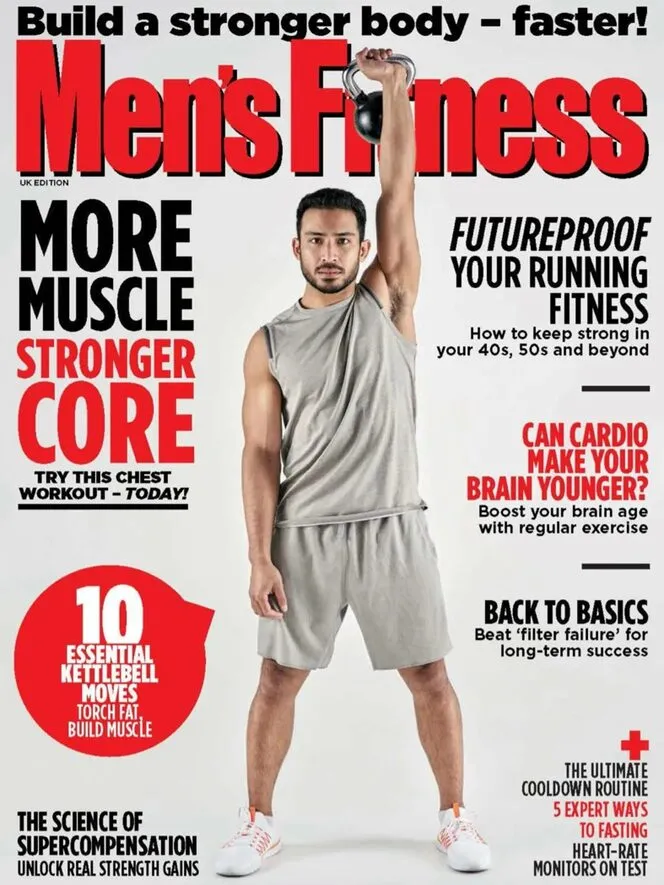
Men's Fitness UK Issue 315, July 2026, bets on running as the anti-ageing anchor: "Futureproof your running fitness" leads a 96-page package that also tackles brain-boosting cardio, heatwave training hacks, the science of supercompensation and 10 essential kettlebell moves — all wrapped around Bradley Rose's story of rebuilding from a stroke at 34.
Cover and issue data verified: Issue 315, July 2026, editor-in-chief David Castle. Cover lines include "Build a stronger body – faster!", "More Muscle / Stronger Core", "10 Essential Kettlebell Moves – Torch Fat, Build Muscle", "The Science of Supercompensation – Block Real Strength Gains", "Futureproof Your Running Fitness", "Can Cardio Make Your Brain Younger?", "Back to Basics", "The Ultimate Cooldown Routine", "5 Expert Ways to Fasting", "Heart-Rate Monitors on Test". Confirmed features: Futureproof Your Running Fitness (p.34), Bradley Rose "The lights just went out" (p.38), Resilience Training with Matt Heason (p.44), Can Cardio Make Your Brain Younger? (p.50), Back to Basics filter failure (p.54). Updates cover Reformer Pilates (p.07), mind-body techniques (p.08), tennis fitness (p.10), eat yourself younger (p.12), heatwave hacks (p.14), obstacle racing (p.16), armwrestling (p.18). Perfect Fit tests Amazfit Cheetah 2 Ultra (p.25) and heart-rate monitors (p.28). Fuel covers watermelon and heart health (p.61), 5 ways to fast while active by Rob Hobson (p.62), and high-fibre meals (p.66). Trainer section covers music and endurance (p.71), supercompensation (p.72), chest workout (p.76), back superset (p.80), kettlebell exercises (p.84), 4-week bodyweight plan (p.90), cool runnings cooldown (p.96).
—————
Content Guide
▸ In Focus
p.34 · Futureproof Your Running Fitness
Running remains one of the best health investments at any age, and this feature explains how to keep doing it into your 40s, 50s and beyond. Specific mobility drills, weekly mileage caps and recovery intervals are calibrated by decade. Switch to a run-walk-run method once you hit 50 — the data shows it preserves joint health without sacrificing endurance.
p.38 · "The Lights Just Went Out"
Bradley Rose survived a life-threatening stroke at 34 and went on to become one of Peloton's most recognisable instructors. He opens up about rebuilding his body from zero, the mental toll of public reinvention, and why setbacks can become your greatest advantage. Watch one of Rose's Peloton classes and note how he cues breathing — that deliberate pacing is a direct product of his post-stroke recovery protocol.
p.44 · Resilience Training: The Art of Assessing Risk
Matt Heason, author of Wild Rock, explains how scrambling builds mental toughness and independent judgement. He grades each route by risk exposure rather than difficulty, arguing that calculated danger sharpens decision-making better than any gym drill. Apply the same risk-grade framework to your next trail run — rate each section 1-5 before you start and review your ratings afterward.
p.50 · Can Cardio Make Your Brain Younger?
New research suggests regular cardiovascular exercise may reverse biomarkers of brain ageing. The article cites specific studies showing hippocampal volume increases in subjects who maintained 150 minutes of moderate cardio per week. You do not need to be an athlete — brisk walking at a pace where conversation becomes difficult hits the required intensity zone.
p.54 · Back to Basics
Information overload is not the problem — filter failure is. The feature cuts through the noise of self-proclaimed experts and provides a decision tree for evaluating any new fitness claim. Apply the "three-source rule": before adopting any new method, find three independent studies or practitioners who agree on the mechanism.
▸ Trainer
p.72 · Is Supercompensation the Training Sweet Spot?
Training harder does not always mean performing better. Understanding supercompensation — the post-recovery performance peak — can help you time sessions for maximum gain. The article maps the stress-recovery-adaptation curve with specific timelines for strength, endurance and power athletes. Schedule your hardest session 48 hours after your last high-volume day, not the morning after.
p.84 · Saved by the Bell
A pick of the best kettlebell exercises for torching fat and building full-body fitness. Each movement is demonstrated with setup cues, rep ranges and common form faults. Start with the two-hand swing only — master the hip hinge before attempting single-arm or snatch variations.
p.90 · Fight Fat & Win
A four-week bodyweight training plan guaranteed to build fitness and lean mass without equipment. Each week progresses in volume and reduces rest intervals. Take a "before" photo and a 1-mile time trial on day one; repeat both on day 28 — the comparison is your progress metric.
▸ Fuel
p.62 · 5 Ways to Fast (When Active)
Nutritionist Rob Hobson explains how to combine intermittent fasting with training without losing muscle or energy. He prescribes specific eating windows, pre-fast meal compositions and refuel protocols for workout days. Break your fast with protein first, carbohydrates second — Hobson's sequencing rule prevents the energy crash that derails most active fasters.
—————
Editor's Take
Issue 315 has the strongest running feature Men's Fitness has published this year. The "Futureproof Your Running" piece (p.34) actually gives decade-specific advice rather than generic "listen to your body" platitudes. The Bradley Rose interview (p.38) earns its length — his stroke-recovery detail is specific enough to be useful, not just inspirational. Weakest part: the heatwave training hacks (p.14) are common sense dressed up as research; "train in the morning" is not a hack. The armwrestling piece (p.18) is fun but takes a slot that could have gone to a second training plan. This issue is for the runner who wants to stay fast past 40 and the lifter curious about supercompensation timing, not for the gym beginner.
Strengths
• Running feature with decade-calibrated mileage and mobility advice
• Bradley Rose interview with specific post-stroke recovery protocols
• Supercompensation explanation with usable training-timing charts
Weaknesses
• Heatwave training tips are obvious ("train earlier, drink water")
• Armwrestling feature is entertaining but low practical takeaway
Verdict: Recommended — Buy it for the running and supercompensation features; skip the front-of-book filler.
