
USA Hockey Magazine – June 2026
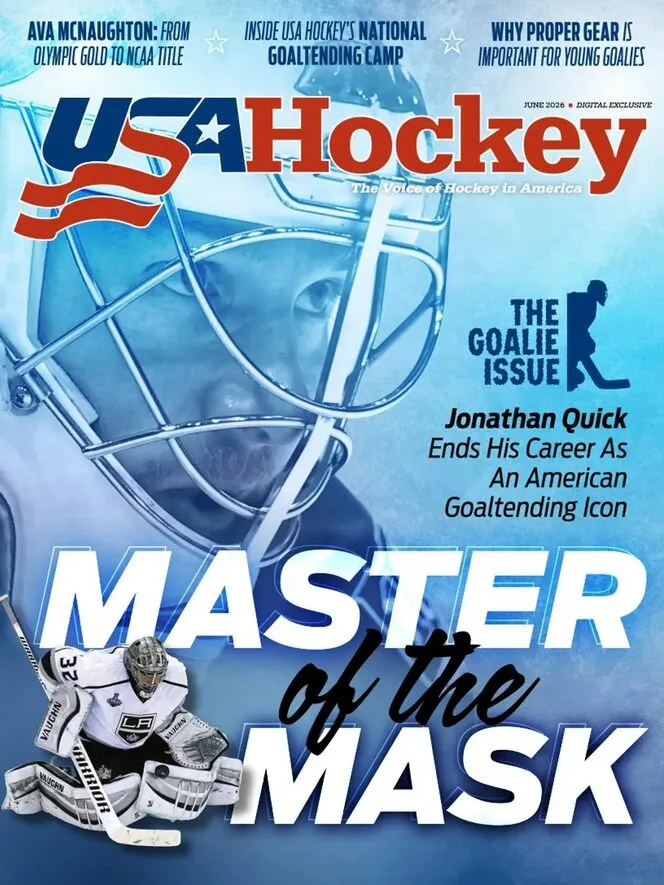
Summary
Vol. 50 No. 5 of USA Hockey Magazine — the June 2026 digital exclusive — is "The Goalie Issue," headlined by Jonathan Quick ending his career as the winningest American-born goaltender in NHL history under the "Master of the Mask" cover story. Quick's retirement feature (p.26) chronicles his career from Connecticut youth hockey through three Stanley Cups, an Olympic silver medal, multiple Jennings Trophies and the all-time wins record for US-born netminders. Produced by Nordstar Media Group in St. Louis Park, MN, the issue also covers Ava McNaughton leading Wisconsin to the 2026 NCAA women's title, the National Goaltending Symposium heading to Boston, and Cole Caufield and Zach Werenski claiming NHL Awards.
The goalie coverage runs deep: "Inside USA Hockey's National Goaltending Development Camp" (p.30) reports on mental-skills training for high-pressure situations. "Why Does My Goalie's Back Hurt So Much?" (p.14) in Ask Dr. Hockey addresses the specific muscular imbalances caused by the butterfly position. "Why Proper Gear and Perspective Matters for Young Goalies" (p.16) in Behind The Glass covers sizing, protection and the psychological pressure parents unwittingly add. The 2026 Goalie Buyer's Guide (p.24) rounds up pads, blockers, catchers, masks and neck guards.
Julia Takatsuka (p.21) is featured for turning Seattle into a goaltending development hub. Joseph Woll of the Philadelphia Flyers is the Rink Rat profile (p.44). Sioux Falls wins the Clark Cup and the USHL announces Western expansion (p.8). The issue is included in USA Hockey's four annual digital-exclusive editions for Allied Members.
—————
Content Guide
▸ Cover Story / Goalie Development / Women's Hockey / NHL Awards / Youth / Buyer's Guide
p.18 · Cool, Calm, Collected and Competitive — Ava McNaughton
McNaughton's season at Wisconsin is reconstructed: her Olympic gold followed by an NCAA championship, the technical adjustments that elevated her game, and her decision to return for another collegiate season rather than turn professional early. She names visualisation as the single practice that differentiates elite goaltending from good goaltending. Apply her pre-game visualisation routine — three minutes of complete-save-sequence mental replay — before your next start.
p.21 · Rising Tides — Julia Takatsuka
Takatsuka's work building Seattle into a goaltending development hub is profiled, covering her coaching methodology, the training facility she established and the number of goalies who have progressed from her programme to NCAA and NHL camps. Her technical focus: "Push first, recover second — most goalies get the order wrong." Correct your push-recovery sequence; the order difference is visible on video and measurable in save percentage.
p.24 · 2026 Goalie Buyer's Guide
A comprehensive guide to new goalie equipment: pads, blockers, catchers, masks, neck guards and chest protectors. Each category includes price range, weight, protection rating and a best-for recommendation. Use the weight and protection rating columns to match gear to your age and competition level; lighter is not always safer.
p.26 · Master of the Mask — Jonathan Quick
Quick's career retrospective covers his Connecticut origins, his draft trajectory, the three Stanley Cups (2012, 2014, 2020), the Olympic silver medal and the all-time US-born wins record. The feature includes quotes from teammates, coaches and opponents about his signature style — the chaotic, athletic scrambles that made conventional positioning coaches cringe. His one consistent technical habit: "I never stop my feet. Stop your feet, stop your career."
p.30 · Inside USA Hockey's National Goaltending Development Camp
A report from the annual goalie camp focused on mental-skills training: visualisation, reset routines, breathing protocols and handling the psychological isolation of the position. The camp director explains that technical instruction is limited at camp — the players arrive technically proficient — so the camp works on "what happens between saves." Build a between-saves reset routine (one breath, one word, one look to the crossbar) before your next game; the routine eliminates the goal that follows a goal.
p.34 · President's Awards Dinner — Honourees
Coverage of USA Hockey's annual President's Awards Dinner, recognising volunteers, coaches and administrators who have contributed to the organisation's mission. The article lists each award recipient, their category and their specific contribution. Use the recipient list to identify potential mentors in your region; volunteer award winners are usually the people most willing to help.
—————
Editor's Take
The "Goalie Issue" is USA Hockey Magazine's best single-theme edition of the year — every feature, from Quick's retirement through the development-camp report to the buyer's guide, serves a clear purpose and audience. The Quick coverage is appropriately reverent without being hagiographic. The National Goaltending Development Camp report is genuinely instructive, not just descriptive. The weakness is the "Ask Dr. Hockey" column on goalie back pain: the information is sound but compressed into a single page when it deserves a feature-length treatment. The Goalie Buyer's Guide is useful for parents but reads like a catalogue. Best for goalies, goalie parents and anyone who appreciates the position's unique psychological demands.
Strengths
• Quick retirement feature is a complete career retrospective
• Goalie development camp report is practically instructive
• Julia Takatsuka profile catches a rising coaching name early
Weaknesses
• Goalie back-pain advice deserves more space
• Buyer's Guide is necessary but commercially driven content
Verdict: Recommended — The only single-issue goalie deep-dive in American hockey publishing; buy for the Quick feature and camp report.
