
The Story of Wrestling – 1st Edition – 9 July 2026
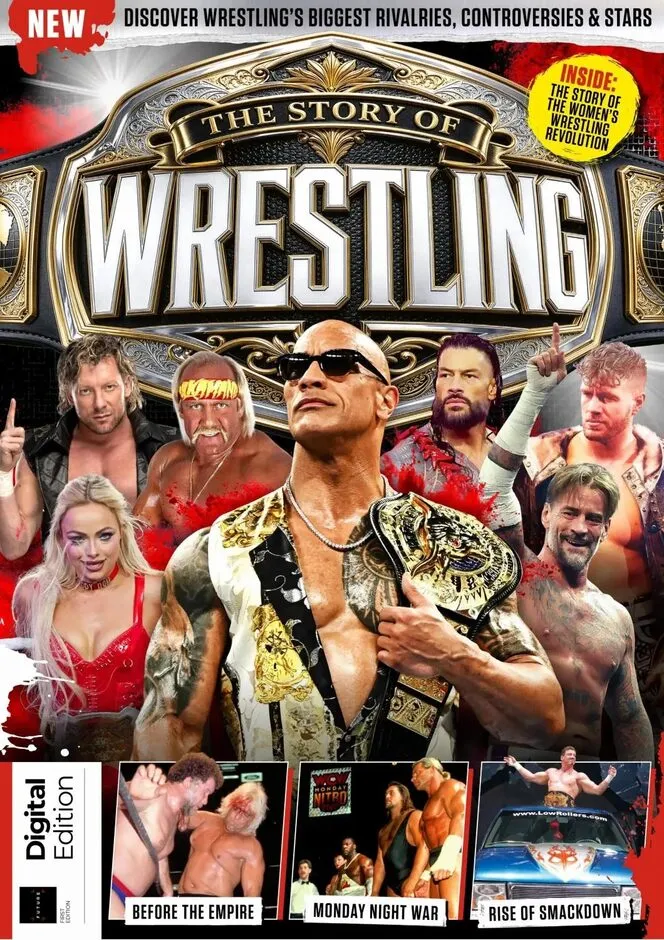
Summary
Jamie Kennedy, writing in the first edition of The Story of Wrestling from 9 July 2026, traces professional wrestling from ancient cave drawings to AEW's modern renaissance across 108 pages. Hulk Hogan, 'Stone Cold' Steve Austin, The Rock and Becky Lynch each get dedicated spotlights, while the women's wrestling revolution and the blood-soaked Attitude Era anchor the narrative arc.
Structured as a chronological journey, the book opens with wrestling's origins in Egyptian and Greek combat, moves through the territory system that built the industry, and hits every major turning point: Vince McMahon's national expansion, the Monday Night War between WWF and WCW, the rise of SmackDown, and ECW's extreme rebellion. Spotlight sections on Hogan, 'Macho Man' Randy Savage, John Cena, Cody Rhodes and Kenny Omega break up the timeline with focused career portraits. Kennedy devotes a full chapter to the women's evolution from sideshow to main event, anchored by Becky Lynch's rise.
Practical reference features include a full contents page with 21 chapter headings and a welcome page that orients first-time readers. The digital edition covers every major scandal, from steroid trials to backstage politics, without flinching. Readers get a compact but thorough single-volume education in why wrestling has held the world hooked since long before television existed.
—————
Content Guide
▸ Origins / Territory Era / Monday Night War
p.06 · A Brief History of Wrestling
Kennedy opens with wrestling in the ancient world — Egyptian cave paintings, Greek Olympic inclusion in 708 BC, and the Roman spectacle framework. He traces Asian traditions including India's Kushti and Japan's sumo, then follows the shift from sport to carnival entertainment. Ends with the Olympic near-removal in 2020 as a modern bookend. Readers finish knowing wrestling's pedigree runs deeper than any piledriver.
p.12 · Before the Empire
How the territory system turned pro wrestling into a nationwide phenomenon before McMahon. Kennedy explains how regional promoters controlled talent, built local heroes, and kept the business profitable for decades. The key takeaway: without territories, there is no foundation for national expansion.
p.30 · WCW: A New World Order
The rise and fall of WWF's biggest rival, from Ted Turner's deep pockets to the nWo angle that briefly beat Raw in ratings. Kennedy charts WCW's creative highs and financial collapse. A cautionary tale about spending without a long-term plan.
p.36 · Monday Night War
The definitive account of the WWF-WCW ratings battle, complete with the key matches, defections and shocking moments that forced both companies to produce their best work. Readers learn why competition, not monopoly, made wrestling great.
▸ Attitude Era / Key Figures
p.46 · Attitude Adjustment
Wrestling's most notorious era dissected: the rise of antiheroes, the edgy content that pushed boundaries, and the cultural moment that made Steve Austin a mainstream star. Kennedy connects the Attitude Era directly to the company's survival.
p.54 · Spotlight: 'Stone Cold' Steve Austin
The man who saved WWE, according to Kennedy, gets a tight profile covering the Austin 3:16 promo, the neck injury that nearly ended him, and his WrestleMania legacy. Readers understand why one promo changed the entire direction of a company.
▸ Women's Revolution
p.82 · Who Run the World?
The true story of the women's wrestling revolution, from lingerie matches to main-eventing WrestleMania. Kennedy traces the shift through the careers of Trish Stratus, Charlotte Flair, Sasha Banks and Becky Lynch. No fluff — just how women forced the company to change.
p.90 · Spotlight: Becky Lynch
The Irish lass-kicker who changed the face of women's wrestling and WWE. Kennedy covers her NXT origins, The Man gimmick, and her mainstream crossover appeal. A blueprint for how character work still matters.
▸ Modern Era
p.100 · New Kid on the Block
How AEW breathed new life into the wrestling ecosystem. Kennedy explains Tony Khan's approach, the importance of All In, and how competition from a second major promotion benefits everyone. Readers get the business case for why AEW matters.
p.108 · Wrestling's Modern Renaissance
Kennedy's closing argument that there has never been a better time to be part of wrestling. Covers the international expansion, streaming accessibility, and the depth of talent across multiple promotions. Puts an optimistic button on the entire history.
—————
Editor's Take
This book does exactly what a first-edition special should do: it picks a clear narrative throughline — from cave drawings to AEW — and never gets bogged down in match-by-match recaps that would bore newcomers. The spotlights on Hogan, Austin, The Rock, Cena, Lynch, Rhodes and Omega give the reader seven distinct entry points depending on which era they care about most, which is smart structuring. The women's wrestling chapter avoids the usual patronising tone and treats the revolution as a business shift, not just a social one. The weakest stretch is the "History of Violence" chapter on blood and brutality, which runs long on gore and short on analysis of why crowds actually wanted it. The book also has zero author bylines beyond Kennedy's name on chapter one, which makes the rest feel anonymous. Best for: a curious sports fan who has never watched wrestling but wants to understand why 50 million people a week used to tune in.
Strengths
• Clean chronological spine across 21 chapters
• Seven focused spotlights break up the timeline
• Women's revolution treated as a business story
Weaknesses
• Only one named author across the entire book
• Violence chapter lacks analytical depth
Verdict: Recommended — A solid one-volume primer for newcomers, though regular fans will find little they haven't read before.
