
California Diving News – June 2026
Summary
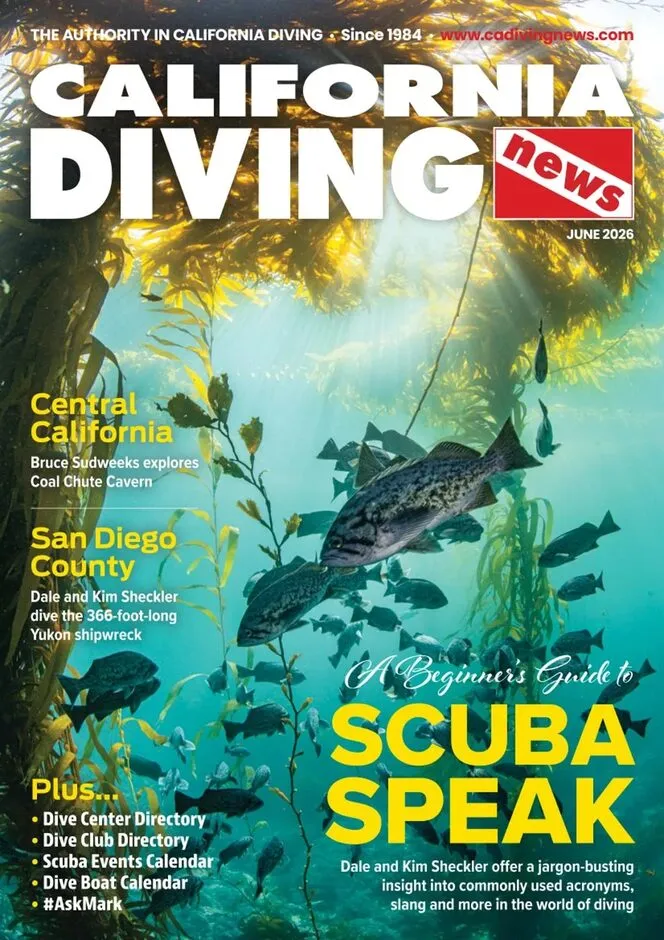
Dale and Kim Sheckler explore the 366-foot-long Canadian destroyer escort Yukon — an artificial reef off San Diego — in California Diving News June 2026, one of two dive spotlights that anchor this 30-page issue. Bruce Sudweeks ventures into Coal Chute Cavern at Point Lobos State Nature Reserve (p20), while a Beginner's Guide to Scuba Speak (p14) decodes the terminology that new divers find most intimidating. The #AskMark column (p30) answers reader questions about drysuit inflation and fin choices.
The San Diego County Dive Spotlight (p10) provides a detailed site description of the Yukon wreck — depth range, current conditions, marine life — alongside practical logistics for shore and boat access. The Central California Dive Spotlight (p20) covers Coal Chute Cavern, a shore-accessible dive site at Point Lobos with surge considerations and light-level warnings for less experienced divers. The News section (p8) reports on the British dive team's discovery of the USCGC Tampa, a World War I wreck, and the ongoing effort to identify and protect submerged historical sites.
The Events Calendar (p24-29) includes dive boat schedules, club meetings, scuba events, a dive centre directory, and a dive club directory — covering the whole of California. The A Beginner's Guide to Scuba Speak (p14) defines common dive terms from "SMB" to "BCD" to "nitrox," with a focus on the acronyms that appear most frequently on dive briefings. #AskMark (p30) tackles three reader questions about drysuit maintenance, the ideal fin for California shore diving, and how often to service a regulator.
—————
Content Guide
▸ Dive Spotlights
p.10 · San Diego County – The Yukon
The 366-foot Canadian destroyer escort Yukon, scuttled as an artificial reef off Mission Beach — depth profile (30-100 feet), marine life seasonality, and the current patterns that determine best visibility. A beginner-friendly wreck route that stays above 60 feet.
p.20 · Central California – Coal Chute Cavern
A shore-accessible dive at Point Lobos State Nature Reserve, with a maximum depth of 45 feet and surge conditions that change with swell direction. The light-level warning at the cavern entrance — bring a primary and backup torch.
▸ Features
p.14 · A Beginner's Guide to Scuba Speak
The most common dive acronyms and terms — SMB, BCD, nitrox, SPG, DIN, yoke — defined with the context in which each is likely to appear on a dive briefing. The term that new divers most frequently confuse with a different meaning.
▸ Regulars
p.8 · News
The British dive team's discovery of the USCGC Tampa, sunk by a German U-boat in 1918, and the implications for World War I wreck preservation off the US East Coast.
p.30 · #AskMark
Three reader questions: how often to service a regulator (annually regardless of use), the best fin type for California shore diving (stiff-blade for surge conditions), and a tip for extending drysuit zipper life.
p.24-29 · Events Calendar & Directories
Dive boat schedule, scuba events calendar, dive centre directory and dive club directory — covering the entire California coast from San Diego to Mendocino.
—————
Editor's Take
California Diving News serves a narrow but dedicated readership, and this June issue delivers exactly what its audience wants: detailed dive site descriptions with practical conditions data. The Yukon wreck article is well-researched, with accurate depth readings and a suggested route that suits intermediate divers. The Coal Chute Cavern piece is stronger — Sudweeks writes from personal experience and includes a sensible safety warning about torch requirements. The Beginner's Guide to Scuba Speak is competent but unnecessary for the magazine's core audience; anyone who needs the BCD acronym explained probably isn't reading California Diving News. The production quality is modest — black-and-white interior, a single colour cover, and limited advertising. The #AskMark column is the weakest section, with answers that are too generic (a Google search would give the same advice). The issue feels thin at 30 pages, and the events directories fill 6 of them.
Strengths
• Yukon wreck article provides accurate depth and route detail
• Coal Chute Cavern piece includes genuine safety insight
• News section covers real industry developments
Weaknesses
• Beginner's Guide is misaligned with the experienced readership
• #AskMark answers are too generic to be useful
Verdict: Selective read — essential for California-based divers planning a trip to the Yukon or Point Lobos, but otherwise a thin and narrowly focused issue.
