
All About History History of Fashion – 2nd Edition – 6 November 2025
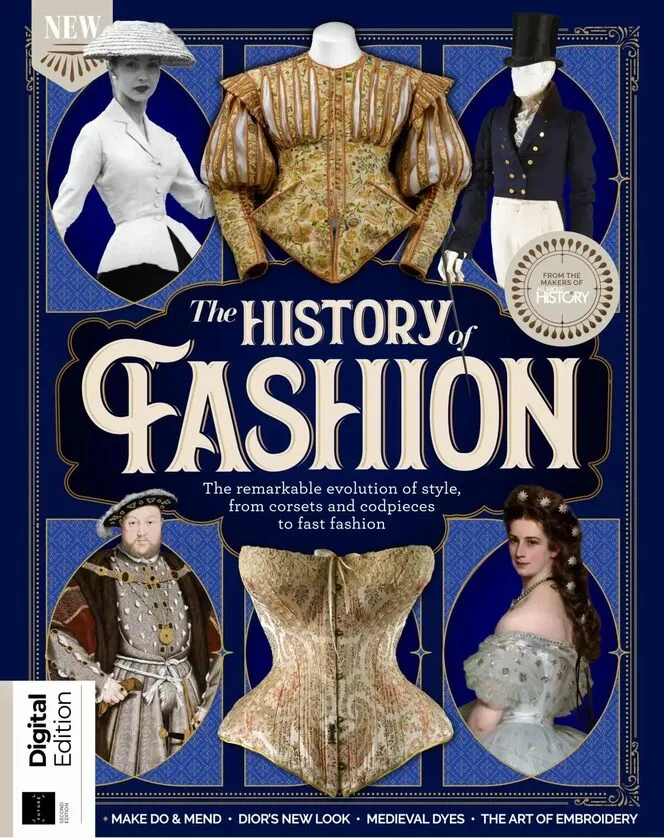
Summary
From Marie Antoinette's extreme makeover to Princess Diana's wedding dress secrets, All About History's History of Fashion 2nd Edition (6 November 2025) traces 500 years of style evolution. Inside, 13 deadliest fashion trends ever, the invention of the suit by Beau Brummell, Coco Chanel's controversial legacy, Dior's New Look post-war revolution, and 20 royal fashion trends from Queen Victoria's white wedding dress to Princess Margaret's cat-eye sunglasses.
—————
This special edition from the makers of All About History magazine traces fashion's remarkable evolution from hand-stitched heirlooms for the ultrarich to the mass-produced fast fashion overflowing from today's wardrobes. The 122-page volume covers 500 years through thematic chapters rather than a strict chronological timeline. Key topics include the Elizabethan ruff (with a DIY sewing guide), the codpiece as masculine statement, Baroque hairstyles from Versailles, 13 of the deadliest fashion trends in history (from lead-based makeup to corset-induced organ damage), the Industrial Revolution's transformation of clothing production, the Triangle Shirtwaist Factory fire of 1911 that changed workplace safety, the Make Do and Mend era of wartime rationing, and the 1960s birth of fast fashion. Royal fashion trends feature 20 examples including Queen Victoria's white wedding dress (1840), Louis XIII's long wigs (1624), Marie Antoinette's pouf hairstyles, Diana's pie-crust collar, and Princess Margaret's cat-eye sunglasses. Fashion icons profiled include Coco Chanel, Christian Dior, Beau Brummell and Elsa Schiaparelli.
—————
Content Guide
▸ Royal Fashion Trends (p.6-11)
20 Royal Fashion Trends That Changed The World
Twenty trends driven by royal influence across five centuries. Queen Victoria's choice of a white wedding dress in 1840 established a tradition that persists today—she also used the occasion to revive Honiton lace craftsmanship in Devon. Louis XIII, balding by his early 20s, adopted long wigs in 1624, transforming a personal insecurity into a century-spanning symbol of social status. Princess Margaret's adoption of cat-eye sunglasses in the 1950s merged Hollywood glamour with royal protocol. Diana's pie-crust collar defined 1980s office wear. Historical insight: royal fashion trends spread not because royals were style innovators but because their images were the most widely circulated—the printing press made Louis XIII's wig famous, not the wig itself.
▸ Historical Fashion (p.12-35)
For The Love Of Codpieces (p.12)
When dresses, tights and frills were markers of masculinity. The codpiece evolved from a practical garment flap into an exaggerated symbol of male virility in 16th-century Europe. Its decline reflected shifting attitudes toward masculine display.
Bigger Is Better: Medieval And Renaissance Silhouettes (p.20)
The evolution of European women's silhouettes from medieval kirtles to Renaissance farthingales, and the engineering required to achieve increasingly extreme shapes. Each expansion of the silhouette corresponded to a shift in idealised femininity.
East Meets West (p.46)
Western fashion did not develop in a vacuum. Centuries of global cultural exchange shaped European dress: Indian cottons, Chinese silks, Ottoman textiles and Japanese kimono construction all influenced what Europeans wore. The feature traces specific techniques and their migration patterns.
▸ Dangerous Fashion (p.52-57)
Drop Dead Gorgeous: 13 Deadliest Fashion Trends
From lead-based face powders that caused neurological damage to mercury-laced hat-making (the original "mad hatter"), corsets that rearranged internal organs, and flammable crinoline skirts that killed thousands of women in the 1860s. The feature balances historical accuracy with the grim satisfaction of knowing that today's uncomfortable shoes are comparatively benign. Risk perspective: every era has fashion that causes harm—the difference is that we now regulate the most dangerous substances, while previous centuries considered personal suffering an acceptable price for beauty.
▸ Industrial Revolution To Modern (p.58-113)
Fashion And The Industrial Revolution (p.58)
The spinning jenny, power loom and sewing machine transformed clothing from a handmade luxury into a manufactured commodity. The mechanisation of textile production created the first ready-to-wear market and laid the foundation for today's fast-fashion economy.
Make Do And Mend (p.102)
World War II clothing rationing forced British women to extend their wardrobes through creativity rather than consumption. The government's "Make Do and Mend" campaign taught garment repair, restyling and repurposing. Relevance today: the skills encouraged by wartime necessity are identical to the skills promoted by contemporary sustainable fashion movements.
Dior's New Look (p.108)
Christian Dior's 1947 "New Look" used 20 yards of fabric per dress in a time of continued rationing, creating controversy and desire simultaneously. The silhouette dominated 1950s fashion and re-established Paris as fashion's capital after wartime disruption.
▸ Fashion Icons (p.86-113)
Coco Chanel: Courting Controversy (p.96)
Chanel's extraordinary rise and disputed legacy. The feature covers her design innovations (the little black dress, jersey fabric for womenswear, Chanel No. 5) alongside her documented collaboration with Nazi intelligence during World War II. Balanced assessment: Chanel's design contributions are undeniable; her moral choices are not.
The Great Masculine Renunciation: Beau Brummell (p.72)
How Beau Brummell invented the modern suit in Regency England, shifting men's fashion from decorative to restrained. His philosophy—understatement as the highest form of elegance—still governs menswear today. The suit's fundamental design has not changed in 200 years.
▸ Underwear History (p.122)
What Lies Beneath
From "wearing nothing" to drawers, corsets and men's linen underwear, the hidden history of what goes under clothing. The feature tracks how underwear evolved from invisible necessity to outerwear statement, with each generation reinventing what "beneath" means.
▸ Practical Features
How To Sew An Elizabethan Ruff (p.18)
Step-by-step guide to creating a Tudor-style ruff, including materials list, measurements and stitching techniques.
How To Get A Baroque Hairstyle (p.44)
Historical hairstyling guide for achieving Versailles-level height and ornamentation, from padding techniques to decorative additions.
—————
Editor's Take
All About History's History of Fashion 2nd Edition is the most intellectually satisfying publication in the entire knowledge base because it has a clear editorial thesis: fashion is a material record of human civilisation, from its most glorious expressions to its deadliest mistakes. The "13 Deadliest Fashion Trends" chapter is the standout—it balances scholarly research with grim narrative appeal, covering lead makeup, mercury hat-making, flammable crinoline skirts and corset-induced organ damage without sensationalism. The 20 Royal Fashion Trends section delivers exactly what the cover promises, with specific examples (Queen Victoria's Honiton lace revival, Louis XIII's wig, Diana's pie-crust collar) rather than generic royal style commentary. Weaknesses: the DIY guides (ruff, Baroque hairstyle) are charming but unlikely to be attempted by any reader. The fast-fashion chapter ends too abruptly—after building a compelling case for how we arrived at disposable clothing, it stops without suggesting what comes next. For any reader who wants to understand why we wear what we wear, this is the most rewarding publication in the collection.
Strengths
• "13 Deadliest Fashion Trends" chapter balances scholarship with narrative appeal
• 20 Royal Fashion Trends uses specific, well-sourced examples
• Broad chronological scope without sacrificing depth on key topics
Weaknesses
• DIY crafting guides are charming but low-utility
• Fast-fashion chapter lacks a forward-looking conclusion
Verdict: Essential — The most intellectually rewarding publication in the collection; buy it for the deadliest trends and royal fashion chapters.
