
All About History History of the Occult – 8th Edition – 20 August 2026
Summary
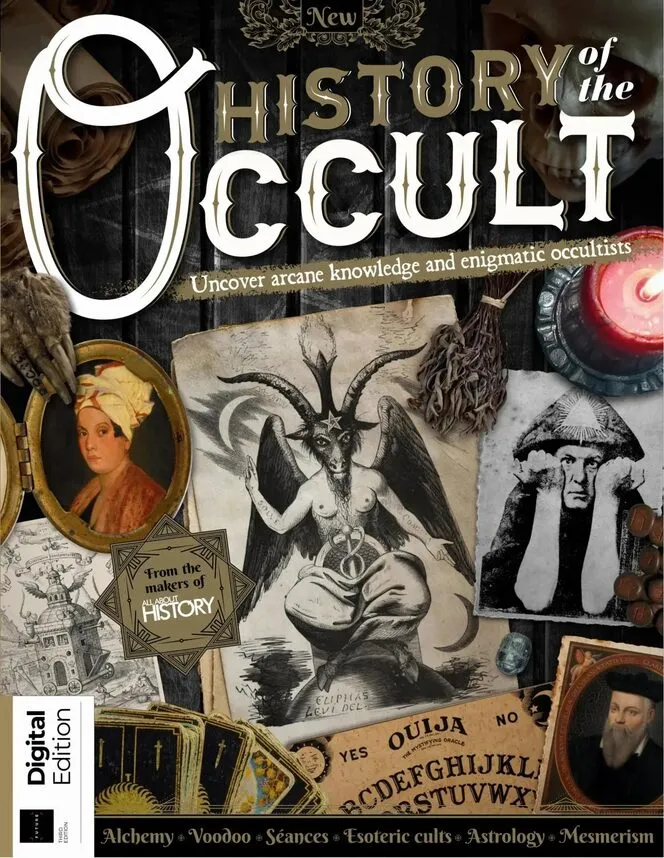
Hermes Trismegistus, John Dee, Aleister Crowley, and Rasputin anchor All About History's History of the Occult 8th Edition, 20 August 2026, tracing esoteric knowledge from Thoth to Wicca across 124 pages. The edition covers alchemy, Kabbalah, astrology, tarot, Mesmerism, Voodoo, and the founding of Gardnerian Wicca.
The volume opens with Thoth, magic, and the Hellenistic fusion that created Hermes Trismegistus (p.6). The Knights Templar betrayal (p.14) is examined for its occult connections, followed by Renaissance magic (p.22), Kabbalah (p.28), and Paracelsus (p.32). Astrology (p.36) and Nostradamus (p.38) lead into John Dee's Enochian magic (p.42) and the secrets of the alchemists (p.46). Enlightenment and occultism (p.52) covers the transition from religious to rationalist esotericism. The Rosicrucian movement (p.64) and Mesmerism (p.68) bridge to the occult revival of the 19th century (p.82).
Later chapters cover Louisiana Voodoo and Marie Laveau (p.76), tarot (p.80), demonology (p.88), Eliphas Levi (p.90), Rasputin (p.94), Aleister Crowley's magickal life (p.104), seances (p.112), Hitler's occult influences (p.114), and Gerald Gardner's Wicca (p.124). Each chapter includes period illustrations, manuscript reproductions, and symbol explanations.
—————
Content Guide
▸ Ancient & Renaissance Occult
p.6 · Thoth, magic, and Hermes Trismegistus
The Egyptian god Thoth is traced through Hellenistic syncretism into Hermes Trismegistus, the legendary author of the Hermetic Corpus. The article reproduces the Emerald Tablet text with its "as above, so below" formula. The Latin translation by Marsilio Ficino in 1471 sparked Renaissance occultism across Europe.
p.42 · John Dee
Elizabeth I's court astrologer and mathematician is documented through his 1582-1587 scrying sessions with Edward Kelley, which produced the Enochian language. The article reproduces pages from Dee's "48 Claves Angelicae" manuscript. The Enochian grammar tables show a constructed language with its own syntax, not random glossolalia.
p.46 · Secrets of the alchemists
Alchemy is presented as a spiritual practice with laboratory applications, not failed chemistry. The article reproduces the woodcut from the 1617 Mutus Liber showing the stages of the Great Work. The colour-change sequence — nigredo to albedo to rubedo — corresponds to Jungian individuation stages.
▸ 19th Century Revival
p.76 · Marie Laveau
The Voodoo Queen of New Orleans is documented through 19th-century newspaper accounts and WPA interviews with her descendants. The article separates her historical influence as a community leader from the sensationalised legends. The Gris-Gris recipe reproduced from period sources shows the blend of Catholic and West African elements.
p.82 · The occult revival
The 19th-century explosion of occult societies — the Hermetic Order of the Golden Dawn, the Theosophical Society, the Rosicrucians — is traced through founding documents and membership lists. The article reproduces the Golden Dawn's Neophyte initiation ritual. W B Yeats and Arthur Conan Doyle were both members.
p.104 · The magickal life of Aleister Crowley
Crowley's career from Cambridge to Cefalu to the Abbey of Thelema is documented through his diaries, arrest records, and published works including The Book of the Law. The article reproduces the Stélé of Revealing and the Thelemic calendar. The biographical timeline shows that Crowley's "wickedest man" reputation was largely self-manufactured.
▸ Modern Occult
p.114 · Hitler and the occult
The Nazi regime's relationship with occultism — the Thule Society, Himmler's Ahnenerbe research unit, the 1935-36 expedition to Tibet — is documented through SS records and post-war debriefings. The article concludes that Hitler used occult imagery for propaganda but was not personally committed to esoteric beliefs. The Ahnenerbe expedition photographs show the gap between mystical claims and actual scientific output.
p.124 · Gardner's genesis of Wicca
Gerald Gardner's 1954 publication Witchcraft Today is presented as the founding text of modern Wicca. The article reproduces Gardner's Book of Shadows excerpts, showing his synthesis of folk magic, Crowleyan ritual, and Masonic structure. The lineage chart traces contemporary Wiccan traditions back to Gardner's Bricket Wood coven.
—————
Editor's Take
All About History's History of the Occult 8th Edition covers an enormous range but sacrifices depth for breadth. The John Dee and Marie Laveau chapters benefit from period manuscript reproductions. Weakest parts: the "Hitler and the occult" chapter perpetuates the idea that Nazism was driven by occult forces, a thesis most historians reject. The Wicca chapter is too brief to do Gardner's synthesis justice at 4 pages. This edition suits the curious beginner who wants a survey before committing to any single occult tradition.
Strengths
• John Dee's Enochian manuscript pages reproduced with grammar analysis
• Marie Laveau documented through primary newspaper accounts
• Golden Dawn initiation ritual text from original sources
Weaknesses
• Hitler-occult chapter overstates Nazi esoteric commitment
• Wicca chapter too compressed for the subject's complexity
Verdict: Selective read — Adequate survey for beginners, shallow for specialists.
