
All About History – Issue 173 2026
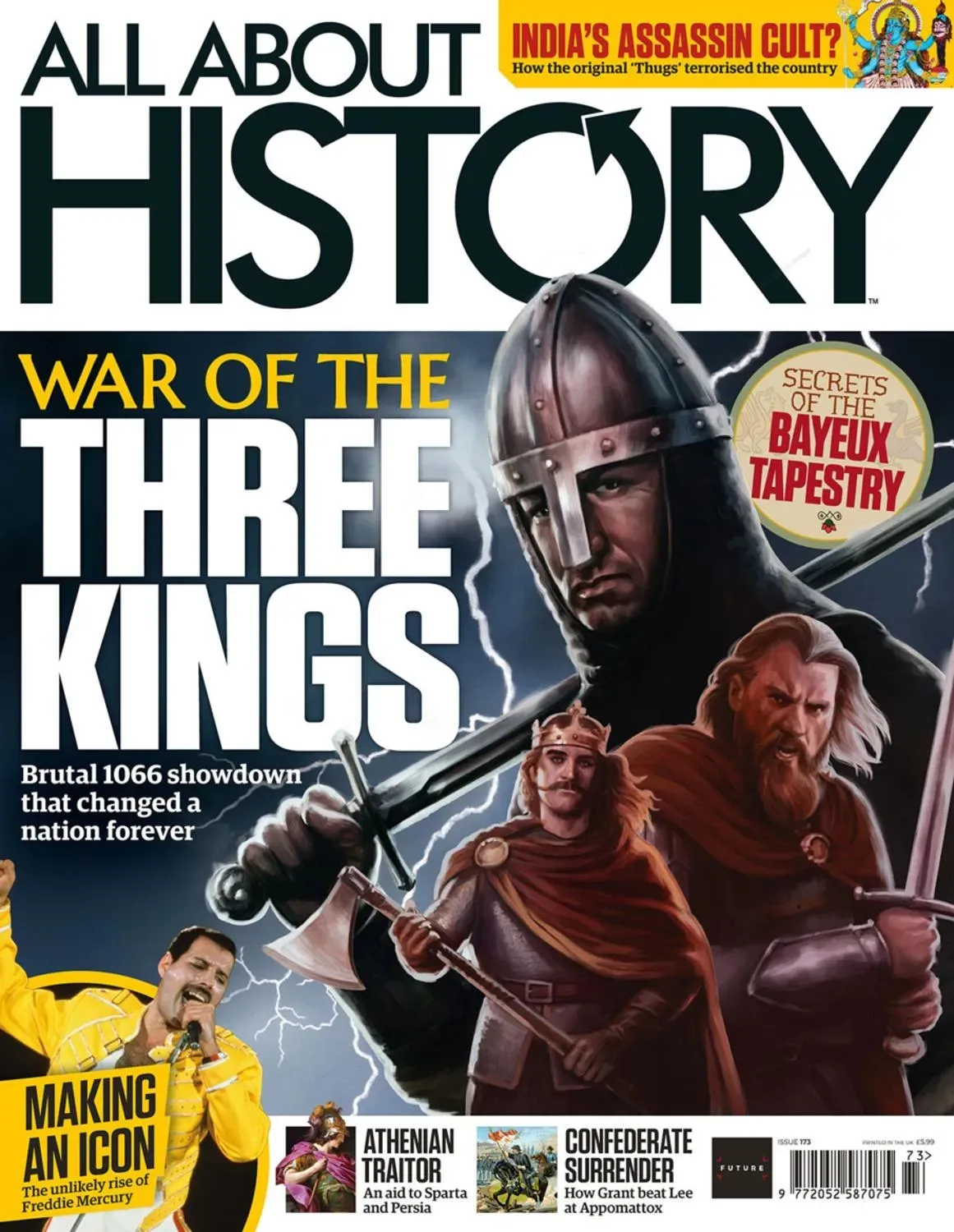
Summary
The 1066 War of the Three Kings and the secrets of the Bayeux Tapestry lead All About History Issue 173, 2026, alongside Freddie Mercury's rise, the Athenian flip-flopper Alcibiades, and Charles II's forgotten fleet. Editor Jonathan Gordon assembles six features, nine regulars, and a Q&A with Viking scholar Levi Roach across 82 pages.
The cover feature "War of the Three Kings" (p.26) follows Harold Godwinson, Harald Hardrada, and William of Normandy through the battles of Fulford, Stamford Bridge, and Hastings that reshaped England in a single month. "Secrets of the Bayeux Tapestry" (p.36) has experts dissect the artefact's material construction and propaganda intent. "Freddie Mercury: Making a Rock Icon" (p.42) traces his life from Zanzibar to Live Aid. "Charles II's Forgotten Fleet" (p.48) examines how the Popish Plot nearly sank the Royal Navy's expansion. "Were the 'Thugs' Really a Killer Cult?" (p.52) separates British colonial propaganda from historical reality. "The Rise and Fall of Alcibiades" (p.58) profiles the Athenian general who switched sides three times during the Peloponnesian War.
The All About… section profiles Norman history from Rollo to Roger I of Sicily, with places to explore across European Norman churches. Regulars include Defining Moments, Greatest Battles on Appomattox, What If Carthage had defeated Rome, Reviews, History Vs Hollywood on Nuremberg, and a beet stroganoff recipe.
—————
Content Guide
▸ Cover Story
p.26 · War of the Three Kings
The 1066 campaign is reconstructed week by week from Harold's coronation in January through the battles of Fulford Gate (20 September), Stamford Bridge (25 September), and Hastings (14 October). The article reproduces the Bayeux Tapestry scene of Halley's Comet, which the English interpreted as an omen. The three-battle timeline proves that Harold's march from York to Sussex — 190 miles in 5 days — was the era's most remarkable military feat.
▸ Features
p.36 · Secrets of the Bayeux Tapestry
Material analysis of the 70-metre linen embroidery — wool yarn dyed with woad and madder, laid thread technique, and the 58 scenes — reveals its construction in Canterbury rather than Bayeux. The article identifies the three missing final scenes from the 18th-century drawings by Bernard de Montfaucon. The missing panels are assumed to have shown William's coronation.
p.42 · Freddie Mercury: Making a Rock Icon
Farrokh Bulsara's journey from Zanzibar to Live Aid is documented through boarding-school records, the Smile band formation at Imperial College, and the 1985 Live Aid performance that redefined stadium showmanship. The article reproduces the Queen setlist from Live Aid. The 21-minute set — six songs — was the shortest of any major band that day but is consistently ranked the greatest live performance in rock history.
p.52 · Were the 'Thugs' Really a Killer Cult?
British colonial accounts of the Thuggee cult — estimating 2 million murders — are examined against Indian judicial records. The article concludes that the British constructed a unified "cult" narrative from disparate bandit groups to justify the 1830s Thuggee suppression campaign. The conviction records show that 95 percent of those executed under anti-Thuggee laws were convicted on the testimony of approvers granted immunity.
▸ History Vs Hollywood
p.81 · Is Nuremberg guilty of tampering with the evidence?
The 2000 film Nuremberg is assessed for historical accuracy against the 1945-1946 trial transcripts. The article concludes that the film compresses the 10-month trial into 3 hours, merging defendants and omitting the acquittals of Schacht, Fritzsche, and von Papen. The verdict-count table shows that 3 of 22 defendants were acquitted — a fact the film entirely suppresses.
▸ Regulars
p.64 · Greatest Battles: Appomattox
The 9 April 1865 Confederate surrender at Appomattox Court House is reconstructed through Grant's and Lee's correspondence. The article reproduces Grant's terms of surrender — officers kept their sidearms, soldiers kept their horses for spring planting. The parole pass reproduced on page 67 was the only identification surrendering Confederates carried home.
p.70 · What If Carthage had defeated Rome?
The counterfactual imagines Hannibal receiving reinforcements after Cannae in 216 BC, taking Rome, and Carthage becoming the dominant Mediterranean power. The scenario projects Punic language survival, no Roman road network, and a fragmented Italian peninsula. The linguistic map shows how Latin would have been a regional dialect rather than a global language root.
p.82 · Recipe: Beet stroganoff
A vegetarian adaptation of the classic Russian dish using roasted beetroot, smoked paprika, and soured cream, with a preparation time of 40 minutes. The recipe specifies beetroot roasted at 200°C for 30 minutes before combining with the sauce base.
—————
Editor's Take
All About History Issue 173 delivers its best cover feature of the year — the three-king timeline is genuinely useful for anyone teaching 1066. The Thuggee debunking is the second-strongest piece, offering a post-colonial corrective that most history magazines avoid. Weakest parts: the Freddie Mercury feature is a rehash of available biographies with no new research. The beet stroganoff recipe has no connection to the issue's history theme and reads as space-filling. This issue suits the secondary-school history teacher planning a 1066 lesson.
Strengths
• 1066 three-battle timeline with Harold's 190-mile march
• Thuggee cult myth debunked with conviction statistics
• Nuremberg film accuracy check with acquittal data
Weaknesses
• Freddie Mercury piece adds nothing to existing biographies
• Beet stroganoff recipe irrelevant to history theme
Verdict: Recommended — Buy for the 1066 and Thuggee features; skip the filler.
