
All About History Weird History of the Victorians – 2nd Edition – May 2026
Summary
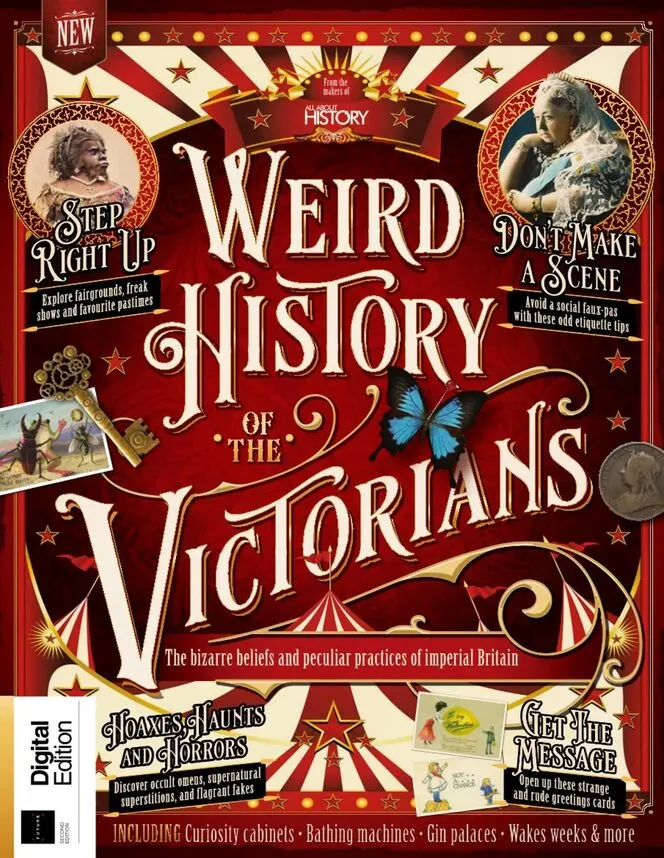
Vinegar valentines, baby farmers, and the golden age of taxidermy fill 128 pages of All About History's Weird History of the Victorians 2nd Edition, May 2026. Jack Griffiths opens by arguing that Victorian Britain was far stranger than its reputation for propriety suggests — from Scheele's green arsenic wallpaper dye to Spring-Heeled Jack leaping across London rooftops.
The book organises 22 chapters across three sections: Society and Culture, Religion and Belief, and Industry and Convention. "Freaky Fascinations" (p.14) documents the Victorian craze for collecting exotic specimens, from taxidermy curios to human remains displayed in travelling shows. "A Sour Note: Vinegar Valentines" (p.22) reproduces actual 19th-century insult cards — the opposite of romantic greeting cards. "Baby Farmers" (p.36) exposes the network of informal child-takers who charged desperate families for care that rarely materialised. "Conspicuous Consumption" (p.52) traces how Victorian romanticism idealised tuberculosis symptoms as a beauty standard. "Muscular Christianity" (p.68) examines the movement that fused evangelical faith with organised sports. "Scheele's Green: The Dye of Death" (p.110) tells the story of the arsenic-laced wallpaper pigment that poisoned entire households.
Industry chapters cover the Crystal Palace exhibitions, Victorian forensics in the Whitechapel murder investigations, and the Everlasting Staircase penal treadmill. The occult section traces the Victorian fascination with seances and spirit photography.
—————
Content Guide
▸ Society & Culture
p.14 · Freaky Fascinations
The Victorian obsession with collecting oddities — from preserved two-headed lambs to ethnographic artefacts — is traced through travelling freak shows, private museums, and the Royal College of Surgeons' Hunterian collection. The article includes a poster gallery of original sideshow advertisements. Show the poster of "The What Is It?" to illustrate how race and disability were marketed as spectacle.
p.22 · A Sour Note: Vinegar Valentines
Actual 19th-century insult Valentines are reproduced in full colour, showing the cruel caricatures and rhyming taunts sent instead of love notes. These cards cost half a penny and were sold openly. The social context section explains why they were especially popular among housemaids and apprentices.
p.36 · Baby Farmers
The informal child-taking network that operated in Victorian cities is documented through police reports and court transcripts. Women advertised as "childminders" would take infants for a one-time fee, with predictable outcomes. The feature includes the 1870 Infant Life Protection Act response timeline.
p.52 · Conspicuous Consumption
Victorian literature and fashion romanticised the pale complexion, flushed cheeks, and translucent skin of tuberculosis patients. The article reproduces period advertisements for corsets designed to achieve the "consumptive look." Show the corset ads to any student who thinks body-image pressure is a modern phenomenon.
▸ Religion & Belief
p.76 · Spring-Heeled Jack
The urban legend of a fire-breathing, metal-clawed figure who leapt over 10-foot walls in Victorian London is traced through police reports and penny-dreadful accounts from 1837 to 1904. The article maps the known sightings across Lambeth and Liverpool. Use the map to demonstrate how newspaper circulation amplified a local rumour into a national panic.
p.90 · The Occult Revival
Victorian occultists including Helena Blavatsky and the Hermetic Order of the Golden Dawn are profiled, with their claimed sources in ancient Egyptian and Kabbalistic traditions. The feature reproduces a Golden Dawn initiation diagram. The diagram's zodiac correspondences are still used in contemporary ceremonial magic.
▸ Industry & Convention
p.110 · Scheele's Green: The Dye of Death
The arsenic-laced copper arsenite pigment used in Victorian wallpaper, clothing, and artificial flowers poisoned through direct contact and off-gassing. The article reproduces 1860s wallpaper patterns that were later found to contain lethal arsenic levels. Check the date on any antique wallpaper in period rooms before handling.
p.120 · CSI Whitechapel: Victorian Forensics
The Jack the Ripper investigation forced the development of crime-scene photography, footprint casting, and witness timeline reconstruction. The article reproduces the original autopsy sketches and the witness map of Dorset Street. The map shows how police still relied on witness memory rather than forensic evidence.
p.128 · The Everlasting Staircase
The penal treadmill — a 24-step revolving cylinder that prisoners climbed for up to 10 hours a day — is documented through prison records and reformer accounts. The feature includes the 1865 Prison Act specifications. The machine generated no power; its sole purpose was exhaustion.
—————
Editor's Take
All About History's Weird History of the Victorians 2nd Edition delivers genuine depth across 22 chapters without feeling like a textbook. The Vinegar Valentines and Scheele's Green pieces are genuinely surprising even for Victorian-history readers. Weakest parts: the Temperance Towns and Model Villages chapter is too short to do its subject justice, and the Crystal Palace entry reads like a Wikipedia summary. This edition suits the general-interest history reader and the GCSE-level student gathering primary-source material for Victorian coursework.
Strengths
• Reproduced insult Valentines and sideshow poster gallery
• Scheele's Green arsenic chemistry with period wallpaper samples
• Spring-Heeled Jack sighting map across 1837-1904 London
Weaknesses
• Temperance Towns entry too compressed for the subject
• Crystal Palace chapter reads as a summary
Verdict: Recommended — Original source material makes this more than a reprint.
