
Ancient History Magazine – Issue 61 2026
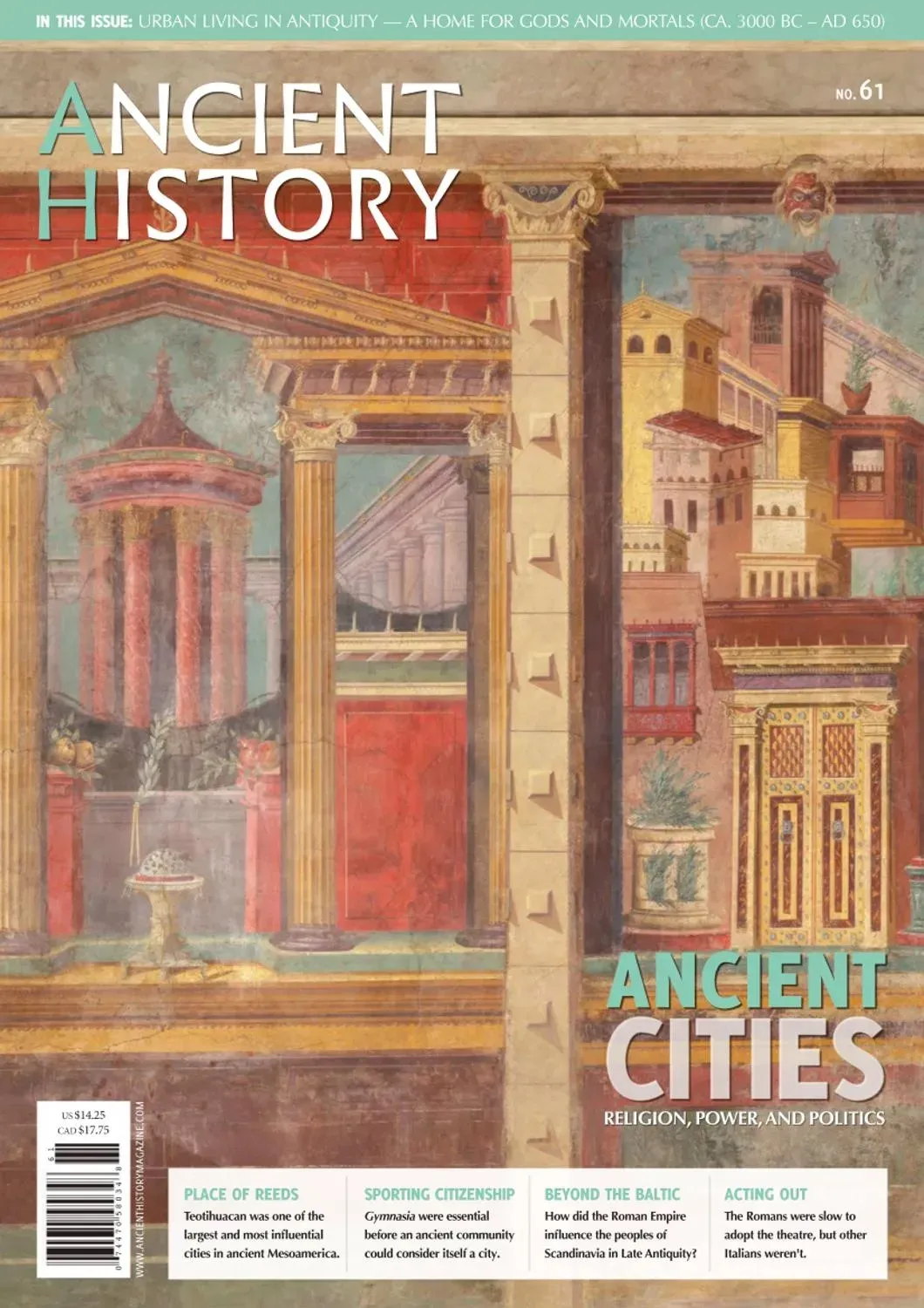
Summary
A Boscoreale villa fresco of an imaginary city-scape opens Ancient History Magazine Issue 61, themed "Urban Living in Antiquity — A Home for Gods and Mortals (ca. 3000 BC – AD 650)." Inside, the Subara suburb challenges the Rome-centred narrative, Teotihuacan emerges as a Mesoamerican immigrant city, and the Baltic Sea's late-antique ties to Rome are mapped through amber and weapon sacrifices.
Jasper Oorthuys and Owain Williams assemble eight features on ancient cities as religious, political, and social hubs. "Divine neighbours" (p.18) examines Mesopotamian city religion through temple-economy records from Ur and Lagash. "The Subara" (p.22) repositions Rome's working-class suburb as a vibrant community rather than a slum, using recent excavations at Ostia Antica. "The poleis in Mesoamerica" (p.26) argues that Teotihuacan and Monte Alban functioned as immigrant city-states with identity-based neighbourhoods. "Lahun" (p.34) reconstructs the pyramid-builders' planned city under Senusret II. "A mark of civic identity" (p.38) argues gymnasia were mandatory infrastructure before a Greek settlement could claim city status.
Special features include "Italic entertainment" (p.8) on whether Roman theatre was an Italian native tradition rather than a Greek import, "Integrated not isolated" (p.14) tracing Spartan-Laconian exchange networks, and "Property of the conquerors" (p.48) on andrapodismos — the enslavement of entire captured populations in Greek warfare. News editor Lindsay Powell's Preliminaries (p.4) covers a Roman library discovered in a Spanish villa and a colourful mural at Armenia's Erebuni Fortress.
—————
Content Guide
▸ Theme: Ancient City Living
p.18 · Divine neighbours
The city-religion feature draws on temple-economy tablets from Ur and Lagash to show how Mesopotamian gods were literal property owners whose temples operated as banks, granaries, and courts. The article maps the sacred precinct of Ningirsu against the private housing quarters. Use the temple-district overlay when teaching the economic role of religion in early urban societies.
p.22 · The Subara
Recent excavations at Ostia Antica reshape the Subara — Rome's working-class district across the Tiber — from a poverty stereotype into a community with its own markets, baths, and guild halls. The artefact distribution map shows imported pottery at nearly every excavated unit, proving integration with Mediterranean trade. The Subara challenges any simplistic patrician-plebeian divide in your next Roman-history discussion.
p.26 · The poleis in Mesoamerica
Teotihuacan's neighbourhoods, organised by migrant identity groups from Oaxaca and the Gulf Coast, formed a city of 125,000 where ethnicity determined district. The article compares this to Monte Alban's hilltop acropolis and the Maya city-states' plaza-centred layouts. The population-density chart puts Teotihuacan level with contemporary Rome — a useful comparison for countering the "New World urban exception" narrative.
p.34 · Lahun
Senusret II's pyramid town at Lahun was a planned company city built for workers constructing the royal tomb, complete with grid streets, standardized housing, and administrative blocks. The excavation plan reveals separate quarters for skilled artisans and unskilled labourers. The worker-grave analysis shows nutritional stress across both classes — a reminder that even planned cities had inequality built in.
p.38 · A mark of civic identity
Gymnasia were not optional in Greek cities — a settlement without one could not claim polis status. The article traces the architectural spread from Athens' Lyceum to Ai Khanoum in Afghanistan, arguing that the gymnasium was the institution that defined citizenship itself. The distribution map of 200 known gymnasium sites shows how the institution followed Alexander's army.
▸ Special Features
p.8 · Italic entertainment: Was Roman theatre Roman?
The evidence from pre-Roman Etruscan and Oscan performance spaces — wooden stages at Monte San Nicola and stone theatres at Pietrabbondante — suggests Italians were staging plays before Greek models arrived. The architectural comparison drawings show native Italian stage design diverging from Greek orchestras. The argument shifts the origin debate from "borrowed from Greece" to "parallel development."
p.14 · Integrated not isolated: Spartan and Laconian exchanges
Contrary to the militaristic isolation stereotype, Laconian pottery and bronzework reached Etruria, Cyrene, and the Black Sea colonies throughout the Archaic period. The distribution map of Laconian kylikes across 30 Mediterranean sites disproves the closed-economy model. A concise reference for the next "Sparta was a hermit state" claim.
p.48 · Property of the conquerors
Andrapodismos — the enslavement of an entire city's population — was a standard Greek warfare tool, not a Persian or Roman import. The article documents cases from Melos (416 BC) to Thebes (335 BC), with the legal formulae inscribed on contemporary stelae. The casualty-and-slavery ratio table shows that andrapodismos was more common than mass execution.
▸ Departments
p.56 · Book reviews
Reviews cover new titles on Roman water management, Carthaginian colonisation, and the archaeology of early medieval pilgrimage. Each review includes the publisher, ISBN, and price in euros and dollars. The Roman water-management title is the pick of the batch for field practitioners.
—————
Editor's Take
Ancient History Issue 61 delivers a genuinely coherent theme issue — rare for a magazine that usually mixes disparate topics. The Subara piece and the andrapodismos survey offer fresh arguments on under-covered subjects. Weakest parts: the Lahun feature, while competent, covers ground already well treated in standard Egyptology textbooks. The gymnasia article is thorough but reads more like a literature review than a narrative. This issue suits the classical-history student who needs ready-made arguments for seminars on urbanism.
Strengths
• Subara revisionist archaeology with Ostia excavation data
• Andrapodismos legal and statistical analysis across Greek warfare
• Mesoamerican city-state comparison with Rome population parity
Weaknesses
• Lahun repeats standard pyramid-town narrative
• Gymnasia feature reads as academic lit review
Verdict: Recommended — Best thematic issue of the year for urban-history readers.
