
Animaltalk Magazine – All About Cats 2025
Summary
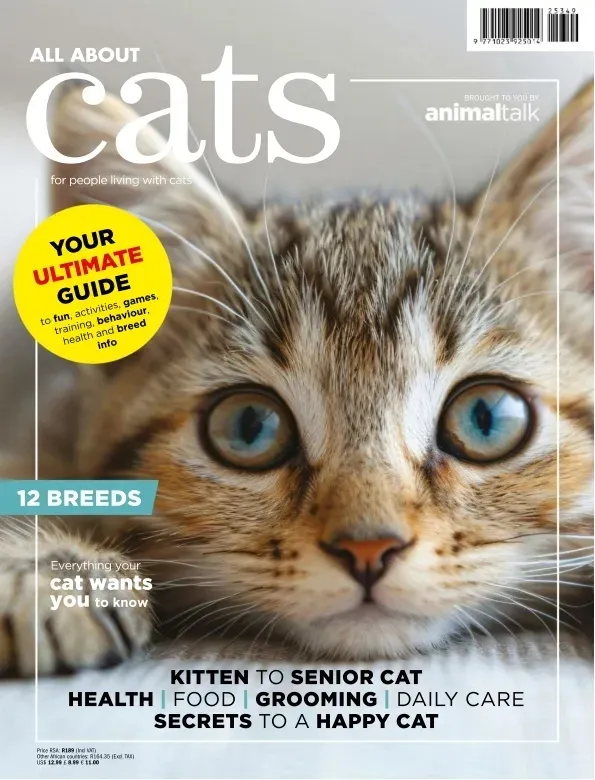
Animaltalk's All About Cats 2025 bookazine (Volume 2) stacks 12 breed profiles — from the water-obsessed Bengal to the chatterbox Oriental — a 5-step plan for introducing a new cat to resident pets, and 16 debunked cat myths into one South African cat care guide that runs all the way to a glossary on page 97.
This Volume 2 cat special from Animaltalk, Panorama Media Corp's South African bookazine stable, runs the full arc of cat ownership: deciding whether to get a cat at all, bringing her home, and keeping her healthy from kitten to senior. Editor Mientjie Kleinhans opens with 'Our world with cats', and the issue then moves through 30-odd themed sections — costs, litterboxes, insurance, sterilisation, grooming, behaviour and training — each cross-referenced to related pages so beginners can navigate without getting lost.
The health block is the most practical part. A symptom checklist tells owners exactly when to skip Dr Google and drive to the vet (not eating for a day, white gums, loss of balance), and an eight-point prevention plan covers vaccinations from six weeks, deworming every three months, neutering around four months and check-ups every 6-12 months. Grooming gets its own toolkit: five brush types matched to coat length, plus nail-clipping guidance that stops at the pink quick.
Behaviour coverage leans fun: 17 cat behaviours 'translated', 10 ways to earn a purr, catnip's nepetalactone explained, and a 16-myth demolition that kills off garlic deworming and the nine-lives legend. The 12-breed portfolio (Bengal to Siamese) gives weight, lifespan, origin and breed-specific health flags, while leash training is broken into 10 steps. It is aimed squarely at first-time and prospective cat owners rather than experienced fanciers.
—————
Content Guide
▸ Cover Feature
p.80 · All Shapes and Sizes
Twelve breeds get the fast-facts treatment — weight, lifespan, country of origin — followed by personality, looks and health. The Bengal (3.6-6.8kg, USA) is flagged as water-obsessed and prone to flat-chested kitten syndrome and patellar luxation; the Oriental is a talkative fetch-player from England; the adventure-driven Abyssinian carries a progressive retinal atrophy risk; the chirpy Birman from Myanmar suits seniors. Each profile closes with breed-specific health notes. Use it to build a shortlist, and ask any breeder whether the parents were health-screened before you pay a deposit.
▸ Cat Care Basics
p.12 · Should I Get A Cat?
A pre-admission honesty test. The article tallies costs beyond the purchase or shelter fee — monthly food, litter and parasite prevention, plus insurance against emergency surgery — and notes vet bills keep rising with the cost of living. It also quantifies the workload: litterbox solids removed daily with a full wash every two weeks, at least an hour of attention per day, and twice-daily feeding with bowls washed after every meal. A QR code links to a readiness quiz. Run these numbers before you fall for the kitten photos.
p.16 · Nice To Meet You
A step-by-step introduction protocol for resident dogs and cats. The new cat starts in her own equipped room; you feed both pets on opposite sides of the door and gradually move the bowls together. Next comes exchanging bedding smells, swapping territories, then crate-to-crate meetings before a supervised neutral-room release. The article warns that cats can take up to a year to settle, and lists sociable multi-cat breeds from Abyssinian to Tonkinese. If aggression appears, drop back a step rather than forcing contact.
p.22 · Happy Cat, Happy Owner
The daily-care checklist: nutrition, water, bedding, toys, identification, grooming and a scratching post. Concrete rules stand out — keep the water bowl away from the food bowl because wild cats separate the two, skip all dairy since most cats are lactose intolerant, and microchip rather than rely on a collar tag cats will remove. Cats sleep 12-16 hours a day and prefer cave-like beds in quiet spots. To sell a new scratching post, rub catnip on it and relocate it until your cat approves.
▸ Health & Grooming
p.28 · Happy and Healthy
The issue's medical backbone. It lists the signs that mean an immediate vet visit — not using the litterbox, not eating for a day or more, white gums, breathing problems, sudden weight loss — and notes cats instinctively hide illness until it is serious. A body-condition scale from emaciated to obese teaches home weight checks, and the eight prevention pillars cover vaccination from six weeks, deworming every three months, year-round parasite control, neutering around four months and vet checks every 6-12 months. Bookmark the emergency list.
p.38 · Not Another Hairball!
Sets a hard number: fewer than one hairball per week is normal, and anything more warrants a vet consult. Hairballs are tubular, not round, and longhaired cats suffer most. The warning signs of a stuck hairball include loss of appetite, dry hacking cough, constipation or diarrhoea, hair entwined with faeces and lethargy. The article distinguishes normal regurgitation from distress, and a cat who seems to be choking needs help fast. Start counting hairballs this week to establish your cat's baseline.
p.44 · Spa Day
A buying guide to the five brushes: the slicker brush with thin curved teeth for medium-to-long coats and mat prevention, the mitt brush that feels like petting and suits all coats, the dual-sided pin-and-bristle brush for short-to-medium fur, plus the Furminator and a shedding comb. A double-coat explainer shows why mats form at skin level and must never be cut out. For nails, clip only the white tip — nicking the pink quick bleeds and hurts, so let the vet demonstrate first.
▸ Understanding Your Cat
p.52 · Purrfectly Content
Explains the mechanism — cats purr by twitching larynx muscles during inhalation and exhalation, releasing endorphins — and the reasons, which are not all happiness: healing, stress-coping, attention-seeking and even end-of-life calm. The frequencies cited (25-50 vibrations per second) match the range at which human muscles heal, and cat ownership is linked to a 40% reduction in owner heart-attack likelihood. Ten practical tips follow, from favourite treats and soft-voiced talking to catnip. Treat sudden purring in a sick cat as a signal, not comfort.
p.54 · Speaking Cat
Seventeen behaviours translated with tongue in cheek: rubbing against you means ownership, dead-animal gifts are dinner presentations, kneading is a 'massage' with claws as acupuncture, and a serious bite with nails out means you crossed a boundary. A captioned photo spread decodes body language from Interested and Relaxed through Worried and Anxious to Terrified, plus tail and ear signals for play, caution and hunting focus. Learn the early 'worried' and 'cautious' postures so you can back off before the bite.
p.58 · Debunking 16 Cat Myths
Sixteen myths killed with facts. Cats usually but not always land on their feet — too close to the ground, the righting reflex fails; cow's milk causes diarrhoea because cats cannot digest other species' milk; all chocolate is toxic thanks to theobromine; cats are crepuscular, not nocturnal, peaking at dusk and dawn; and garlic does not deworm — it can cause anaemia, so buy a proper vet treatment instead. The nine-lives myth is traced to Egyptian lore and Tom and Jerry cartoons. Check which ones you still believe.
p.62 · Wonder Herb
A catnip primer with a gardening angle. Nepetalactone mimics feline pheromones and triggers the happy receptors, but most cats only respond from about six months old — and not all cats respond at all. Growing advice is South Africa-specific: plant Nepeta cataria in a large, low container or garden corner, 30-45cm apart, and let plants establish before the cat gets access. Overindulgence causes vomiting or diarrhoea, though overdose is impossible. Humans can brew the leaves as a calming tea while the cat rolls.
▸ Features & Fun
p.10 · Cat Fascination
The history feature traces Felis catus to the Near Eastern wildcat, citing a 9,500-year-old human-and-cat burial in Cyprus and DNA work by Carlos Driscoll and Stephen O'Brien. Cats essentially self-domesticated around Fertile Crescent grain stores, were worshipped via Bastet in Egypt by 2000 BCE, persecuted in medieval Europe, and revered in Ottoman Istanbul — a tradition visible in Türkiye's café cats today. The piece ends at Grumpy Cat and Nala. Read it to understand why your housecat still stalks the living room like a granary hunter.
p.88 · Let's Go Walkies
Leash training in 10 steps, honestly labelled as one of the hardest cues to teach. Buy a comfortable harness and lightweight leash, leave them near her sleeping spot to absorb scent, and fit the harness so two fingers slide underneath. Reward with treats immediately after harnessing, keep early sessions short, follow rather than drag, and progress from indoors to quiet outdoor spaces only when she is ready. The younger the cat, the easier it goes — and if she refuses entirely, the article says to accept that leash walking is not for every cat.
—————
Editor's Take
Animaltalk All About Cats works as a beginner's manual, not a magazine you read for pleasure. The strongest material is procedural: the five-step cat-to-cat introduction protocol, the emergency symptom list and the eight-pillar health plan are things a new owner can act on tonight, and the 12-breed portfolio is unusually honest about hereditary problems like Bengal flat-chested kitten syndrome and Abyssinian progressive retinal atrophy. The weakest stretch is behaviour, where purring and body-language facts are recycled across three separate articles and jokey pieces like Speaking Cat pad pages without adding much. Sloppy proofreading shows — the 'Good to Rember' box header is misspelled twice in print. If you are adopting your first cat, buy it; if you have kept cats for a decade, read the breed pages and move on.
Strengths
• Actionable protocols throughout: 5-step introductions, 8-pillar health plan, 10-step leash training
• Breed profiles flag real hereditary health issues, not just looks
• Emergency symptom list tells owners exactly when to call the vet
Weaknesses
• Purring and body-language content repeats across three separate articles
• Humour-driven behaviour pieces sit where specific training advice is needed
Verdict: Recommended — First-time cat owners get genuinely actionable protocols; experienced owners only need the breed pages.
