
Archaeology – September-October 2026
Summary
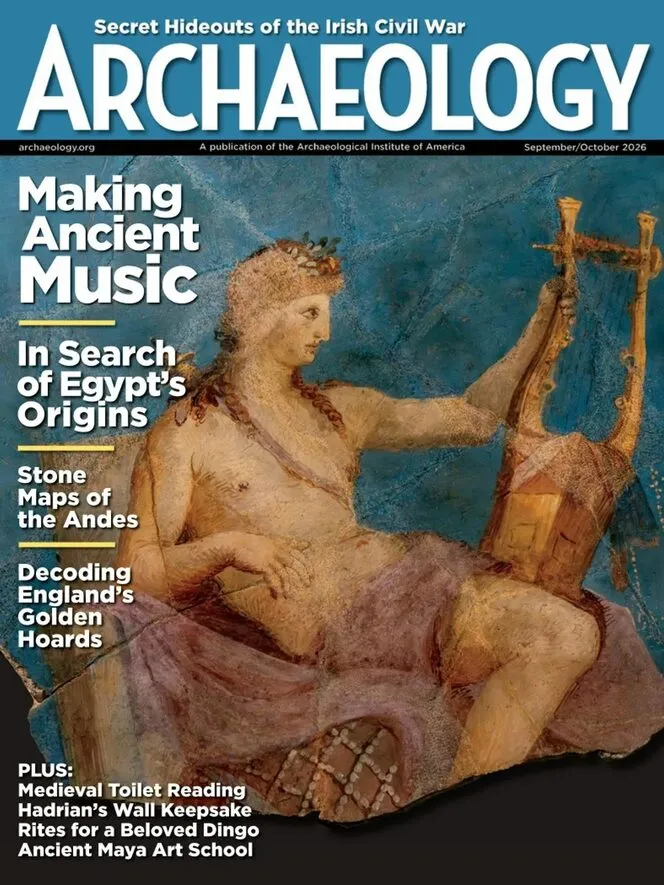
A Roman fresco of Apollo with his cithara leads Archaeology September/October 2026 into a feature on reconstructing ancient music, while Irish Civil War survivors left their story in a mountain hideout rediscovered on the Cork-Kerry border. Hoards of gold and silver neck rings buried on an English hill mark a dramatic social shift, and Greece's Antikythera wreck finally yields its full narrative after 2,000 years under the Aegean.
The Editors' "The Music of Time" (p.24) recovers the sounds of antiquity through reconstructed instruments — a Roman water organ, Greek auloi, and Sumerian lyres — with acoustic archaeology data from excavated performance spaces. Daniel Weiss reports from England's Wraxall parish (p.32), where a hoard of 37 gold and silver neck rings signals a 1st-century BC power transition. Eric A. Powell travels to Peru's Chincana highlands (p.36) to document carved stone fields that pre-Inca farmers used as three-dimensional land-management maps. Andrew Curry traces the pre-dynastic origins of Egypt (p.42) at Hierakonpolis and Abydos, pushing the date of organised state formation earlier than the First Dynasty. Jarrett A. Lobell (p.50) compiles the latest Antikythera wreck dives, including the skeletal remains and the astronomical calculator's missing gear fragments.
Departments include Digs & Discoveries on a medieval falcon menagerie and Hadrian's Wall souvenir cup, Off the Grid at Belize's Xunantunich, and a Letter from Ireland by Jason Urbanus on an IRA Civil War hideout.
—————
Content Guide
▸ Features
p.24 · The Music of Time
The Editors survey acoustic archaeology from a reconstructed Roman water organ in Hungary to Sumerian bull lyres in Ur, matching excavated instruments against performance spaces measured for resonance. The feature includes a QR-linked audio sample of a Greek aulos played in a reconstructed Athenian odeion. Play the audio track before a museum visit — it changes how you read the iconography on painted pottery.
p.32 · A Change in Fashion
Daniel Weiss examines 37 gold and silver neck rings buried at a single site in Wraxall, Somerset, arguing that the hoard represents a competitive display of status during the late Iron Age transition from chieftain rule to Roman client kingship. The metallurgical analysis shows silver sourced from two distinct regions. Compare the ring types against the Torrs pony-cap in the National Museum of Scotland for a regional distribution pattern.
p.36 · Cultivating Fields of Stone
Eric A. Powell documents the carved stone fields of Peru's Chincana region, where pre-Inca farmers built three-dimensional rock maps encoding water flow, planting zones, and seasonal rotation schedules. The fields are still legible after 800 years. The site plan overlay shows how modern farmers could revive the irrigation logic for drought-prone Andean valleys today.
p.42 · Where Was Ancient Egypt Born?
Andrew Curry follows excavations at Hierakonpolis and Abydos that push state formation back centuries before the First Dynasty. Elite cemeteries, brewery complexes, and a proto-hieroglyphic标签 point to organised kingship emerging by 3400 BC. The timeline graphic aligns the Naqada phases with known tomb U-j artefacts. Use the pull-out chronology when teaching the transition from Predynastic to Early Dynastic.
p.50 · 2,000 Years Under the Sea
Jarrett A. Lobell synthesises the latest Antikythera wreck dives, including human skeletal remains that DNA analysis traces to the eastern Aegean and a missing gear fragment from the Antikythera mechanism. The corrosion-layer CT scans reveal inscriptions not read since the 1st century BC. The site map marks precisely where each major artefact group was recovered.
▸ Departments
p.11 · Digs & Discoveries
Short reports include a medieval falcon menagerie identified in the UAE, Scandinavian foot carvings at a Viking trading site, a dingo burial in pre-colonial Australia, and a souvenir cup depicting Hadrian's Wall. Each story runs under 300 words with a location map. The Hadrian's Wall cup is the strongest conversation piece — show it to anyone who thinks souvenirs are a modern invention.
p.20 · Off the Grid: Xunantunich, Belize
A practical visitor guide to the Maya site of Xunantunich, including bus routes from San Ignacio, entry fees in local currency, and the best morning light for photographing El Castillo before the tour buses arrive.
p.55 · Letter from Ireland: A War Between Friends
Jason Urbanus traces IRA volunteers who survived the Irish Civil War by hiding in a secret mountain shelter on the Cork-Kerry border, recently rediscovered by local historians. The hideout's surviving possessions — a tea tin, a rifle bolt, a copy of "The Tailor and Ansty" — paint a portrait of daily survival. The coordinates are published for the first time; the site is now on the county heritage walk.
—————
Editor's Take
Archaeology September/October 2026 delivers its best spread of original field reporting in recent issues. The Antikythera update and the Irish Civil War hideout piece are both genuinely new material you will not find aggregated elsewhere. The Music of Time feature is ambitious but over-reliant on QR-linked audio gimmicks that feel dated on paper. Weakest part: the Wraxall neck-ring piece, though well sourced, dedicates six pages to what is essentially a single-hoard analysis with limited comparative data. This issue suits the field archaeologist and the serious museum-goer who wants context before exhibitions.
Strengths
• Antikythera wreck DNA and gear-fragment discoveries
• Irish Civil War hideout with first-published coordinates
• Pre-dynastic Egypt timeline pushing state formation earlier
Weaknesses
• Wraxall hoard piece padded across 6 pages
• Music feature relies on QR audio gimmicks
Verdict: Recommended — Strong original fieldwork, skip the gimmicky extras.
