
Business English Magazine – January 2026
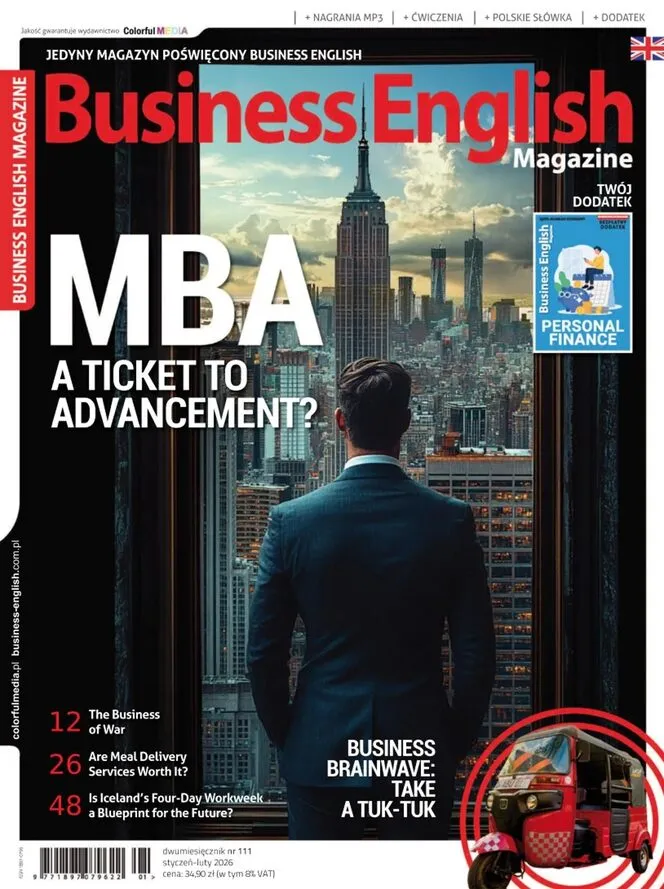
Summary
MBA — a ticket to advancement or an overpriced credential? Paul Martin investigates that question in the cover story of Business English Magazine's January 2026 issue, a bilingual (English-Polish) learning resource published by Colorful MEDIA. The issue also examines the USD 600 billion global chip race in "Hokkaido Valley," the business of war, meal-delivery economics and Iceland's four-day workweek experiment.
The cover feature at P38 weighs the ROI of a Master of Business Administration for Polish professionals, with vocabulary support for intermediate-to-advanced English learners. "Hokkaido Valley" (P08) reports on Japan's USD 65 billion push to build a semiconductor powerhouse in Hokkaido, where Rapidus — backed by Toyota, Sony and the Japanese government — aims to produce 2-nanometre chips by 2027. "The Business of War" (P12) uses SIPRI data to explain the USD 138 billion global arms trade. Other articles cover Ghana as a frontier market, new translation tools from Apple and Google, and a profile of futurist Jonathan Brill. The issue includes a downloadable Personal Finance supplement and audio MP3 exercises.
—————
Content Guide
▸ Cover Story / Business Skills
P38 · MBA — A Ticket to Advancement?
Paul Martin weighs the Master of Business Administration as a career accelerator in the Polish context. He asks whether the three-letter credential still delivers higher salaries and international mobility in 2026. Any professional considering an EMBA should read the "differentiator" argument before signing a tuition cheque.
▸ Industry / Geopolitics
P08 · Hokkaido Valley
Japan is spending tens of billions to turn a dairy-and-powder-snow region into a semiconductor superpower. Rapidus, the government-backed chip venture, targets 2nm production by 2027. The piece explains why water supply and earthquake stability make Hokkaido the chosen site. Supply-chain managers in electronics should monitor whether Rapidus hits its three-times-faster custom-chip timeline.
P12 · The Business of War
An overview of the global arms trade using SIPRI's 2024 data: at least USD 138 billion in known transfers, with Ukraine now producing 200,000 drones per month, up from 20,000 in early 2024. The piece connects defence spending to procurement cycles that procurement officers in adjacent industries should watch.
▸ Economics / Lifestyle
P26 · Are Meal Delivery Services Worth It?
A cost-benefit breakdown of meal-kit and prepared-meal subscriptions against supermarket shopping. The analysis accounts for time, waste and nutrition — not just price-per-serving.
P48 · Is Iceland's Four-Day Workweek a Blueprint for the Future?
A business profile examining Iceland's shorter-workweek trials and whether the model transfers to larger, more complex economies. HR leaders piloting flexible-work policies should compare the productivity data cited here with their own pilot results.
▸ Technology / Travel
Incredible New Translation Tools Have Arrived — But Will They Get Lost in Translation?
Michael Gaylord tests Apple's and Google's latest translation tools, wearing Ray-Ban smart glasses, to assess accuracy, latency and cultural nuance loss. International business teams should use his findings to set realistic expectations before deploying these tools in client-facing settings.
Business Brainwave: Take a Tuk-tuk
A travel-business crossover piece on tuk-tuks as a logistics and tourism vehicle in developing markets.
Ghana: West Africa's Dynamic Gateway Nation
An investment-environment profile covering Ghana's gold sector, cocoa processing, renewable energy potential and the bureaucratic realities — business registration is straightforward, but licences take 2-8 weeks and environmental clearance can stretch to 4-6 months.
▸ Language Learning / Regulars
Business Dialogues: When the Numbers Don't Add Up
A business-English dialogue exercise focused on financial disagreement scenarios, with key phrases for negotiations.
The Brilliant Jonathan Brill
A profile of futurist Jonathan Brill, who studied industrial design at Pratt and executive training at Stanford GSB before working as a research consultant at the MIT Media Lab.
Influential People / Book & Film Reviews
Closing section profiling notable business figures and reviewing recent business-related books and films.
—————
Editor's Take
This is the most honest business English magazine on the market — it does not pretend to be The Economist, and its value proposition is clarity for Polish learners who need real business content. The cover story on MBAs is genuinely useful (it answers the question rather than dodging it), and the Hokkaido Valley piece is well-reported for a B2-C1 reading level. The weakness is structural: the vocabulary glosses and Polish translations take up roughly half the page space, which slows down anyone who already reads business English fluently. The downloadable Personal Finance supplement and MP3 audio are smart additions. Best for intermediate English learners in central Europe who want to improve their business vocabulary without boring textbook exercises.
Strengths
• MBA cover story delivers a real answer, not filler
• Hokkaido Valley piece is current and well-sourced
• MP3 audio and download supplement add genuine learning value
Weaknesses
• Polish glosses crowd the page for fluent readers
• No cover price visible in the edition
Verdict: Selective read — Buy for the MBA analysis and chip-industry piece if you are a B2-C1 English learner; fluent readers will find the gloss-heavy layout frustrating.
