
Business Today – 26 April 2026
Summary
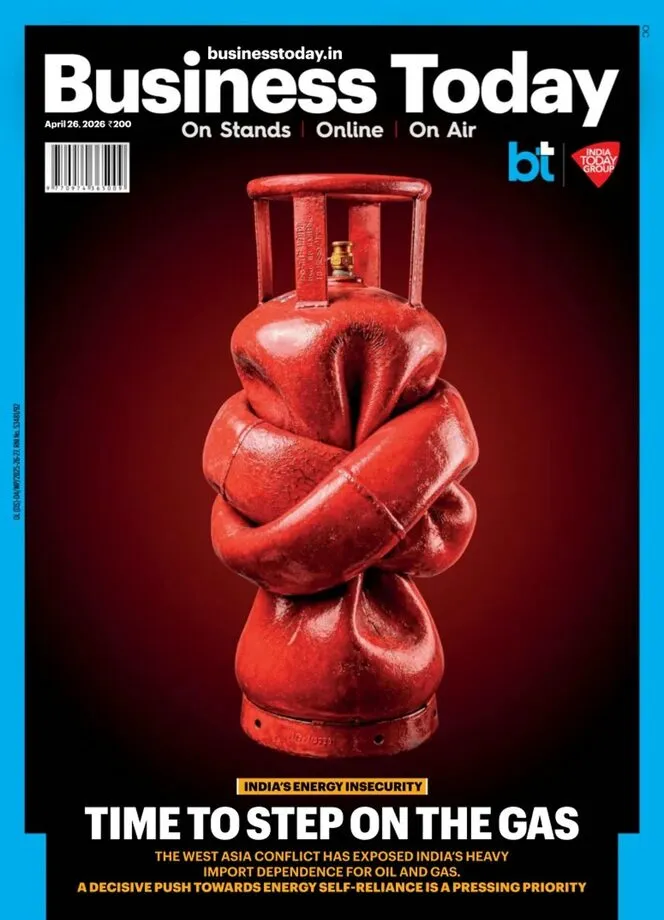
Indian investors lost billions when the West Asia war triggered a 9.4 percent Nifty 50 correction — Business Today's April 26, 2026 issue (Vol 35 No 9) leads with the cover story "India's Energy Insecurity" and asks whether the country's crude import dependency has become a strategic liability. HARMAN CEO Christian Sobottka explains why the automotive industry is becoming more like tech, and Manoj Kohli argues for energy sovereignty. The issue tracks how the market sell-off erased 18 lakh crore in investor wealth within six weeks.
The cover story maps India's 85 percent oil import dependence against a backdrop of Hormuz blockade risks and refinery capacity constraints. A start-up analysis reveals how much cash runway India's 100 most-funded companies actually have left. The pharma sector gets attention as semaglutide patents expire in India and prices drop sharply.
Regular sections include The Point, BT Interview, Policy, Banking, Start-ups, and The Good Life lifestyle section.
—————
Content Guide
▸ Cover Story / Energy & Geopolitics
p.16 · India's Energy Insecurity
India imports 85 percent of its crude oil, and the West Asia conflict has pushed the import bill to an annualised 185 billion dollars. The article calculates that every 10-dollar rise in crude prices widens the current account deficit by 0.4 percent of GDP. Strategic reserve capacity stands at 13 days compared to the IEA-mandated 90 days. Energy procurement managers can use the CAD sensitivity data in their board-level risk presentations.
▸ Interview / Technology
p.10 · Automotive Industry is Becoming More Like Tech
HARMAN CEO Christian Sobottka outlines the company's India roadmap: a new R&D centre in Bengaluru hiring 2,000 engineers focused on software-defined vehicles and AI cockpit systems. He states that India is now HARMAN's second-largest talent base after the US. Product strategists in automotive tech can benchmark their India R&D investments against Sobottka's hiring numbers.
▸ Markets / Economy
p.6 · Shredding Wealth
Since the West Asia conflict escalated, Indian stock markets lost 18 lakh crore in market capitalisation. Foreign portfolio investors pulled out 2.3 billion dollars in March alone. The piece breaks down which sectors were hit hardest — oil and gas down 18 percent, IT down 12 percent, pharma relatively flat. Portfolio managers should review their sector beta against this drawdown pattern.
▸ Policy / Agriculture
p.28 · Shattered Dreams
India's plan to replace 50 percent of chemical fertilisers with nano-fertilisers by 2030 is stalling. Field trials across 5 states show yield drops of 8-12 percent in wheat and rice when nano-urea replaces conventional urea entirely. The government has scaled back the rollout target. Agri-input companies can use the trial data to adjust their product R&D pipelines.
▸ Start-ups / Venture Capital
p.38 · Outlasting The Slowdown
BT analysed the balance sheets of India's 100 most-funded start-ups and found that 34 have less than 12 months of cash runway at current burn rates. The analysis names the sectors with the tightest runways: edtech and food delivery. Venture investors can use the runway data as a starting point for portfolio triage.
▸ Pharma
p.52 · Weight Loss Utopia
Semaglutide prices in India dropped from 3,500 rupees per month to under 1,000 rupees within weeks of patent expiry. The article reports that 4 Indian manufacturers have launched generic versions, and monthly prescriptions have jumped 300 percent. Healthcare investors tracking the GLP-1 opportunity should note the pricing elasticity data.
▸ Banking
p.46 · Banking On Mistry
HDFC Bank Interim Chairman Keki Mistry faces questions about board transparency raised by former SEBI member Atanu Chakraborty. The article tracks the governance timeline since the HDFC-HDFC Bank merger and lists the unresolved compliance issues. Governance analysts can use the timeline to compare board responsiveness across India's top private banks.
▸ Lifestyle / Business Travel
p.74 · Polar Express
A new wave of Indian explorers is trading tropical getaways for Antarctic and Arctic expeditions. The article reports that Indian bookings for polar cruises grew 140 percent year-on-year, led by affluent professionals aged 35-45. Luxury travel operators can use this demographic data to tailor expedition packages.
—————
Editor's Take
The energy security cover story is the most consequential piece BT has published this year — it connects a military conflict to a hard national balance-sheet number (185 billion dollars) and gives procurement teams a framework for scenario planning. The start-up cash-runway analysis is the kind of proprietary data work that separates business magazines from daily news. HARMAN's Sobottka interview is a solid tech-industry addition. The nano-fertiliser policy piece is a well-reported alert for anyone in agri-inputs. Weakest section is The Good Life, which runs too long for a compressed issue — two pages on polar cruises could have been one. The Banking column on HDFC is useful but reads like the middle of a story rather than a complete report.
Strengths
• Energy cover story combines geopolitics with hard economic data
• Start-up runway analysis offers proprietary venture intelligence
• Semaglutide pricing data is actionable for healthcare investors
Weaknesses
• The Good Life lifestyle section is overstretched
• HDFC banking piece lacks a conclusion
Verdict: Essential — The energy security analysis and start-up cash-runway data make this the most practically valuable BT issue of Q2 2026.
