
Business Today – 27 September 2026
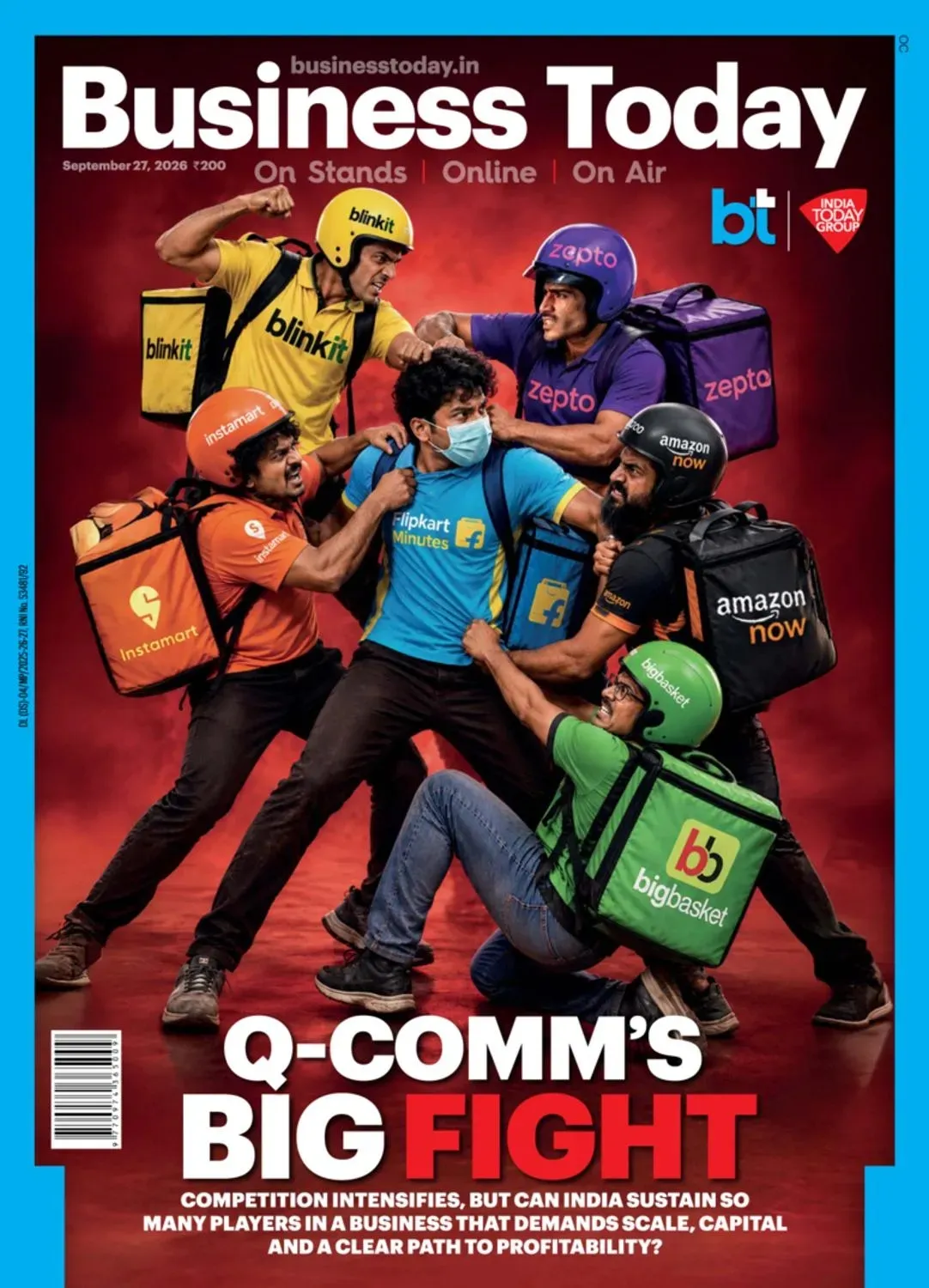
Summary
Blinkit turned profitable, Tech Mahindra is halfway through its turnaround, and India's quick-commerce battlefield now has four well-funded fighters — Business Today's September 27, 2026 issue (Vol 35 No 20) maps who will survive the margin squeeze. The cover story "Q-Comm's Big Fight" opens with a blunt question: can India sustain four players in a business where scale alone is not enough? Uttarakhand CM Pushkar Singh Dhami argues development and environment are not adversaries, while ADB Chief Economist Albert Park says continued reform is the only path to better job creation.
The cover story profiles Blinkit, Zepto, Swiggy Instamart, and BigBasket, reporting that only one has achieved operating profitability. Tech Mahindra's turnaround under CEO Mohit Joshi is tracked quarter by quarter, showing revenue per employee climbing. The fintech section debates whether charging MDR on UPI would strengthen the ecosystem or kill adoption.
Regular columns The Point, BT Interview, and Investing return, alongside event coverage of Business Today's India@100 summit. The edition also includes a shipbuilding industry feature and an infra summit highlight.
—————
Content Guide
▸ Cover Story / E-commerce
p.18 · Q-Comm's Big Fight
India's quick-commerce market saw gross order values cross $6 billion in 2025, but only Blinkit posted positive operating margins. Zepto is burning cash to acquire shelf space in metro clusters, while Swiggy and BigBasket are pivoting to slower, high-margin categories. The article includes a side-by-side table of each player's average order value and delivery radius. Category managers can use the data to decide which platform gets their next new-product launch.
▸ Technology / IT
p.40 · Tech Mahindra's Turnaround Test
India's fifth-largest IT services firm cut attrition from 24 percent to 15 percent and lifted operating margins by 320 basis points in 18 months. CEO Mohit Joshi's strategy focuses on telecom-adjacent verticals rather than chasing generic cloud deals. IT services buyers evaluating mid-tier vendors will find his vertical-first argument worth quoting in RFPs.
▸ Finance / Fintech
p.32 · Crypto Redux
Despite the 30 percent tax and TDS rules, India's crypto exchanges recorded a 40 percent jump in monthly active users in Q2 2026. The article profiles CoinDCX and CoinSwitch, both of which have added insured custody features to attract wary retail money. Finance teams monitoring virtual asset exposure should note the compliance shift.
p.58 · Levy on UPI
The article models a scenario where NPCI introduces a 0.3 percent interchange fee on UPI merchant transactions, which would generate roughly 8,000 crore annually for the ecosystem. Small merchants surveyed say any fee could push them back to cash. Product teams building UPI-first apps need to factor in this regulatory risk.
▸ Economy / Policy
p.14 · Development and Environment are Not Adversaries
Uttarakhand CM Pushkar Singh Dhami defends the state's industrial expansion policy, citing 12,000 crore in committed investments across pharma and tourism. He addresses the balancing act between Himalayan ecology and job creation. Policy analysts tracking state-level Ease of Doing Business rankings should read his timeline for single-window clearance.
p.66 · Continued Reform Will Promote Better Job Creation
ADB Chief Economist Albert Park argues that India's demographic dividend depends on labour-intensive manufacturing and export diversification. He points to Vietnam and Bangladesh as benchmarks where women's workforce participation is 20 percentage points higher. Economic researchers will find his comparison of South Asia's formal-sector shares data-rich.
▸ Industry / Infrastructure
p.68 · Setting Sail
India's plan to break into the top 10 shipbuilding nations involves a 70,000-crore package covering subsidies, port modernisation, and a dedicated shipbuilding finance corporation. The article names Gujarat and Andhra Pradesh as the likely hub locations. Supply chain managers tracking India's logistics cost reduction targets will need this data.
p.102 · The Great Build-Out
Highlights from Business Today's Infra India 2047 summit feature road, rail, and port secretaries outlining a 5-year capex pipeline. The piece includes specific targets: 50 new airport terminals, 25,000 km of national highways, and 7 major port projects by 2030. Infrastructure investors can treat this as a priority list for project finance.
—————
Editor's Take
This is BT operating at its full-business-spectrum best: the quick-commerce cover story is timely, data-backed, and genuinely useful for anyone tracking Indian consumer internet. Tech Mahindra's turnaround piece shows the magazine can still do straight-ahead corporate reporting without cheerleading. The UPI levy article is the kind of regulatory foresight that distinguishes a fortnightly from daily news. What drags the issue down is the advertising density — pages 70 through 85 are essentially a paid-section block that breaks the editorial rhythm. The event coverage pages (India@100 and Infra Summit) read like press releases and could have been trimmed to free space for a second tech feature.
Strengths
• Q-Comm cover story is the best sector analysis this year
• UPI levy article delivers genuine regulatory insight
• Tech Mahindra turnaround tracked with hard numbers
Weaknesses
• Heavy ad block between pages 70-85 disrupts flow
• Infra summit coverage reads as sponsored content
Verdict: Essential — Buy for the quick-commerce deep-dive; the UPI analysis and Tech Mahindra report make this the strongest BT issue of Q3 2026.
