
Business Traveller Middle East – September 2026
Summary
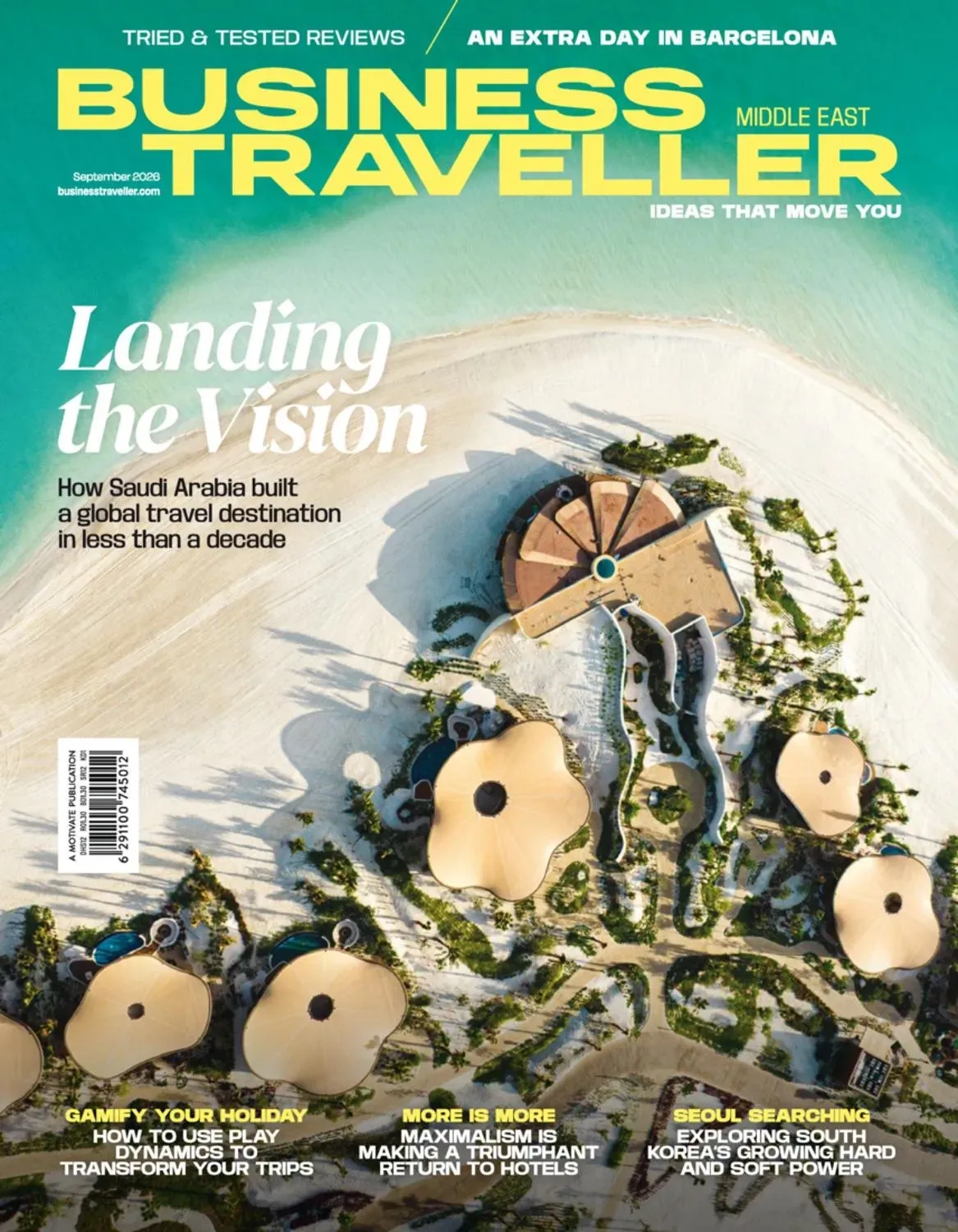
Saudi Arabia built a global travel destination in less than a decade — the September 2026 Business Traveller Middle East cover story dissects Phase Three of Vision 2030 and names the specific resorts, airlines, and giga-projects driving the kingdom's transformation.
The cover story (p.34) tracks how Saudi Arabia moved from vision to execution, with Red Sea Global now operating 11 hotels and NEOM's Sindalah Island open for business. Maximalism returns to hotel design in a feature (p.42) that tracks how velvet, marble, and bold patterns are replacing Scandi minimalism. The electric revolution in Africa is covered (p.46), and a Seoul searching piece (p.54) explores South Korea's hard and soft power in the Middle East partnership space. Relais & Chateaux president Laurent Gardinier shares his hospitality philosophy on p.15.
Updates cover cryptocurrency adoption in aviation as the hot ticket, with regional and global news roundups. Barcelona gets the Extra Day treatment on p.27, and the Postcard previews AlUla's Dark Sky travel initiative. Malaysia Airlines' A330neo business class gets a second review, and Fairmont Tokyo is tested alongside a ProtoArc keyboard and Belkin wall charger.
—————
Content Guide
▸ Cover Story / Features
p.34 · Landing the Vision
The third phase of Saudi Arabia's Vision 2030 tourism strategy is detailed. Eleven Red Sea Global hotels are now operational, with a twelfth opening in December 2026. The article includes specific booking data: average occupancy at Six Senses Southern Dunes reached 78 percent in Q2 2026. Takeaway: the "Saudi Summer" programme offers 50 percent off domestic flights for international visitors transiting through Riyadh — valid from June to September 2026.
p.38 · Gamify Your Holiday
How play dynamics — scavenger hunts, loyalty points for non-purchase activity, and city-based challenges — are transforming travel engagement. Marriott's "Bonvoy Moments" gamification was tested by the writer. Takeaway: downloading the "Wonder" app before your next Dubai trip earns points for walking through specific neighbourhoods — 500 points unlock a free coffee at participating cafes.
p.42 · More Is More
Maximalism is back in hotel design. The feature tracks how velvet upholstery, bold wallpapers, and statement lighting are replacing the minimalist aesthetic that dominated the past decade. Properties at the W Dubai Mina Seyahi and the newly opened Raffles Jeddah are showcased. Takeaway: request a room on the "maximalist floor" at hotels that offer design-differentiated categories — these rooms often cost the same as standard rooms but get upgraded soft furnishings.
p.52 · Uncovering Old Dubai
A walking guide to traditional Dubai: the Al Fahidi Historical Neighbourhood, Dubai Creek abra rides, and the Spice Souk. Takeaway: the Dubai Creek abra ride from Al Fahidi to Deira costs $0.50 — the cheapest tourism experience in the city and a reliable photo opportunity for client entertainment.
p.54 · Seoul Searching
South Korea's cultural and technological influence on the Middle East is examined. K-pop fans in the region and Korean construction firms' role in NEOM are connecting the two regions. Takeaway: Korean Air's new Seoul-Dubai A380 service features a celadon-themed bar in business class — book the 10pm departure for the lowest load factors.
▸ Insight
p.15 · Laurent Gardinier, President of Relais & Chateaux
The hospitality leader discusses authentic, soul-led hospitality and the brand's expansion into the Middle East with properties in Saudi Arabia and Oman. Takeaway: Relais & Chateaux now offers a "Table of the World" membership at $1,200 per year, giving access to chef's table experiences at 580 member properties.
p.24 · Sushi Master Endo Kazutoshi
The London-based omakase chef discusses his clientele of Middle Eastern VIPs who fly to London specifically for his counter. Takeaway: Endo's private dining room seats six and can be booked for corporate dinners at $600 per head — the waitlist is eight months long.
▸ Reviews
p.61 · Malaysia Airlines A330neo Business Class
A second review of this cabin product, this time on the Kuala Lumpur-Dubai route. The review notes consistent catering standards across both legs. Takeaway: the satay starter is halal-certified and served warm — request it during the pre-departure beverage round for faster service.
p.63 · Fairmont Tokyo
The Fairmont's first Japanese property is reviewed from a Middle Eastern traveller's perspective, noting specific services for Gulf guests including halal menu options and prayer room availability. Takeaway: Fairmont Tokyo's private dining room on the 32nd floor offers Mount Fuji views and can be reserved for iftar during Ramadan.
▸ Regulars
p.07 · Hot Ticket: Crypto Takes Flight
Airlines are adopting cryptocurrency for ticket payments. AirBaltic, LOT, and three Middle Eastern carriers now accept Bitcoin and Ethereum. Takeaway: booking with crypto can save 2-3 percent in currency conversion fees — check the airline's crypto partner before purchase.
p.27 · Extra Day in Barcelona
A curated 24-hour guide covering the Barcelona Design Museum, the Poblenou startup district, and the renovated Barceloneta market. Takeaway: the T-Casual transport card costs $12 for 10 rides and works on all metro, bus, and tram lines across the metropolitan area.
—————
Editor's Take
The September issue has the strongest cover story of any Business Traveller Middle East edition this year — the Vision 2030 progress report is data-rich, names specific operational hotels, and resists the boosterism that usually plagues Saudi coverage in travel media. The maximalism feature is timely and the Seoul searching piece draws a genuinely unexpected connection between K-pop and NEOM construction. Weaknesses: the "Gamify Your Holiday" feature is conceptually interesting but the examples (scavenger hunts, walking apps) feel like they were written three years ago. The Maliaysia Airlines review is a repeat of a cabin product reviewed in the UK edition — the same seat, same service sequence. The crypto hot-ticket item is useful but thin. Best suited for corporate buyers tracking Saudi's tourism infrastructure, and design-interested travellers.
Strengths
• Vision 2030 Phase Three with specific hotel occupancy data
• Maximalism-in-hotels trend piece with specific property examples
• Seoul-Middle East connection is a genuinely novel angle
Weaknesses
• Gamification feature feels conceptually dated
• Malaysia Airlines review duplicates UK edition coverage
Verdict: Essential — The Saudi progress report is the definitive English-language summary of where Vision 2030 tourism actually stands.
