
Canadian Wildlife – January-February 2024
Summary
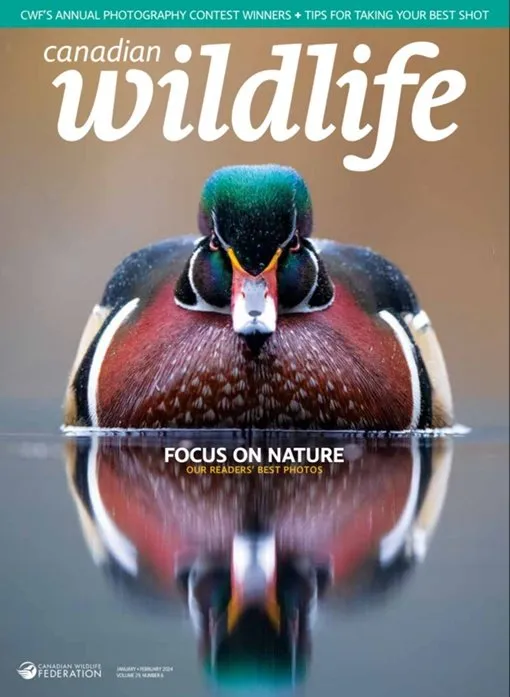
Joe Rousseau of Milton, Ontario captured a wood duck in Vancouver, B.C. — the Focus on Fauna Finalist that lands on the cover of Canadian Wildlife January/February 2024 (Vol. 29 No. 6) as the Reflections of Nature photo contest celebrates its best reader-submitted images from across Canada.
The photo contest feature runs across three articles: “Key Gear for When You’re in the Field” (page 20), “Shoot It RAW: Cook Up Your Best Image” (page 28), and “Shooting Right by Doing Right” (page 34), which covers ethics in wildlife photography. The contest, introduced by CWF in 2007, awards winners across categories. Alexandra Morton receives the 2023 Roland Michener Conservation Award. Nominations are open for the 2024 CWF Conservation Achievement Awards in nine categories.
Science reporting includes Wayne Lynch’s profile of the red squirrel (Tamiasciurus hudsonicus) — Canada’s greatest mushroom muncher, eating more fungi varieties than any other forest mammal — and the “Bigger Picture” feature on the kakapo revival. Roseate spoonbills in Canada get a birding column, while a new urban wildlife web series debuts on page 42.
—————
Content Guide
▸ Photo Contest
p.20 · Key Gear for When You’re in the Field
The camera bodies, lenses, and accessories that contest winners actually carry. The recommendations are field-tested by Canadian nature photographers working in winter conditions. If you are buying a lens for cold-weather shooting, the sealant and fogging test results here matter more than the spec sheet.
p.28 · Shoot It RAW: Cook Up Your Best Image
Post-processing techniques that turn a good field shot into a contest-worthy image. The tutorial covers exposure blending, colour grading, and noise reduction specific to wildlife photography. Apply the white-balance adjustment described here to your last forest-floor shot and watch the moss turn the right shade of green.
p.34 · Shooting Right by Doing Right
An ethics primer for wildlife photographers: how close is too close, when to back away from a den, and what to do if your presence alters animal behaviour. The CWF guidelines cited here are the same standards used by contest judges. Memorise the three-distance rule before your next shoot.
▸ Wildlife Science
p.9 · Out There — Red Squirrels Go Nuts for Mushrooms
Wayne Lynch profiles Tamiasciurus hudsonicus across Canada’s coniferous forests from Yukon to Newfoundland. The species eats a greater variety of mushrooms than any other boreal mammal — more than voles, mice, lemmings, shrews, flying squirrels, and snowshoe hares combined. Watch for caching behaviour in late summer: the squirrels store dozens of different fungus species for winter.
p.10 · Bigger Picture — Kakapo, the Ungainly, Unlikely Phoenix
New Zealand’s flightless, nocturnal parrot is staging a remarkable comeback. The article tracks the population recovery through the most recent breeding season. The conservation techniques used for the Kakapo — island translocation, supplementary feeding, smart transmitters — are now case studies in species recovery programmes worldwide.
▸ Birding
p.38 · Why Are Roseate Spoonbills in Canada?
A species more associated with Florida and the Gulf Coast is appearing in Canadian wetlands with increasing frequency. The column explores range expansion linked to warming temperatures. If you bird the Great Lakes shoreline, add roseate spoonbill to your expected-species list and check the identification tips against the similar-looking egrets.
▸ Urban Wildlife
p.42 · On the Prowl with a New Web Series
A new digital series follows urban wildlife through Canadian cities — raccoons, coyotes, and peregrine falcons adapting to human infrastructure. The series’ production notes include camera trap setups for urban environments. The lens and trigger-settings shared here work for backyard monitoring projects too.
▸ CWF Engage
p.44 · Five Questions for Dan Frawley
Frawley, CWF’s participant support specialist for Indigenous Inclusion, discusses the WILD Outside programme and community-based conservation. The programme connects Indigenous youth with land-based learning. If you work in environmental education, the programme evaluation metrics referenced here can be adapted for your own youth engagement tracking.
—————
Editor’s Take
The photo contest package — gear, technique, and ethics — is the most cohesive editorial sequence this issue offers, valuable for anyone entering the competition. Wayne Lynch’s red squirrel piece is a model of engaging science writing. Weakness: the kakapo revival and roseate spoonbill pieces are underreported; both deserve double the space they get. The urban wildlife web series column reads as a press release for a project still finding its audience. Best for CWF members and Canadian nature photographers; too niche for general wildlife readers outside Canada.
Strengths
• Wayne Lynch’s red squirrel mushroom-diet profile with specific boreal species data
• Three-part photo contest sequence covering gear, RAW processing, and field ethics
• Alexandra Morton Roland Michener Conservation Award announcement with 2024 nomination details
Weaknesses
• Kakapo and roseate spoonbill features too short for the significance of their subjects
• Urban wildlife web series coverage reads as promotional rather than editorial
Verdict: Recommended — Buy for the photo contest package and red squirrel feature; CWF members should not skip this issue.
