
Canadian Wildlife – March-April 2026
Summary
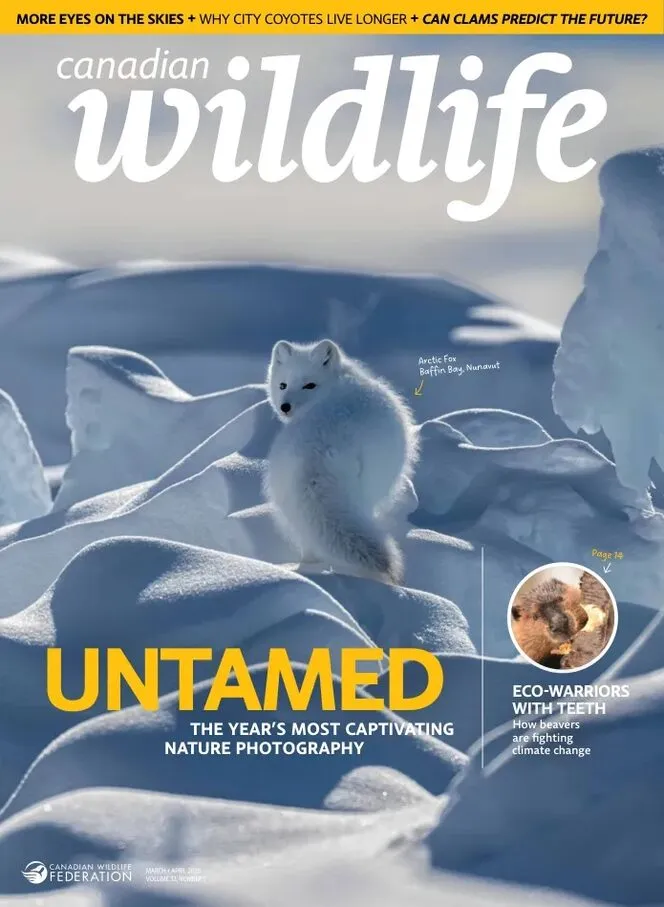
The March-April 2026 Canadian Wildlife magazine (Vol. 32, No. 1) opens with a number: during southern Alberta's catastrophic 2013 flood, two-thirds of beaver dams in Kananaskis Country held intact, anchoring Niki Wilson's cover story on American Beavers as a climate ally, with 10,000-plus photo contest entries and clam-shell climate science alongside.
Niki Wilson's cover feature, "Furry Climate Superheroes," follows University of Saskatchewan ecohydrologist Cherie Westbrook into Sibbald Fen, where her sensors showed beaver ponds delaying downstream flood transfer during the 2013 southern Alberta disaster. Glynnis Hood's Elk Island National Park data adds that beaver-occupied sites held nine times more open water during the 2001-2002 drought, and her Miquelon Lake research found beaver canals expand shoreline perimeter by 575 per cent. The piece closes with Holly Kinas's Miistakis Institute coexistence program, now guiding Red Deer and St. Albert toward beaver-friendly climate policy.
The 10,000-entry Reflections of Nature Photo Contest fills 20-plus pages under the banner "Belonging to the Wild," led by Steven Heipel's Grand Prize Arctic Fox portrait shot on Baffin Bay sea ice and John Meragias's Cottongrass sunrise in Tombstone Territorial Park. Alanna Mitchell's "A Shell's Prophesy" explains how Université du Québec à Rimouski researchers read 200-year-old Ocean Quahog shells as records of North Atlantic instability, finding two wobbles since 1800 that point toward a circulation tipping point.
Back-of-book regulars stay practical: David Bird's Birding column argues 96 million North American birders still aren't enough as 40 per cent of Canadian species decline; the Field Guide assesses Common Snowberry's garden value; Urban Wildlife unpacks why resident Chicago coyotes outlive transients 1.7-fold; and CWF's John Wilmshurst explains the new Canadian Grassland Coalition protecting prairie where 80 per cent of native cover is already gone.
—————
Content Guide
▸ Cover Story
p.14 · Furry Climate Superheroes
Niki Wilson follows ecohydrologist Cherie Westbrook's Sibbald Fen sensor network through the June 2013 southern Alberta flood, where two-thirds of beaver dams held and beaver ponds delayed floodwater moving downstream. Glynnis Hood's Elk Island National Park record shows beaver sites kept nine times more open water through the 2001-2002 drought, and her Miquelon Lake surveys found beaver-dug canals expand pond shoreline by 575 per cent on average. Holly Kinas details the Miistakis Institute's coexistence tools and a Red Deer case study that cuts municipal maintenance costs. Check whether your municipality's climate adaptation plan includes beaver coexistence before the next flood season.
▸ Features
p.10 · A Shell's Prophesy
Alanna Mitchell reports on a Science Advances study in which Pierre Poitevin of Université du Québec à Rimouski and colleagues read growth layers in 200-plus-year-old Dog Cockle and Ocean Quahog shells from seabeds off Newfoundland. The layers record temperature, salinity and recovery rates, revealing two North Atlantic instability periods since 1800 — one before 1920, one recent — that suggest the region is heading toward a tipping point where the subpolar gyre fails before the larger Atlantic Meridional Overturning Circulation. Track AMOC research going forward; this shell-based method gives you an early-warning baseline to cite.
p.20 · Belonging to the Wild
Over 10,000 Canadians entered this year's Reflections of Nature Photo Contest. Grand Prize winner Steven Heipel waited alone at a Baffin Bay iceberg until an Arctic Fox glanced back; John Meragias hauled a 30-kilogram pack through Tombstone Territorial Park for his Cottongrass sunrise; Glen Strickey logged more than 1,000 kilometres over 10 days chasing a Short-eared Owl near Darnley, PEI. Every winning shot lists full camera specs — body, lens, ISO, aperture, shutter speed — so you can reverse-engineer the technique. Enter your own work through the monthly By Popular Vote contest at CanadianWildlifeFederation.ca.
p.6 · In Focus: Harp Seal
Dominic Carbonneau's photo of a whitecoat Harp Seal pup documents the ice-poor winter of 2025 in Gaspésie, Quebec, when thin ice forced mothers to give birth on beaches, leaving pups exposed to predators. The caption ties the frame directly to climate disruption of the species' life cycle — the whole story in one image. CWF accepts photo contest entries monthly, so a shot like this can be published; submit yours at CanadianWildlifeFederation.ca/photocontest.
p.9 · Out There: Snow Bunting
Wayne Lynch profiles the Snow Bunting, Canada's most northerly breeding songbird, nesting at 83 degrees north on Ellesmere Island, less than 800 kilometres from the North Pole. Females line rock-cavity nests with ptarmigan feathers, Muskox wool and Arctic Fox fur while males deliver seeds, insects and spiders through the two-week incubation. If you want to see them, time it right: the flocks leave southern Canada's frozen fields for the High Arctic in April.
▸ Outdoors Regulars
p.36 · Join the Club!
David Bird stacks the numbers: roughly 96 million North Americans watch birds, yet close to 40 per cent of Canada's 460 regularly occurring species have declined since 1970 and 61 are listed as Threatened or Endangered. He cites a 26,000-person, 26-country European study finding avian diversity matters to life satisfaction as much as income, plus a 2024 North Carolina State study showing birdwatching reduces distress more than generic nature walks. Stock your feeders and log sightings — citizen-science counts drive the conservation decisions.
p.38 · Field Guide: Common Snowberry
Mary Whittaker's entry on Symphoricarpos albus notes the shrub grows wild in nearly every province and territory, tolerates clay, sand, drought and poor soil, and feeds Cedar Waxwings, Hermit Thrushes, Northern Flickers and grosbeaks through autumn and winter. Its blooms attract bumble bees, leafcutter bees, Rufous and Anna's Hummingbirds, and it hosts the Snowberry Sphinx Moth. One caution before planting: the berries contain saponin and are toxic to people and pets, so site it away from play areas and budget for annual pruning.
p.40 · City Slickers
April Overall summarizes a University of California and Ohio State study that tracked 214 coyotes in Chicago's roughly 4,000-animal population. Resident coyotes holding territories were 1.7 times more likely to reach age two than wandering transients, and urban animals outsurvived rural ones thanks to less trapping and hunting, shelter from harsh weather, and easy food in compost, trash and outdoor pet bowls. Two habits remove the main attractants the study identifies: secure your compost and bring pet food indoors.
p.44 · Conserving Canada's Last Remaining Grasslands
John Wilmshurst, CWF's native grassland conservation manager, answers five questions on an ecosystem where roughly 80 per cent of native cover has been converted to crops or hay, with more than 90 species at risk, from Burrowing Owl and Swift Fox to Ord's Kangaroo Rat. He maps where remnants survive — the Prairie provinces, the south Okanagan, patches near Windsor and Rouge National Urban Park — and introduces the first Canadian Grassland Coalition of dozens of partner organizations. Start at canadasgrasslands.ca to find actions near you.
p.46 · Right Here: Cape Scott Provincial Park
The issue's closing page fixes Cape Scott Provincial Park on northern Vancouver Island, British Columbia, at 50° 40' 29.0" N, 128° 16' 51.2" W, in a photograph by Visnja Gasparic Vojvodic. The bare-coordinates format works as a standing invitation to locate Canada's wild places yourself rather than take a place name on faith. Copy the coordinates into your mapping app and add this remote coastal park to your British Columbia trip shortlist.
—————
Editor's Take
Wilson's beaver feature is the issue's spine, and it earns the cover: nearly every claim carries a named scientist, a place and a number, from the 2013 Kananaskis flood sensors to the 575-per-cent shoreline gain from beaver canals. Mitchell's clam piece runs a close second, turning shell-layer chemistry into prose a non-scientist can follow. The weakest stretch is the back half — Birding, Field Guide and Urban Wildlife read as competent but padded columns around a parade of CWF self-promotion for the CCNbE, poster sales and legacy giving that fills six-plus pages. The photo portfolio is genuinely strong, though a few captions lean sentimental. Buy it for the beaver story and the portfolio if you track climate adaptation or wetland restoration; skip it if you want hard news beyond the Science Advances shell study.
Strengths
• Wilson's beaver feature cites named researchers, places and numbers in nearly every paragraph
• 20-plus-page photo portfolio with full camera specs for every winning shot
• Mitchell translates 200-year clam shell records into readable tipping-point science
Weaknesses
• Roughly six pages of CWF self-promotion — CCNbE, posters, legacy giving — crowd the back half
• Outdoors columns are brief and lightly sourced next to the front-of-book features
Verdict: Recommended — Strong beaver cover story and photo portfolio outweigh thin back-of-book columns and heavy in-house promotion.
