
Chickens – September-October 2026
Summary
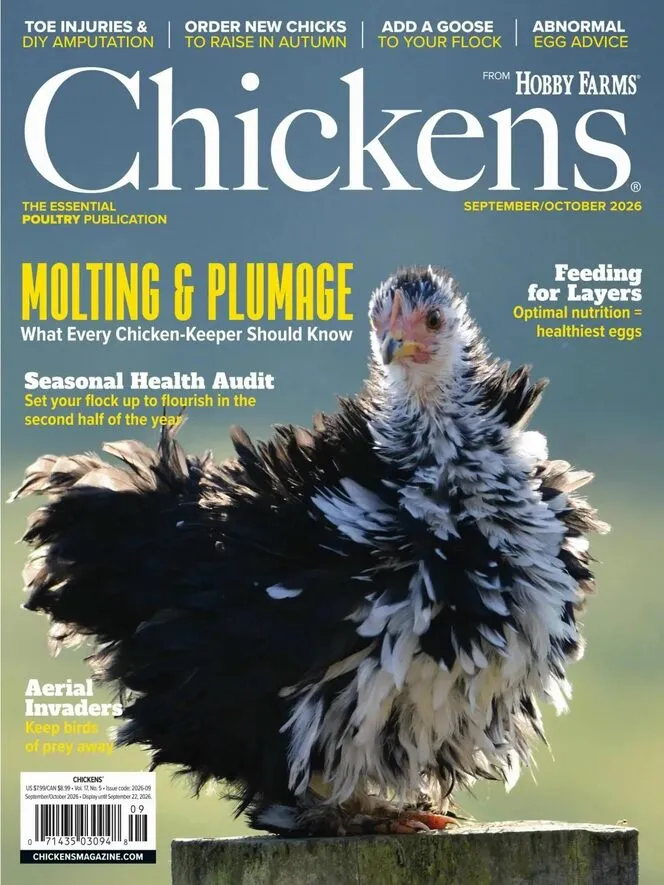
Chickens September/October 2026 (Volume 17, Number 5) makes MOLTING & PLUMAGE — What Every Chicken-Keeper Should Know the cover theme, with cover art from LORNAPAGE/STOCK.ADOBE.COM. The cover also carries Feeding for Layers and the Seasonal Health Audit.
The Australorp breed profile at p4 is the issue's best page: bred in Australia around the turn of the 20th century from Black Orpingtons with Rhode Island Red, Minorca, White Leghorn and Langshan blood, one hen holds the world record of 364 eggs in 365 days, and black Australorps can start laying at 16 weeks against about six months for many breeds.
The features run from Birds of Prey at p14 through Design Details at p24, Under the Weather at p32, Birds of a Feather at p40, Finding Fence at p48, Feeding for Layers at p56, Shell Construction at p66 and Goose or Gaggle at p72.
—————
Content Guide
▸ Breed Profile
p.4 · Australorp
The Australorp was first bred in Australia around the turn of the 20th century and is regarded there as the honorary national bird. Black Orpingtons were imported from Britain as meat birds; Australian breeders preferred their large brown eggs and selected for laying, adding Rhode Island Red, Minorca, White Leghorn and Langshan blood to produce a large, high-producing hen. One Australorp holds the world laying record: 364 eggs in 365 days. It was imported to Britain in the early 1920s and to the United States, where it was once called the "Australian Utility Black Orpington" before the name shortened to Australorp, from "Australian Orpington." Once considered an endangered heritage breed, it has largely recovered as its popularity rose. The author notes black Australorps grow faster than many breeds, spending less time in the brooder — hers were out at exactly five weeks, though the weather helped — and start laying earlier: many breeds begin around six months, while black Australorps can start at 16 weeks. Three hundred and sixty-four eggs in three hundred and sixty-five days is the record every layer is measured against. Check your own flock's laying rate against it.
▸ Features
p.14 · Birds of Prey — Shelly Wutke
Shelly Wutke covers keeping birds of prey away, the cover's aerial invaders. Predators are the loss keepers underestimate most. Check one weakness in your own run today.
p.24 · Design Details — Kyra Kirkwood
Kyra Kirkwood writes on coop design details. Design is the decision that shapes every daily chore. Sketch one improvement to your own coop.
p.32 · Under the Weather — Julianna Jespersen, Ph.D.
Dr Julianna Jespersen covers weather and health. Weather is the health variable keepers plan for least. Watch one forecast and act before it arrives.
p.40 · Birds of a Feather — Sharon Biggs Waller
Sharon Biggs Waller writes on feathered birds. Feather condition is the first sign of a health problem. Run your hand over one hen today.
p.48 · Finding Fence — Sharon Biggs Waller
Sharon Biggs Waller's second feature covers fencing. Fencing is the purchase keepers regret skimping on. Walk your boundary and find one gap.
p.56 · Feeding for Layers — University of California, Davis School of Veterinary Medicine
The UC Davis veterinary school contributes the cover's feeding-for-layers feature, on optimal nutrition for the healthiest eggs. Layer nutrition is the science behind every egg you collect. Check one feed's protein against your flock's age.
p.66 · Shell Construction — Deb Buehler
Deb Buehler covers shell formation. Shell quality is the egg problem keepers notice first. Examine one egg's shell this week.
p.72 · Goose or Gaggle — Kirsten Lie-Nielsen
Kirsten Lie-Nielsen asks whether to add a goose. Geese are the addition keepers argue about most. Ask one keeper what a goose changed on their place.
▸ Columns and Departments
p.6 · Flock Talk — Toe Injuries & Amputation
The column covers toe injuries and do-it-yourself amputation, listed on the cover. Toe injuries are the emergency keepers face without a vet. Learn one first-aid step before you need it.
p.10 · Chicken Checkup — Fall Health Audit
The cover's seasonal health audit for the second half of the year. Health audits are the routine that prevents winter loss. Weigh and check one bird this week.
p.31 · Chicken Chat
Reader chat runs here. Chat pages are where a magazine's community shows. Send one note this month.
p.36 · In the Kitchen — Croque Madame
The kitchen column offers croque Madame. Egg recipes are the reason many people keep hens. Cook one recipe with your own eggs this weekend.
p.38 · One Cool Coop
A coop is featured. Coop tours are the pages readers copy from. Steal one idea for your own setup.
p.46 · Storefront
Products are showcased. Storefront pages are the real buying guide. Compare one product with your own needs.
p.54 · Wing Tip — Abnormal Egg Advice
Advice on abnormal eggs. Abnormal eggs are the puzzle every keeper photographs. Save one and look up what caused it.
p.62 · Shutterclucks — Reader-submitted Photos
Reader photographs. Reader photos are the most honest pages in any magazine. Send in one photograph of your own flock.
p.80 · Last Squawk — Fall Chicks
The closing column covers raising chicks ordered for autumn. Autumn chicks are the decision that changes a flock's spring. Order one batch before the cold.
▸ Advertising, Feed and Publishing
Purina and the Seeds of Hope book
Purina's page features keeper Shelby Diebold (@vineygrovegoats) and her husband Jackson, who keep Black Copper Marans. Her method: start chicks on Purina Start & Grow with electrolytes and probiotics in the water, then after a few weeks transition from starter to Purina Layena layer feed, mixing feeds and reducing starter until it runs out. Purina Layena 16% Layer Hen Feed is for 18+ weeks. SEEDS OF HOPE — THE AZURE STANDARD STORY, by David Stelzer with Ken Abraham and a foreword by Joel Salatin, tells how a family health crisis led to a chemical-free farming shift, tracing Azure Standard from a small delivery van to a national organic food business, by a couple with eleven children who kept going through major bereavement. Sixteen per cent protein at 18+ weeks is the number to check on your own bag. Read one label before you buy.
Subscription and contact
Chickens (ISSN 2154-0845) is published bimonthly — January/February, March/April, May/June, July/August, September/October, November/December — by EG Media Investments LLC. A one-year subscription of six issues is $24.95 and twelve issues $39.95, adding $19 a year for Canada and foreign surface mail in US funds. New subscriptions take six to eight weeks to start, and address changes need six weeks' notice. The home office is at 3622 Lyckan Parkway, Suite 3003, Durham, NC, and subscription mail goes to EG Media Investments LLC, WHSL LBX Dept. #263, 3451 Prescott Road, Memphis, TN 38118. Editor in Chief Roger Sipe, Publisher Rima Dorsey, Senior Digital Editor Pam Freeman, Art Director Kenny Boyer, President Prashant Upadhyaya. Printed in the United States. Six issues for $24.95 is the rate to compare. Check your own renewal before it lapses.
—————
Editor's Take
The Australorp profile is the reason Chickens September/October 2026 is worth keeping: 364 eggs in 365 days, bred around the turn of the 20th century from Black Orpingtons with Rhode Island Red, Minorca, White Leghorn and Langshan, once endangered and now recovered, laying at 16 weeks against about six months for many breeds, and out of the brooder at exactly five weeks is a breed page with real record and real dates. The molting cover theme, the UC Davis feeding-for-layers feature and the fall health audit are the practical heart of a September issue. Weakest is the source: all eight features from p14 to p72 survive as titles and one-line summaries only, so no predator-proofing method, fence type, feed formula or shell-quality cause can be quoted, and the cover molting feature never appears in the text. The Purina 16% at 18+ weeks and the $24.95 subscription give more concrete figures than the features. Buy this for the Australorp; the features are a contents page.
Strengths
• Australorp gives 364 eggs in 365 days
• Bloodlines and the 1920s imports are named
• 16 weeks against six months is a real comparison
• UC Davis contributes the layer feeding feature
Weaknesses
• No feature body text available to quote
• Molting cover theme absent from the text
• Feeding and fencing detail unquoted
Verdict: Selective read — the Australorp profile, features unquoted.
