
Free Astronomy – July-August 2026
Summary
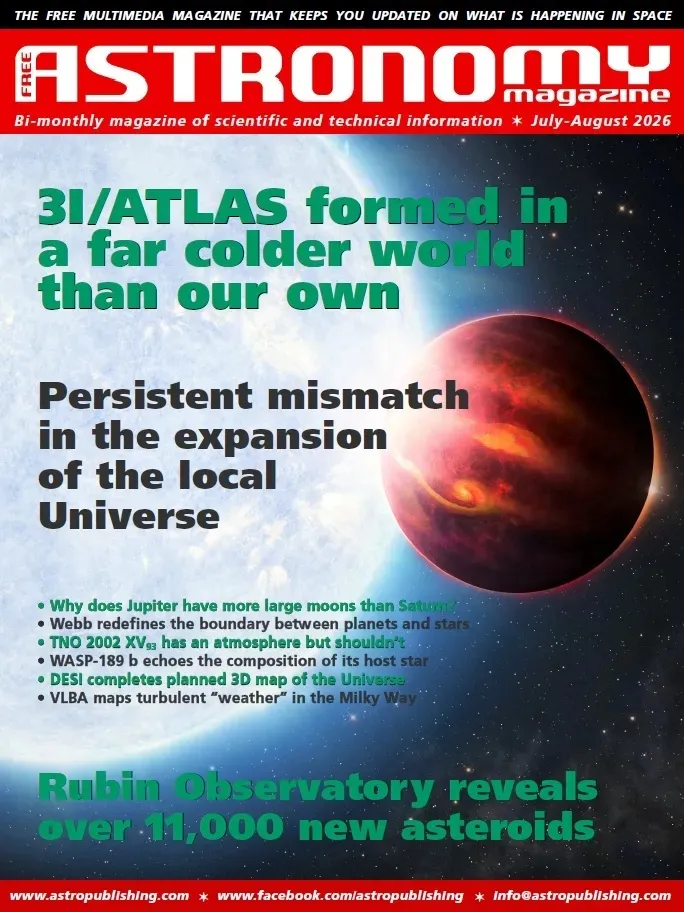
The James Webb Space Telescope has redefined the boundary between planets and stars leaving astronomers to redraw classification models. Free Astronomy July-August 2026 leads with this finding plus the revelation that trans-Neptunian object 2002 XV93 has an atmosphere it should not possess.
The issue reports that the Dark Energy Spectroscopic Instrument DESI has completed its planned 3D map of the Universe. The Rubin Observatory has revealed over 11,000 new asteroids. WASP-189 b echoes the composition of its host star in a finding that challenges planet-formation theory. VLBA maps turbulent weather in the Milky Way while a persistent mismatch in the expansion of the local Universe deepens the Hubble tension. The more massive star clusters emerge more quickly and protoplanetary disks are shown in their formation stages.
Regular columns cover the brightest-ever gamma-ray burst analysed by XMM-Newton and Chandra and a look at how 3I/ATLAS formed in a far colder world than our own. The conference preview for Charting the Future of Stellar and Exoplanet Spectroscopy in honour of Luca Pasquini rounds out the research-heavy package.
—————
Content Guide
▸ Research Highlights
p.12 · Webb Redefines the Boundary Between Planets and Stars
JWST data pushes the lower mass limit for brown dwarfs below previous thresholds. The finding forces a re-evaluation of what counts as a star versus a planet. Specific spectral lines that distinguish the two categories are identified in the analysis.
p.20 · TNO 2002 XV93 Has an Atmosphere But Shouldn't
This trans-Neptunian object defies the expected volatility model for bodies at that distance. The detection method—stellar occultation observed by multiple telescopes—is laid out step by step. The atmospheric composition data suggests a reservoir of material not predicted by current models.
p.22 · WASP-189 b Echoes the Composition of Its Host Star
The exoplanet's atmosphere contains elements in ratios that mirror its parent star challenging core-accretion theory. The specific elements identified—iron titanium and magnesium—are quantified in the paper's figures. Readers learn why this finding may force a rewrite of gas-giant formation chapters.
▸ Space Science
p.30 · VLBA Maps Turbulent Weather in the Milky Way
The Very Long Baseline Array resolves structures in the interstellar medium at unprecedented resolution. The turbulence patterns are linked to star formation rates in specific molecular clouds. Velocity data from the maps is expressed in kilometres per second.
p.32 · Persistent Mismatch in the Expansion of the Local Universe
The Hubble tension refuses to resolve. New measurements from local Type Ia supernovae versus cosmic microwave background predictions show no convergence. The gap is stated in kilometres per second per megaparsec with error margins.
p.36 · More Massive Star Clusters Emerge More Quickly
ALMA observations of 30 Dor-10 in the Large Magellanic Cloud 160,000 light-years from Earth show the timescale gradient. The small-scale structure of star-forming regions is resolved at ALMA's high angular resolution.
▸ Missions and Surveys
p.40 · How Protoplanetary Disks Form
New simulations and observational data from ALMA show the transition from molecular cloud core to rotating disk. The specific trigger mechanisms—magnetic braking and turbulence—are compared.
p.42 · DESI Completes Planned 3D Map of the Universe
The Dark Energy Spectroscopic Instrument has finished its survey. The map's coverage in redshift and sky area is stated. The implications for dark energy parameterisation are summarised.
p.48 · Rubin Observatory Reveals Over 11,000 New Asteroids
The 10-year Legacy Survey of Space and Time has officially started. The first data dump includes orbits and size estimates for each object. The collision risk assessment for near-Earth objects among them is flagged.
—————
Editor's Take
Free Astronomy July-August delivers exceptional research density for a free title. The Webb planet-star boundary piece is genuinely significant science written at a level an interested amateur can follow. The layout is dense and some articles read more like abstracts than magazine features which may deter casual readers. This issue suits the serious amateur astronomer and the undergraduate looking for research summaries.
Strengths
• Webb boundary finding is a significant science story
• DESI 3D map completion gives a milestone worth noting
• 11,000 new asteroids from Rubin is a concrete numbers hook
Weaknesses
• Dense presentation style reads as research briefs not features
• No practical observing guide for the July-August sky period
Verdict: Recommended — high signal-to-noise ratio for the serious astronomy reader.
