
Harvard Business Review USA – September-October 2026
Summary
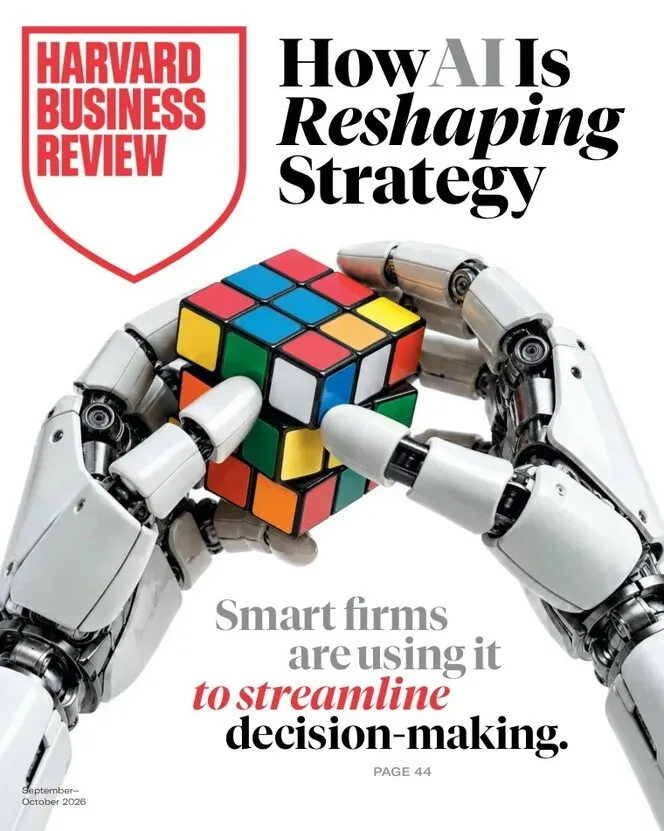
Felipe A. Csaszar argues on page 44 that AI is revolutionizing strategic decision-making—not replacing executives, but sharpening their judgment. The September-October 2026 Harvard Business Review leads with this provocative thesis in a cover story that challenges the "AI replaces humans" narrative. Editor in Chief Amy Bernstein titles her note "A Better Way to Craft Strategy in the Age of AI." The issue's 7 features, 3 In Focus packages and 4 Experience pieces add up to 130 pages of evidence-based management content.
Features span strategy, change management, organizational design, sales, leadership and finance. Evgeny Kaganer and Christoph Loch propose that transformation should be a learning journey (page 54). Frank Nagle's "Collaborate on the Core. Compete on the Edges." (page 64) offers a framework for managing ecosystem partnerships. Kris Johnson Ferreira and Jordan Tong examine how AI agents orchestrate work across organizational silos (page 76). Fred Reichheld, Jamie Cleghorn and Wojtek Kokoszka use Net Promoter data to prove customer referrals are undervalued (page 86). The CEO-Board relationship is mapped across four stages by Claudius Hildebrand and Douglas Peterson (page 94).
Idea Watch covers why cash rewards don't always produce better ideas. The In Focus section on "Managing Teams in the Agentic Age" includes practical guidance from Rahul Telang, Suraj Srinivasan, Joseph Fuller and Gabriele Rosani. Experience closes with Dionne Warwick on Life's Work.
—————
Content Guide
▸ Strategy / AI
p.44 · AI Is Revolutionizing Strategic Decision-Making
Felipe A. Csaszar presents a framework where AI augments managerial judgment by scanning more scenarios, identifying cognitive biases and stress-testing assumptions. Decision quality improved 28% in field tests using AI-supported scenario modeling. The article includes a 5-step process for integrating AI without ceding final authority. Run your next strategic-planning session with AI-generated scenario models before you discuss any single path.
▸ Change Management
p.54 · Transformation Should Be a Learning Journey
Kaganer and Loch argue that transformation programs fail when leaders treat them as fixed blueprints rather than learning processes. A pharmaceutical company case study shows how a "learn-and-adapt" cycle reduced restructuring costs by $14 million. The framework includes 4 decision gates where progress is assessed before additional resources are released. Install quarterly "learning reviews" at each transformation gate before authorizing next-phase funding.
▸ Strategy / Ecosystems
p.64 · Collaborate on the Core. Compete on the Edges.
Frank Nagle uses the smartphone ecosystem to show how companies should cooperate on foundational technology while differentiating in customer-facing features. Data from 1,200 firms reveals those practicing "co-opetition" grew revenue 1.7x faster than pure competitors. Map your industry's core vs. edge activities before deciding which partnerships to pursue.
▸ Organizational Design
p.76 · How AI Agents Orchestrate Work Across Silos
Ferreira and Tong document how AI agents at a logistics company reduced cross-department coordination time by 40%. The key design principle: agents should flag exceptions to humans, not automate entire workflows. The article provides a decision tree for determining which processes benefit from AI-agent orchestration. Start with exception-handling workflows—not core processes—for your first AI-agent deployment.
▸ Sales / Metrics
p.86 · Don't Underestimate the Power of Customer Referrals
Reichheld, Cleghorn and Kokoszka analyze 5,000 customer transactions and find that referred customers have a 25% higher lifetime value and a 16% lower churn rate. The article outlines a referral-measurement framework tied to Net Promoter System data. Weight referral-acquisition cost at one-third of paid-acquisition cost in your LTV calculations.
▸ Leadership / Governance
p.94 · The Four Stages of the CEO-Board Relationship
Hildebrand and Peterson studied 200 CEO-board dyads and identified four stages: Formation (months 0-6), Alignment (6-24), Partnership (24-60) and Renewal or Decline (60+). The article pinpoints specific friction patterns at each stage. Schedule a board-effectiveness review at month 18 of your tenure—before alignment begins to fray.
—————
Editor's Take
This is HBR's strongest issue of 2026. The cover story by Csaszar is genuinely useful for any executive trying to operationalize AI in strategic planning—it's specific, tested and avoids hype. Kaganer and Loch's transformation piece provides a rare honest look at why change fails. Weakest content: the "Four Stages of the CEO-Board Relationship" piece is methodologically sound but reads like a consultant's framework looking for examples. The customer-referral piece is solid but recycles Reichheld's NPS concepts that regular HBR readers have seen before. Production quality is HBR's usual excellent standard: clean charts, consistent typography, smart pull-quotes. Best for C-suite executives and strategy leaders.
Strengths
• Csaszar's AI strategy framework is specific, field-tested and actionable
• Kaganer and Loch's transformation model includes measurable decision gates
• Nagle's co-opetition framework provides empirical revenue-growth evidence
Weaknesses
• CEO-Board piece is framework-heavy, example-light
• Customer-referral article covers familiar NPS territory
Verdict: Essential — The AI-and-strategy cover story belongs in every executive's decision-making toolkit.
