
Horse Illustrated – March-April 2026
Summary
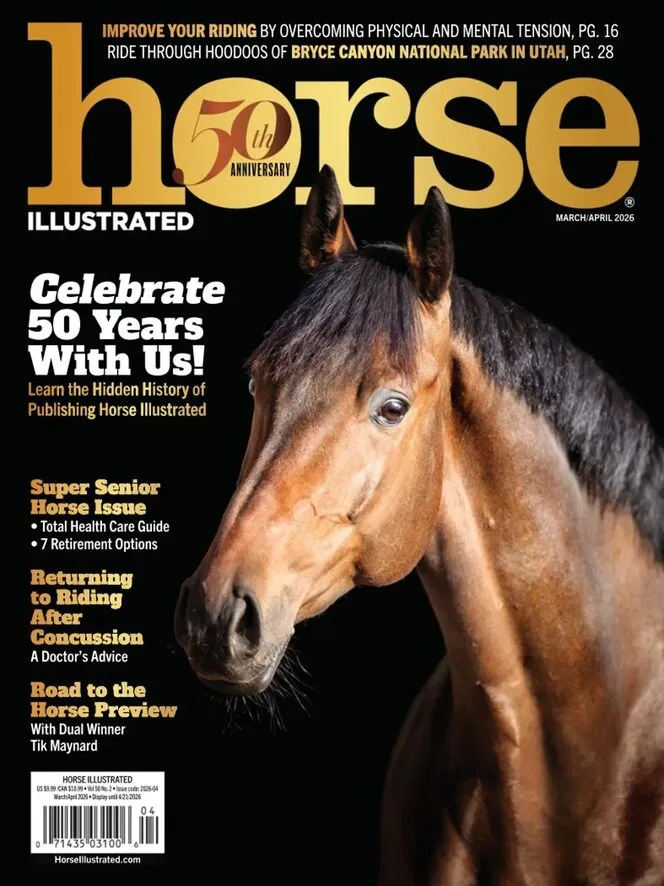
Horse Illustrated's March/April 2026 issue marks Volume 50 with a 50th-anniversary history written by the HI staff and a Thoroughbred cover shot by Christiane Slawik, alongside a super-senior horse health guide, US Equestrian's six-stage concussion return-to-riding plan, and the 2026 Road to the Horse preview.
Editor in Chief Holly Caccamise opens the 50th-anniversary mega issue with 'It's Golden,' then hands six pages to HI's own history: Richard Gibson founding the title in 1976 after a rival magazine let him go, the 1981 sale to Fancy Publications, and the seven editors who reshaped the nameplate from the 1991 serif to today's lowercase 'horse.' The July 1991 Thoroughbred cover is reprinted on the same spread as Christiane Slawik's 2026 one.
The issue doubles as a super-senior horse guide. Joyce Bloemker profiles Pam Vennare's Paint mare Ellie Mae and Quarter Horse Nash, lesson horses that kept teaching past 30; Lucile Vigouroux covers semi-retirement, barefoot transitions and beet-pulp diets with Mountain Pointe's Jessica Martin, DVM; and Cynthia McFarland weighs boarding at Aurora Farms in Shelbyville, Ky., leasing, adoption through myrighthorse.org, and humane euthanasia.
Elsewhere, Cynthia McFarland explains the AAEP's 2024 targeted deworming rules and the 200 and 1,000 eggs-per-gram shedding thresholds; Dr. Cindy Lin walks through US Equestrian's six-stage return-to-riding plan after concussion; Justin Nemmers breaks flying lead changes into a corner-to-corner pattern; and Audrey Pavia books the 4.5-mile horse trail through Bryce Canyon's hoodoos, open May to October.
—————
Content Guide
▸ Cover Story: 50 Years of Horse Illustrated
p.32 · The History of Horse Illustrated
HI's own staff retrace five decades in print, from Richard Gibson launching the title in 1976 after a rival magazine let him go, through the 1981 sale to Fancy Publications, to the lowercase 'horse' nameplate that debuted in 2015. Editors Jill Marie Jones, Sharon Ralls Lemon, Susan Wells and Audrey Pavia recall the campaign against barbed wire, the Nov. 1992 expose 'The Last Ride,' and the May 1996 Shah Azim cover by Bob Langrish. Use the reprinted July 1991 Thoroughbred cover as a checklist for why the breed-portrait formula still sells.
▸ Super Senior Horse Issue
p.10 · Senior Horses have more to give
Joyce Bloemker tells the story of Pam Vennare's lesson string: Ellie Mae, a chestnut Paint mare pulled off a truck at 12 who won a ribbon at 30 and died at 33, and Nash, a bay Quarter Horse who cleared 4 feet in his first groundwork session and then taught hundreds of riders to jump. Both were retired at 30 and stayed home. If you run a lesson program with an ageing horse, start planning their pasture retirement two or three years before the last ride.
p.50 · Retirement Transition
Lucile Vigouroux argues against a sudden full stop: semi-retire by hacking instead of jumping, hand-walk a stalled horse, and expect a barefoot transition to take several trim cycles with hoof boots and topical hardeners on standby. Jessica Martin, DVM, of Mountain Pointe Equine Veterinary Services in Long Valley, N.J., recommends swapping sweet feed for soaked beet pulp and switching diets over one to two weeks. Book one dental exam a year, and start weighing your retiree monthly, because weight loss is the first sign of failing teeth.
p.72 · Rewriting Retirement
Cynthia McFarland prices out the options when you can no longer keep an older horse: full retirement board such as Melody Adler's 104-acre Aurora Farms in Shelbyville, Ky. (25 retirees, a waiting list, compatible groups of five or fewer, veterinary and farrier billed separately), lease arrangements, surrender for adoption, and humane euthanasia. ASPCA senior manager Joanna Magee notes horses are present-focused, so comfort now beats quantity of years. Adler's blunt advice: don't judge a farm by its website, plan a surprise visit before you sign.
p.86 · Breed Portrait: Thoroughbred
Shoshana Rudski reports on aftercare rather than racing: why off-track Thoroughbreds now compete in dressage, hunters, jumpers, western dressage and trail, and who pays for that transition. The Jockey Club backs the Thoroughbred Aftercare Alliance, Thoroughbred Charities of America raises funds, auction houses such as Fasig-Tipton add voluntary contributions, and the Retired Racehorse Project runs the Thoroughbred Makeover across 10 disciplines every October. Aftercare only became a buzzword around 2010. Check thoroughbredaftercare.org/organizations before you adopt.
▸ Health & Veterinary Care
p.46 · Deworming Updates
Cynthia McFarland explains how the old every-eight-weeks rotation bred resistance across all four anthelmintic classes, and what the AAEP's 2024 guidelines replace it with. Martin K. Nielsen at Aarhus University and Zoetis's Abby Sage, VMD, walk through fecal egg count testing, the 14-day fecal egg count reduction test, and the shedding cut-offs: under 200 eggs per gram is a low shedder, over 1,000 is high. Run a reduction test annually, one product at a time, so you know your dewormer still works before you buy another tube.
p.14 · How Horses Sleep
Daniel Johnson's short column corrects the assumption that horses barely sleep: adults need about six hours a day, but only 30 minutes of it in REM, and REM demands lying flat. Standing rest uses a locking stay mechanism for slow-wave sleep; sternal recumbency delivers the same; foals sleep up to 18 hours. The real risk is herd dynamics, because a low-ranking horse may never relax enough to lie down. Count your stalls and split oversized groups so the bottom of the pecking order still gets flat-out REM.
p.60 · Riding After Concussion
Sports medicine physician Cindy Lin, M.D. writes from her own college fall, when a head CT cleared her and nobody told her to skip exams or riding. Roughly one in four equestrians treated in emergency departments after a fall has a head injury. She lays out US Equestrian's six stages, from rest with limited screen time through light exercise, unmounted barn chores, walking laps in the arena, then patterns and speed changes, then jumps, each separated by one to two days. Replace the helmet that took the impact; its foam absorbs one hit only.
▸ Training & Horsemanship
p.16 · Tackling Tension
Cathy Woods, who teaches the Body, Mind, Equine retreats at White Stallion Ranch in Arizona, treats a tense rider as the cause rather than the horse. Clenched glutes, tight hips or tense shoulders show up as tripping and short choppy steps. Her fixes are cheap: a pre-ride mindful movement set, a mounted body scan from feet to face while asking the horse to stand, shoulder rolls and a spinal twist mid-ride, then post-ride stretches. Before your next ride, name what is draining you mentally, then breathe it out first.
p.38 · Lead Change Learning
Trainer Justin Nemmers of Longmont, Colo., breaks the flying change into a corner-to-corner pattern before asking for the finished move. Lope the long diagonal on the left lead, sit deep and say 'whoa' at the three-quarter mark, sidepass to move the hip, then lope off on the right lead. Once that is solid, condense to a trot transition, then fewer trot strides, then the flying change, and move the drill around the arena so your horse never learns to anticipate. A change that swaps only in front is a judged penalty, not a change.
p.42 · Handling the Pushy or Spooky Horse
Jason Irwin separates the two problems and fixes ground manners first, on the logic that a horse which runs into you is more dangerous than one that shies. Stand facing the horse with about 4 feet of lead rope, walk in with energy while swinging a training stick, and stop everything the instant he steps back. Repeat swinging the lead rope at his shoulder. Then desensitise with a flag on a stick: hold it between you and the horse, back away so he follows it, and work down the legs. Keep rest breaks at 5 or 6 feet.
p.78 · High-Quality Horsemanship
Previewing Road to the Horse 2026 at the Alltech Arena in Lexington, Ky., March 19-22, the piece explains the format: four colour-coded round pens, one hour and 45 minutes per round with a mandatory 15-minute break, judged on how calmly the colt accepts catching, haltering, saddling and mounting. Wild cards include Horse Illustrated contributor Jason Irwin of Ontario and Sadie Fisher of Unbridled Equine in Pennsylvania, while Nick Dowers, Ryan Rose and Elisa Wallace take the main slots. Two-time champion Tik Maynard frames handling as four ingredients borrowed from Salt, Fat, Acid, Heat.
▸ Breeds & Riding Destinations
p.90 · Bonus Breed: Dales Pony
Julie Maddock profiles a critically endangered British native: 14 to 14.2 hands, black, bay, grey or roan, heavy manes and feathered fetlocks, bred to carry adults over hilly Yorkshire farm country and to serve as mountain artillery pack ponies in both World Wars. Sheila Enochs bought a 3-year-old stallion, Envoy De Kingmaker ('Ziggy'), despite calling herself timid, and shows him in dressage, eventing and jumping. Jennifer Mims of the Dales Pony Conservancy North America keeps five. Contact dalespony.org or dpcna.com before you shop, because the gene pool is small.
p.28 · Riding in Bryce Canyon
Audrey Pavia covers Bryce Canyon National Park's 4.5-mile dedicated horse route, open May to October, from Mixing Circle at the rim down switchbacks to the Peekaboo Loop and the canyon floor at 6,620 feet. Private stock rides must be reserved for a fixed half-hour slot between 4:30 and 7:30 p.m., with 10 riders maximum; horses from outside Utah need a 30-day Certificate of Veterinary Inspection and a Coggins test under 12 months, plus certified weed-free feed for 48 hours beforehand. Reserve at recreation.gov, or book the concessioner's two- and three-hour trips.
—————
Editor's Take
The 50th-anniversary package is the reason to buy this issue: Richard Gibson's 1976 launch, the nameplate changes, Bob Langrish's 1996 Shah Azim cover and the Nov. 1992 'The Last Ride' controversy are all here, and the reprinted covers carry the story better than the text does. The senior-horse thread holds up too, because Vigouroux's barefoot and beet-pulp detail and Adler's 104-acre Aurora Farms are specific enough to act on. The weakest link is the edit: 'Better Boarding' and 'Point, Shoot, and Post' read like filler wedged between a dozen full-page supplement ads. This one is for committed amateur owners with an ageing horse, not for competitors chasing show-ring technique.
Strengths
• Reprinted covers from 1976 to 2016 make the 50-year history legible at a glance
• AAEP 2024 deworming thresholds and USEF's six concussion stages are citable, not vague
• Senior-horse advice names vets, farms, prices and timelines instead of generalities
Weaknesses
• Ad density is heavy; supplement spreads break up the feature run
• Training coverage skews groundwork and ranch riding, with nothing aimed at hunter-jumper riders
Verdict: Recommended — The 50th-anniversary history and senior-horse package justify the $9.99 cover price; skip it if you want competition technique.
