
Horse Rider UK – March 2026
Summary
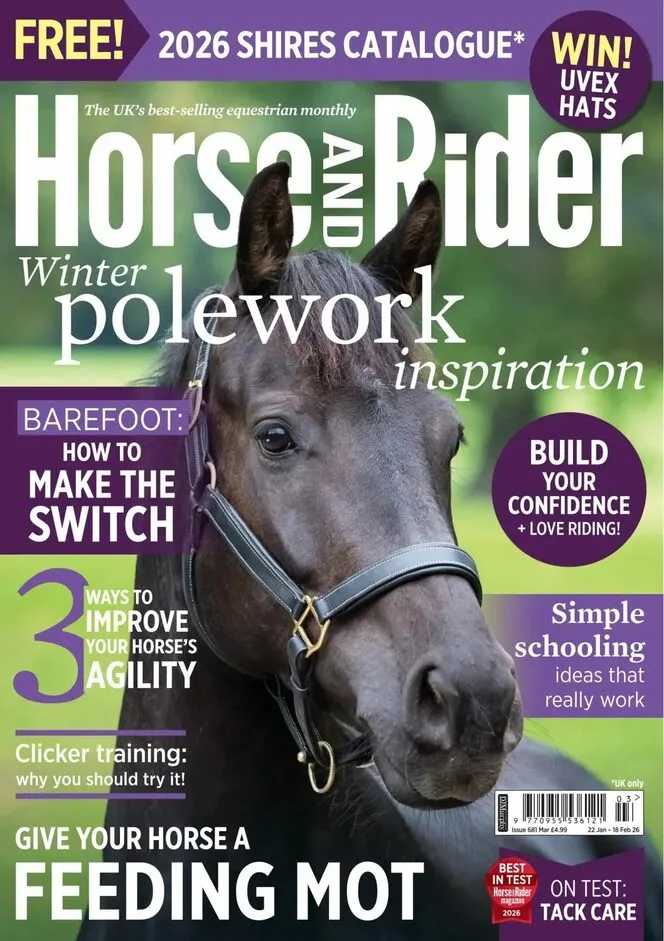
Horse&Rider UK's March 2026 issue (No. 681, £4.99) makes winter polework its centrepiece — BHS Stage 4 coach Nina Gill's six-pole layout, eventer Meg Elphick's 20-pole groundwork line and Gemma Stevens' four-level curving bounces — backed by a barefoot transition guide and clicker training for vet-shy horses.
The training block leads: Nina Gill opens her Polework Patterns series with one six-pole layout covering rhythm, straightness, suppleness and balance, each line with its own problem-solver. Gemma Stevens progresses bounces on a curve across four levels, from poles on the ground to 70cm fences; Meg Elphick long-reins roughly 20 raised walk poles spaced 0.8-1.2m apart, calling it a water-treadmill mimic. Jay Buxton's part two builds a cross-pole with a 3m landing box that teaches rushers to wait.
The confidence section runs three features: ABTC-registered behaviourist Lucy Chester maps clicker training and counter-conditioning for needle-shy horses, listing triggers from the vet's car to latex gloves; psychotherapist Sean Roberts tackles fear of judgement; mindfulness coach Angie Jones-Moore scripts vet-visit preparation. Horse care covers quality-of-life assessment with Rossdales vet Grace Twitchett, yard time-management from Fizz Tickridge-Marshall, and the barefoot debate between farrier Elliott Scales and podiotrist Olivia Cresswell.
Regulars include farrier and TikTok creator Sam Dracott ahead of his National Equine Show appearance (NEC Birmingham, 28 February-1 March), a 2026 equestrian calendar running from Bicton to Burghley and HOYS, seven expert Q&A pages, and an equestrian art tour reaching the Munnings Museum's 65th anniversary in Dedham, Essex. Feed and supplement advertising – Dengie, Thunderbrook, CushCare – sits densely between features.
—————
Content Guide
▸ Cover Story
p.40 · Polework patterns
BHS Stage 4 Coach Nina Gill (Fancy Footwork Equestrian, Warwickshire) builds one layout from six 3m poles and works it in four lines mapped to the scales of training: rhythm over the middle, straightness point-to-point, suppleness through turns and loops, balance on a 20m circle. Each line carries how-to-ride bullets and a problem solver – if your horse skips the second pole, adjust his pace and gears on the approach. Spread the lines over several sessions rather than cramming one. Use a spare 3m pole as your measuring stick when setting up.
p.48 · A long line
Event rider Meg Elphick, with four Badminton Grassroots top-10 placings, shares her staple groundwork layout: around 20 poles down the long side at 0.8-1.2m spacing, half of them randomly raised on blocks. She works it long-reined or in-hand in walk – the slower the better – to build core strength, mobility and proprioception, calling the exercise a water-treadmill mimic. If your horse wobbles, cut the pole count and rebuild over several sessions; film from head-on to check straightness. Raise the poles before you start, never mid-session.
▸ Riding & Training
p.24 · Athletic and agile
Five-star eventer Gemma Stevens, winner of the 2025 Hickstead Eventer's Grand Prix, teaches bounces on a curving line in four levels: poles on the ground, a 70cm middle fence, fences at positions one and five, then all raised. She drops groundlines so the horse learns to judge the fence himself, and tells riders to stay in a light seat without leaning into the curve. If he drifts, check he is wrapped around your inside leg rather than bending through his neck. Ride the exercise equally on both reins to even out a favoured landing lead.
p.34 · Jumping solutions
International showjumper Jay Buxton (Strides Equestrian, Cheshire) continues his series with a cross-pole on the centre line, a placing pole 6.5m in front and guide rails plus a 3m box on the landing side. The box makes the horse bascule and land shorter, fixing rushing and flattening. Introduce it in trot from both reins, progress to a small upright, and stop after 10 minutes if every progression has gone well. Adding wings a few strides after the fence teaches straighter landings.
▸ Confidence & Mindset
p.52 · Working in harmony
Behaviourist Lucy Chester, registered with the Animal Behaviour and Training Council, explains co-operative care: list every trigger for your needle-shy horse – the vet's car, latex gloves, a hand reaching for the neck – then change each association using systematic desensitisation and counter-conditioning before adding the clicker. Train with a full tummy, low-value reinforcers such as hay pellets, and a quiet time of day. Slice the end behaviour into small steps trained in isolation. Wear a riding hat whenever you handle, and stop before stress signs appear.
p.58 · Nothing to prove
Psychotherapist Sean Roberts argues that confidence built on riding well in front of others always collapses, because performance varies and the limbic brain treats peer judgement as a survival threat. Riders then avoid new challenges, over-analyse every session and hold tension the horse mirrors back. His fix: rehearse success internally so your brain treats it as evidence, and redefine success around progress goals rather than outcomes. Genuine confidence is knowing you will cope when the plan wobbles – and that belief is within reach today.
p.64 · Emotional rescue
Mindfulness practitioner Angie Jones-Moore prepares you for the vet visit itself. Before booking, list the symptoms and the questions you want answered – there is no such thing as a cheap visit, and pre-warning your vet can prevent a second call-out. Take notes or record the appointment with consent, ask about sliding-scale care options, and practise active listening so the vet is not repeating herself. Remember that you know your horse's lumps, bumps and scars far better than a snapshot on one day ever will.
▸ Horse Care
p.88 · A life worth living
Rossdales vet Grace Twitchett walks through quality-of-life assessment. Learn your horse's normal, because prey animals hide pain: watch for withdrawal, a resting respiratory rate over 20 breaths per minute, heart rate over 40 beats, triangular eyes, flinching at touch and flank-watching. Many causes of lameness can be medically managed while continuing ridden work; the challenge rises with degenerative joint disease or multiple affected structures. Raise concerns with your vet early – an open discussion arms you for whatever decision follows.
p.92 · A professional approach
Fizz Tickridge-Marshall – former Hartpury Equine Therapy Centre manager who worked for Jonjo O'Neill and Carl Hester, now running a Herefordshire livery yard – borrows pro-yard efficiency for one-horse owners. Check legs twice daily, pick feet out before leaving the stable and again coming in from the field to catch thrush and loose shoes early, and run your hand down each leg before lifting the foot to feel for heat. Groom at night to cut morning prep. Make every trip to the hay barn carry something back.
p.98 · Stepping out
Registered farrier Elliott Scales and equine podiatrist Olivia Cresswell compare the barefoot routes side by side. Farriers register with the Farriers Registration Council under the 1975 Act, and modern farriery exams now include a barefoot trimming assessment; podiatry has no statutory regulator, so look for the Equine Podiatry Association's Level 5 Diploma. Shoes remain a practical tool, with glue-ons and boots widening the options. Whichever professional you choose, verify qualifications and agree a shared philosophy that treats underlying hoof imbalance rather than symptoms.
▸ Regulars
p.22 · Five minutes with… Sam Dracott
Farrier and TikTok creator Sam Dracott, interviewed ahead of the National Equine Show (NEC Birmingham, 28 February-1 March 2026), argues that live demos break down the barrier between farriers and owners, giving people a safe space to ask what they have always wondered. He presents 'Let's learn farriery' at 12.15 on 28 February, with a meet-and-greet at 13.50. He competed to 2* level and on Junior teams before turning to shoeing full-time. Catch his session, then bring your hoof questions along.
p.8 · Horses in art
A seven-stop tour of UK equestrian art spans the Animals in War Memorial, the white chalk horses and London's Sladmore Gallery, with location and what-to-see notes for each stop. The Munnings Art Museum in Dedham, Essex marks its 65th anniversary in 2026 with new displays, projects and events still to be announced. Use it to plan a non-riding day out this spring, and check venues ahead for anniversary openings before you travel.
—————
Editor's Take
This is a working issue, not a glossy one. The training block is the strongest thing here: Gill's six-pole layout and Elphick's 20-pole line give measured, buildable sessions, and Stevens' four-level progression respects a horse's confidence instead of rushing him. The confidence section earns its space too – Chester's trigger-listing method is usable the same week you read it. The weakest link is the packaging: feed and supplement advertising (Dengie, Thunderbrook, CushCare, Equell) sits so close to the care features that the editorial voice gets diluted, and a multi-page college directory pads the middle. Photography is functional rather than inspiring – diagram-led, few atmosphere shots. It suits the grassroots rider with an arena, poles and a winter to fill; competition followers and gear hunters get little. Buy it for the schooling plans.
Strengths
• Three buildable polework layouts with exact measurements (3m spacings, 0.8-1.2m walk strides)
• Every feature names a credentialed expert: ABTC behaviourist, MRCVS vet, registered farrier
• Gemma Stevens' four-level bounces progression protects the horse's confidence at each stage
Weaknesses
• Dense feed-supplement advertising sits close enough to care features to blur editorial independence
• Multi-page college and education directory pads the middle without practical reader value
Verdict: Recommended — Practical winter schooling plans and usable confidence advice outweigh the ad-heavy packaging; buy it for the arena.
