
India Today – 14 September 2026
Summary
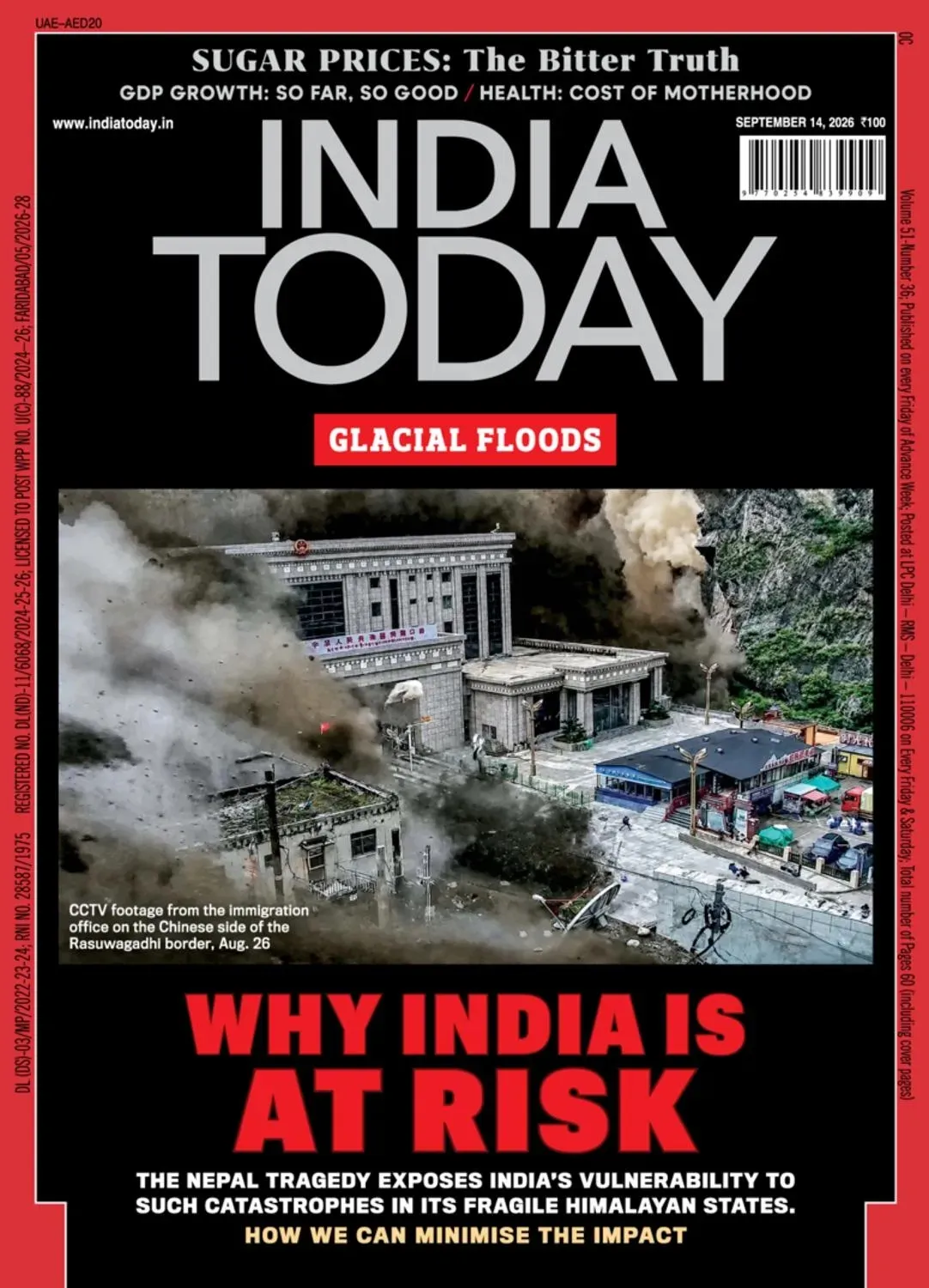
Glacial Floods — Why India Is at Risk — Jumana Shah reports that the Nepal tragedy exposes India's vulnerability to such catastrophes in its fragile Himalayan states, in the September 14, 2026 issue of India Today (Vol. 51 No. 36, Rs 100).
The cover story (page 20) by Senior Associate Editor Jumana Shah examines how glacial lake outburst floods threaten India's Himalayan states, following the Nepal disaster that exposed gaps in early warning systems, infra-structure resilience and cross-border data sharing. Upfront (page 5) reports GDP Growth — So Far, So Good, tempering India's headline expansion numbers with concerns about employment elasticity and rural demand. Sugar Prices — A Bitter Aftertaste (page 34) tracks the impact of rising sugar costs on household budgets and the food-processing industry. Andhra Pradesh — Amaravati Reimagined (page 38) follows the state's renewed push to build its capital. Health — Cost of Motherhood examines the financial burden of maternal healthcare across Indian states.
—–
Content Guide
▸ Cover Story
p.20 · Glacial Floods — Why India Is at Risk — by Jumana Shah
The Nepal tragedy exposed India's vulnerability to glacial lake outburst floods in its fragile Himalayan states. Shah reports on the specific lakes being monitored, the warning systems that do not exist across borders, and the infrastructure — hydroelectric dams, bridges, roads — that would be most exposed in a GLOF event. The article identifies the Himalayan states at highest risk: Uttarakhand, Himachal Pradesh, Sikkim and Arunachal Pradesh. Ask your district disaster-management office whether your valley has a GLOF evacuation plan — most do not.
▸ Upfront
p.05 · GDP Growth — So Far, So Good
India's headline GDP numbers remain strong but the article examines the employment elasticity of that growth — how many jobs each percentage point of expansion creates compared with historical averages. The rural-demand picture is weaker than urban consumption data suggests.
▸ Features
p.34 · Sugar Prices — A Bitter Aftertaste
Rising sugar costs are hitting household budgets and the food-processing industry. The article tracks the price trajectory over the past 12 months, the government's export restrictions, and the impact on beverage and confectionery manufacturers. Specific price-per-kilo data across major cities is presented.
p.38 · Andhra Pradesh — Amaravati Reimagined
The state's renewed push to build its capital city, Amaravati, after years of political back-and-forth between the previous and current state governments. The feature reports on land acquisition progress, infrastructure spending allocations and the investors who have committed to the project.
p.XX · Health — Cost of Motherhood
The financial burden of maternal healthcare across Indian states, from antenatal care to hospital delivery to postpartum support. The article cites specific state-wise data on out-of-pocket expenditure for institutional deliveries and the gap between the Ayushman Bharat coverage and actual costs.
▸ Regulars
p.XX · States
Legislative and political developments across India's states, with specific chief ministers, bills and policy announcements.
p.XX · Business & Economy
Corporate earnings, market movements and sector analysis for the week.
—–
Editor's Take
Jumana Shah's glacial floods cover story is the issue's clear editorial highlight — the specific lake identifications, the cross-border warning-system gap, and the infrastructure-exposure analysis give it a level of detail that general-interest newsweeklies rarely achieve on climate-risk reporting. The GDP Growth piece (page 5) provides a useful corrective to the headline-growth triumphalism found in business media, though it stops short of quantifying the employment-elasticity gap. The Sugar Prices feature (page 34) is a strong piece of economic-reporting that connects a commodity price to household budgets in a way readers will feel in their own shopping — the city-by-city price data is a practical addition. The Health — Cost of Motherhood piece is important but too short, occupying less than two pages when the topic deserves feature treatment. Advertising includes full-page placements from BPCL, NTPC and a Ministry of Health awareness campaign, which is moderate for India Today's standards. This issue suits the reader who follows climate-risk policy and is less concerned with political gossip.
Strengths
• Shah's glacial floods reporting with specific at-risk states and infrastructure data
• Sugar Prices feature with city-by-city price comparison data
• GDP Growth piece corrects headline-growth triumphalism
Weaknesses
• Health — Cost of Motherhood needed feature length, not two pages
• Employment-elasticity analysis stops short of a quantified gap
Verdict: Recommended — The glacial floods cover story is the kind of climate-risk reporting that India Today should do more of; the rest of the issue is solid but not spectacular.
