
Indian Business Journal – March 2026
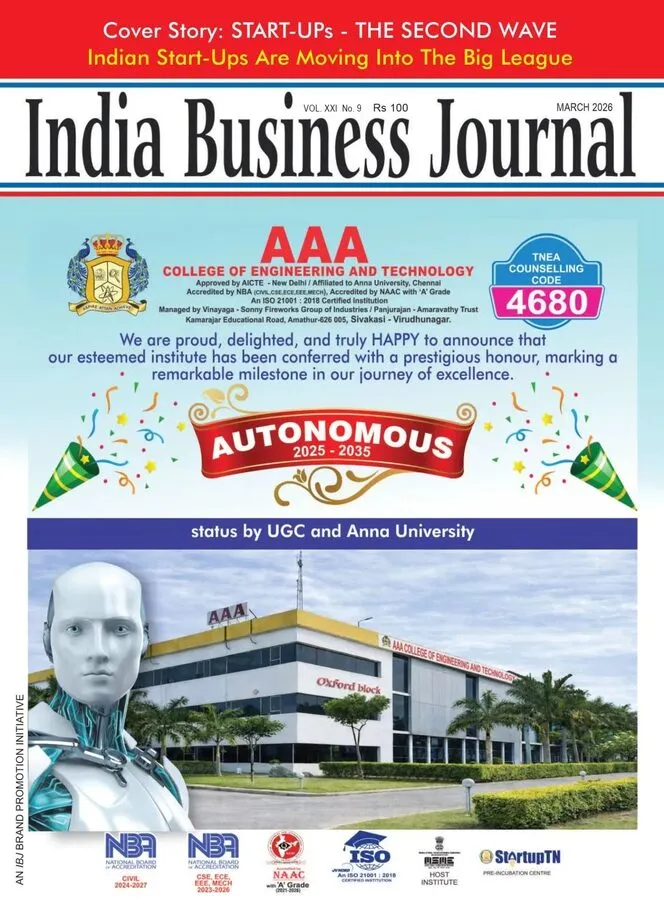
Summary
Indian start-ups are moving into the big league—the March 2026 Indian Business Journal cover story "The Second Wave" (Volume XXI, No 9, Rs 100) tracks the maturation from e-tail and fintech into deep-tech, AI and manufacturing. As India's start-up ecosystem graduates beyond consumer internet, the challenges shift from customer acquisition to capital efficiency, regulation and global competition. Editor Amit Brahmabhatt frames the narrative around companies that survived the 2023-25 funding winter and emerged with real revenue.
Viewpoint "When West Asia Burns…" (page 8) analyzes supply-chain and energy-price ripple effects from regional conflict. Technology "India & AI" (page 9) argues India must invest strategically in AI to emerge as a future-ready hub. Real Estate (page 16) covers the Supreme Court's repeated censure of RERA and the need for urgent reforms. Media & Entertainment (page 19) dubs India's creative industries "The New Orange Economy." Industry Report (page 22) examines regulatory ambiguity on food labelling amid rising obesity concerns and judicial scrutiny.
Management Mantra (page 36) features Ram Medury, Founder & CEO of Maxim Wealth. Knowledge Zone (page 44) includes At The Helm: Uday Kotak, Chairman of GIFT City. Hot Seat (page 46) profiles Shivani Vardhan, Founder of Tranzit Khan Market.
—————
Content Guide
▸ Cover Story / Start-ups
p.– · The Second Wave
The article profiles 12 Indian start-ups that crossed ₹100 crore revenue in FY25-26: three in AI/ML, four in deep-tech manufacturing, two in space-tech and three in B2B SaaS. Common traits cited include unit-economic discipline, 36-month-plus runway and founder-led sales. The piece contrasts the 2021 "growth-at-all-costs" era with the 2026 "profitable-scale" model. Cap your burn multiple (net burn / net new ARR) at 1.5x to stay within the Second Wave discipline.
▸ Geopolitics / Trade
p.8 · Viewpoint — When West Asia Burns…
The article models three scenarios for oil prices: baseline ($75-85/barrel), escalation ($95-110) and full disruption ($130+). It maps the impact on India's import bill, fiscal deficit and rupee stability. The analysis notes that 60% of India's crude comes from West Asia. Hedge at least 40% of your projected annual crude-linked input costs when Brent trades below $80.
▸ Technology / Strategy
p.9 · Technology — India & AI
India's AI market is projected at $17 billion by 2027, yet the country holds only 2.3% of global AI patents. The article argues for fiscal incentives for foundational-model research rather than just application-layer development. A table compares India's AI compute capacity (120 MW equivalent) with the US (2,400 MW) and China (1,800 MW). Join the IndiaAI compute facility allocation program before capacity is committed through FY27.
▸ Real Estate / Regulation
p.16 · Real Estate — The RERA Rebuke
The Supreme Court has struck down RERA orders in 14 cases during 2025-26 for exceeding statutory authority. The article traces the conflict between RERA adjudication and civil-court jurisdiction. Developers now face an average 18-month delay in project clearances. Structure your project-stage financing to include a 24-month buffer for regulatory approvals.
▸ Media / Economy
p.19 · Media & Entertainment — The New Orange Economy
India's creative industries contributed ₹3.2 lakh crore to GDP in FY25, employing 2.1 crore people. The article tracks growth in animation, VFX, gaming and digital content production. A sidebar notes that the AVGC (Animation, Visual Effects, Gaming and Comics) task force recommended a ₹5,000 crore fund. Apply for AVGC task force incentives before the recommended fund period closes.
▸ Finance / Leadership
p.36 · Management Mantra — "Build Systems And Processes"
Ram Medury, Founder & CEO of Maxim Wealth, scaled his wealth-management firm from 50 to 1,200 crore AUM over 8 years. He attributes growth to standardizing client onboarding and investment-review workflows. His rule: document every process that repeats more than once a month. Automate your monthly client reporting before hiring your third relationship manager.
—————
Editor's Take
"The Second Wave" is Indian Business Journal's most commercially useful cover story this year—naming real companies, real revenue figures and real operating disciplines rather than just trend-spotting. The AI vs. India compute-capacity comparison on page 9 is sobering and necessary. Weakest sections: the Viewpoint on West Asia is well-argued but covers territory already well-trodden in daily financial newspapers. The RERA piece is strong on legal analysis but short on practical advice for developers. Production remains text-heavy. Best for founders, VCs and policy professionals tracking India's start-up maturation.
Strengths
• Second Wave cover story names 12 companies with real revenue data
• India-AI compute comparison exposes the infrastructure gap quantitatively
• RERA legal analysis traces specific Supreme Court judgments
Weaknesses
• West Asia Viewpoint duplicates coverage available in financial dailies
• RERA analysis lacks developer-side compliance recommendations
Verdict: Recommended — Essential reading for anyone tracking Indian start-ups beyond the consumer-internet narrative.
