
Inside History Collection – Greatest Empires, 2026
Summary
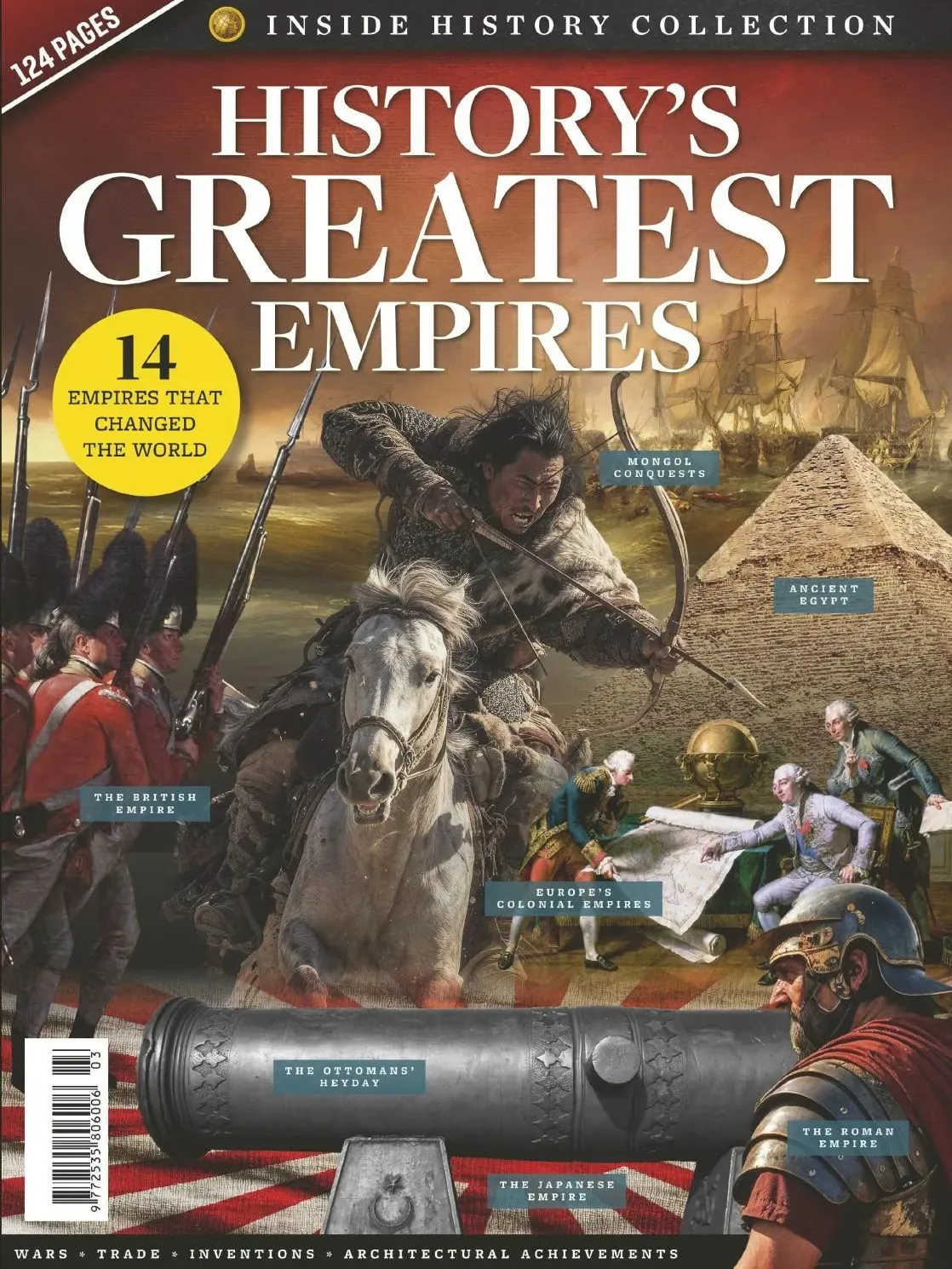
Inside History Collection: Greatest Empires (2026, 124 pages) surveys 14 empires that changed the world, from the British Empire (35.5 million km² at its height — 24% of Earth's land surface) to the Mongol Empire's 73-year conquest spree, the Roman Empire's 1,000-year reign, and Mali's gold-fuelled prosperity under Mansa Musa. The cover touts "Mongol Conquests," "The British Empire," "Ancient Egypt" and "The Ottomans' Heyday."
Eleven of 14 chapters are visible in the TOC: The British Empire (p.10) — largest in geographical terms at 35.5 million km²; The Russian Empire (p.24) — fuelled by fur trade and the dream of a warm-water naval port; The Han Dynasty (p.36) — China's first great imperial dynasty; Mali's Golden Empire (p.42) — Mansa Musa's 1324 hajj distributed so much gold that Egyptian inflation lasted a decade; The Mongol Empire (p.50) — the largest contiguous empire in history, expanding from virtually no land to 24 million km² in under 70 years under Genghis Khan; The Ottoman Empire (p.62) — elite Janissary troops and enormous cannons transformed a small principality; The Roman Empire (p.74) — more than 1,000 years from 753 BC to AD 476; Europe's Colonial Empires (p.82) — beginning with Henry the Navigator's 1427 expedition along Africa's west coast; The Egyptian Kingdom (p.92); The Japanese Empire (p.100) — 1868 Meiji Restoration to 1945; The Inca Empire (p.112).
—————
Content Guide
▸ Largest Empires
p.10 · The British Empire
At its peak, the British Empire controlled 35.5 million km² — 24% of Earth's land surface — and ruled over 400 million people. The chapter traces the empire from 1583 to 1997. The article includes a data box comparing British, Mongol and Russian empires by area, population and duration. The empire was so large that the sun never set on it — a literal statement, since British territories spanned every time zone.
p.50 · The Mongol Empire
Genghis Khan united Mongolia's warring tribes in 1206. By 1279, the empire stretched from the Pacific Ocean to Eastern Europe — 24 million km² conquered in 73 years. Mongol riders could fire an arrow every three seconds while hanging from the side of a horse. The empire's Yam postal system allowed riders to travel 200 kilometres per day by changing horses at relay stations. The chapter covers Genghis's rise from outcast to ruler — he began life hungry and homeless on the steppes after his father was poisoned when he was nine years old.
p.74 · The Roman Empire
The Roman Empire existed for more than 1,000 years, from 753 BC to AD 476. At its peak in AD 117, provinces stretched across Europe, Africa, Asia Minor and the Levant. The chapter covers the Republic-to-Empire transition, the Pax Romana, Hadrian's Wall and the empire's administrative legacy in law, language and architecture. Roman concrete — opus caementicium — is still used as a reference standard for modern concrete durability.
▸ Cultural & Economic Empires
p.36 · The Han Dynasty
China's first great imperial dynasty (206 BC-AD 220) established the Silk Road, standardised weights and measures, and invented paper. The chapter examines how skilled emperors and a bureaucracy of inventive officials created a model that Chinese dynasties followed for 2,000 years. The Han dynasty's population of 60 million made it the largest political unit in the world at the time.
p.42 · Mali's Golden Empire
Mansa Musa's 1324 pilgrimage to Mecca included 60,000 attendants and 80 camels each carrying 140 kilograms of gold. The gold distribution in Cairo caused inflation that took a decade to recover. The chapter places Mali's wealth in context: the empire controlled the West African gold fields that supplied Europe, North Africa and the Middle East.
p.62 · The Ottoman Empire
Elite Janissary troops — Christian boys converted to Islam and trained from childhood — and enormous bronze cannons gave the Ottomans military superiority. The capture of Constantinople in 1453 used a cannon that fired 600-kilogram stone balls. The chapter covers the empire's 600-year span from 1299 to 1922.
▸ The Americas
p.112 · The Inca Empire
At its peak in the 15th century, the Inca Empire stretched 4,000 kilometres along the Andes from modern Colombia to Chile — the largest pre-Columbian empire in the Americas. The chapter covers the road system (40,000 kilometres of paved roads), terrace agriculture and the quipu knotted-string recording system. The Spanish conquest under Francisco Pizarro in 1532 used 168 men to defeat an empire of 10 million.
—————
Editor's Take
Inside History Collection: Greatest Empires is a visually rich 124-page survey that benefits from its comparative structure — data boxes ranking empires by area, population and duration appear in every chapter, allowing readers to compare the Mongol 24 million km² in 73 years against the British 35.5 million km² across 400-plus years. The Mali chapter (p.42) is the strongest entry: Mansa Musa's gold-distribution causing decade-long Egyptian inflation is a specific economic detail that most empire surveys omit. The Inca chapter (p.112) correctly emphasises the quipu recording system and 40,000-kilometre road network, positioning the empire as an engineering achievement rather than a conquest narrative. The weakness is the 14-empire promise: only 11 of 14 chapters are visible in the available content. The Han Dynasty chapter (p.36) is too compressed — paper invention and Silk Road establishment deserve more than four pages. The design uses AI-generated imagery credited to Midjourney, which produces visually striking but historically imprecise illustrations — Genghis Khan's armour is anachronistic.
Strengths
• Comparative data boxes rank empires by area, population and duration across chapters
• Mali chapter covers Mansa Musa's decade-long Egyptian inflation from gold distribution
• Inca chapter emphasises quipu recording system and 40,000 km road network
Weaknesses
• Only 11 of 14 promised empire chapters visible in the contents
• AI-generated Midjourney illustrations include anachronistic armour details
Verdict: Recommended — A well-structured comparative survey; the Mali and Inca chapters are the standouts. (17 words)
