
National Geographic Little Kids UK – Issue 47 2026
Summary
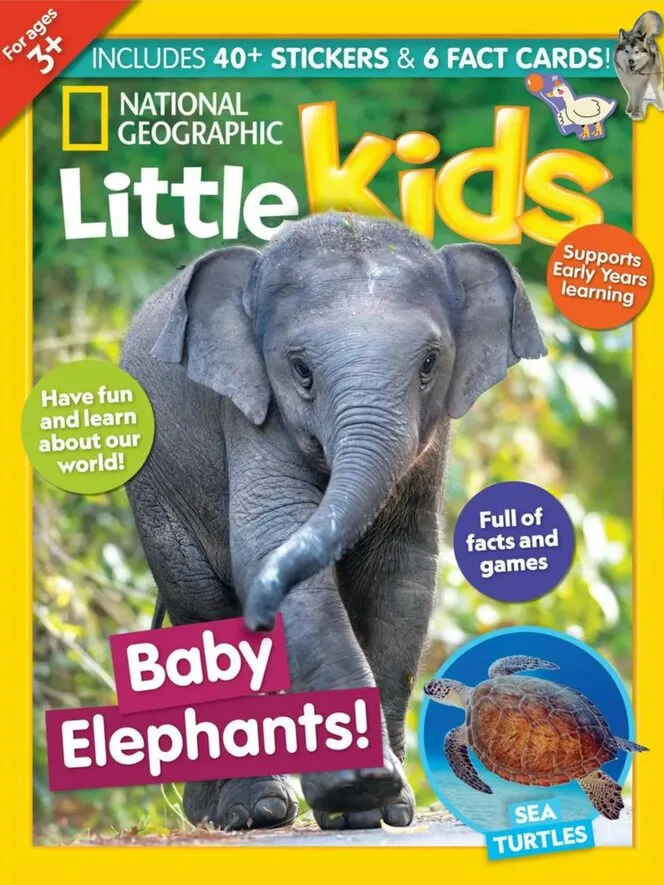
National Geographic Little Kids UK Issue 47 (2026, ages 3+) leads with baby Asian elephants at play — a cover that delivers exactly what it promises: trunk-wrestling, mud-bathing and ear-flapping calves photographed in their jungle nursery. Inside, cotton-top tamarins, sea turtles, star-nosed moles, an Oviraptor dinosaur and a Let's Visit Alaska page fill 36 pages with 40-plus stickers and 6 fact cards.
The issue opens with a cactus page explaining spines (p.4), then moves through a "Silvery Stuff" guessing game (p.6), Asian elephant babies (p.8), cotton-top tamarin monkeys (p.10), a special-vehicle ride page (p.14), sea turtles with seven species (p.16), silly sentences (p.20), star-nosed mole underground life (p.22), a kitchen search-and-find (p.24), the birdlike Oviraptor dinosaur (p.26), Let's Visit Alaska (p.28), the Little Kids Big Quiz (p.32) and an on-the-farm game (p.34). The 6 perforated fact cards cover cacti, Asian elephants, cotton-top tamarins, sea turtles, star-nosed moles and Oviraptor.
Each spread follows the established format: one factual sentence, a "Time to Chat" question for the adult, and an on-page activity. The UK edition includes UK spellings and references (metres instead of feet, Celsius instead of Fahrenheit).
—————
Content Guide
▸ Animal Features
p.8 · Asian Elephants — Playtime for babies!
Calves at the Elephant Nature Park in Thailand wrestle with their trunks, take mud baths and stay within five metres of their mothers at all times. A newborn elephant can stand within 30 minutes of birth. Ask your child why the baby stays so close to its mother — then explain that elephant calves drink milk for two years.
p.10 · Cotton-Top Tamarins — Cute monkeys!
A family of cotton-top tamarins from Colombia's rainforests. The white crest on their head is longer than their face. Tamarin fathers carry the babies for the first three months, handing them to the mother only for feeding. Look at your own hair in the mirror — tamarin crests grow as long as a child's hand.
p.16 · Sea Turtles — Seven super species
Seven species compared by shell pattern, size and diet. The leatherback grows to two metres — longer than a bathtub. The hawksbill has a beak shaped like a bird's for reaching into coral crevices. Paint seven pebbles with each turtle's shell pattern and hide them in the garden for a fossil-dig game.
p.22 · Star-Nosed Mole — Life underground
A mole with 22 pink tentacles around its nose — the most sensitive touch organ of any mammal. It can identify prey in under 200 milliseconds. The mole's paddle-shaped front claws are built for digging. Fill a shoebox with soil and bury a few toys — let your child dig like a star-nosed mole to find them.
▸ Science & Nature
p.4 · Cactus — Why is this plant so spiky?
Spines are modified leaves that reduce water loss and shade the stem. Cacti store water in their thick stems — a mature saguaro can hold up to 200 gallons. Touch a cactus spine carefully (through a thick glove) — the barbed tip is designed to catch fur for seed dispersal.
p.20 · Silly Sentences
Fill-in-the-letter game with animal names. The letters are missing from "e_e_h_nt" and "t_m_r_n" — children write the vowels back in. Say each word aloud with the missing sound and let your child hear the gap before writing the letter.
▸ Activities & Games
p.14 · Enjoy the Ride
Special vehicles for jobs: a tractor (farming), a fire engine (emergency), a campervan (holiday) and a bulldozer (construction). Each vehicle has a job description and a matching badge. Draw your own vehicle for a made-up job — a banana delivery truck with a bunch-shaped roof.
p.26 · Oviraptor — Meet a birdlike dino
A feathered dinosaur from the Gobi Desert that sat on its eggs like a bird. Oviraptor was first thought to be an egg-thief, but fossils show it was protecting its own nest. The name means "egg thief" — a case of mistaken identity that lasted 70 years. Find a chicken egg and compare it to the Oviraptor egg shown on this page — which is bigger?
▸ World Culture
p.28 · Let's Visit… Alaska!
Giant glaciers, big brown bears and the Northern Lights. Alaska has more coastline than all other US states combined. The spread shows a dog sled team, a salmon run and the Aurora Borealis. Stand in a dark room and wave a green glow stick slowly — that green arc looks close to how the aurora moves across the sky.
—————
Editor's Take
Little Kids UK Issue 47 is the weaker of the two UK issues reviewed, dragged down by the star-nosed mole spread (p.22) — a creature so alien-looking that several parents may skip the page. The Asian elephant cover (p.8) is well-executed: baby-elephant play is a guaranteed attention-holder. The cotton-top tamarin spread (p.10) introduces the unusual fact that fathers carry offspring, which subverts the "mama-and-baby" norm in preschool publishing. The Oviraptor page (p.26) teaches a genuine scientific correction — the dinosaur was slandered as an egg thief for 70 years — which is the kind of surprising detail adults enjoy reading aloud. The Alaska cultural page (p.28) offers the Aurora glow-stick activity, which is this issue's best extension idea. But the star-nosed mole's 22 tentacles may trigger a sensory-overload reaction in sensitive preschoolers.
Strengths
• Asian elephant cover uses newborn-standing-within-30-minutes fact for immediate engagement
• Cotton-top tamarin spread reveals father-as-primary-carrier parenting model
• Oviraptor page corrects a 70-year scientific misidentification
Weaknesses
• Star-nosed mole's 22 nose tentacles may unsettle sensitive preschoolers
• No food or cooking feature — Alaska page focuses only on landscape
Verdict: Recommended — A good issue anchored by the elephant cover, but weaker than Issue 48's line-up. (16 words)
