
New Scientist International Edition – 11 July 2026
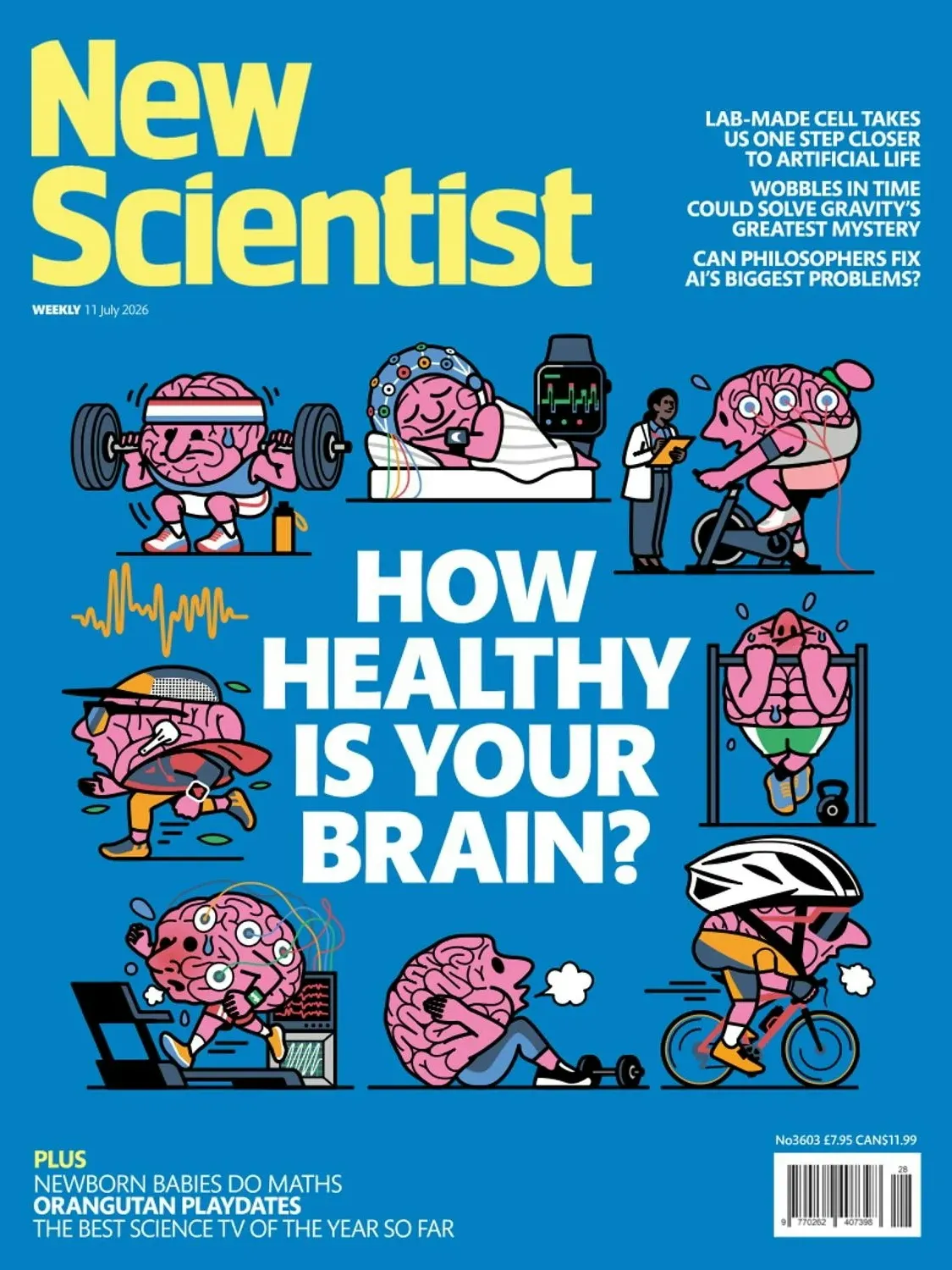
Summary
Vol 271 No 3603 (11 July 2026) asks "How healthy is your brain?" on the cover—a feature that examines whether any of the popular brain-training tests, supplements, and lifestyle interventions actually work, and how to separate evidence from wishful thinking. The issue also reports lab-made cells taking us one step closer to artificial life (p.8), wobbles in time that could solve gravity's greatest mystery (p.4), and whether philosophers can fix AI's biggest problems (p.10).
Three features run: the brain-health check-up cover (p.32), the end of Occam's razor in complex scientific modelling (p.37), and strange metals that force a rethink of electricity flow (p.40). News includes orangutan mothers planning trips so their young can play (p.14), newborn babies doing maths (p.16), and an inevitable shutdown of a key ocean current (p.9).
The back pages explain why ice cream is so delicious, and Feedback reveals how the poop emoji got its shape from lugworm poop.
—————
Content Guide
▸ Cover Story / Neuroscience
p.32 · Your brain check-up — In our efforts to keep our brains healthy, how do we know what is working?
The feature reviews the evidence for six popular brain interventions: cognitive training games (no far-transfer effect), omega-3 supplements (small benefit only if deficient), aerobic exercise (strongest effect, especially on hippocampal volume), bilingualism (delays dementia onset by 4-5 years), meditation (reduces amygdala reactivity but not cognition), and sleep extension (improves memory consolidation). It grades each intervention on a scale from A (strong evidence) to D (harmful). A pull-out chart ranks them by effect size and cost.
p.6 · Not so special — Our unusually large brains may have grown for no particular reason
A null-result paper that made headlines: genome-wide association studies found no selective sweep signatures for brain size. The brain's expansion may be a neutral by-product of body-size increase.
▸ Artificial Life
p.8 · Lab-made cell takes us one step closer to artificial life
The synthetic cell "SpudCell" contains a minimal genome of 473 genes, of which 100 have unknown functions. The team demonstrated that the cell can self-maintain and divide for 30 generations. The article clarifies that SpudCell is not autonomous—it requires a supply of pre-made amino acids and lipids.
p.10 · Can philosophers fix AI's biggest problems?
A workshop at Cambridge brought together philosophers and AI researchers to address the alignment problem, the black-box problem, and the value-loading problem. The article concludes that philosophy offers useful framing but no technical solutions yet.
▸ Physics
p.4 · Wobbles in time could solve gravity's greatest mystery
If time fluctuates at quantum scales, these fluctuations would produce a detectable signal in atomic clocks. The article explains how a 10^-21 second wobble in time-flow could resolve the conflict between general relativity and quantum mechanics. An experiment with optical lattice clocks is scheduled for 2028.
p.40 · Unusual conduct — Strange metals are forcing us to rethink how electricity flows
Materials that violate the Wiedemann-Franz law challenge our understanding of electrical conduction. The feature profiles a strontium ruthenate compound where heat and charge move independently.
▸ Regulars
p.45 · Puzzles — Try our crossword, puzzle and quick quiz
The logic puzzle tasks readers with ranking six brain interventions by effect size, directly testing the cover feature data.
p.46 · Almost the last word — Why is ice cream so delicious?
The answer: fat content (14-16 percent), air incorporation (50 percent overrun), and temperature-dependent sweetness perception.
—————
Editor's Take
The brain check-up cover is the most practically useful feature in the July New Scientist issues—the effect-size-versus-cost chart is clinic-ready. The artificial-life update (p.8) is responsibly framed, avoiding the breathless "we created life" narrative. The "strange metals" feature (p.40) is dense and rewarding for physics readers. Weakest item: "Philosophers fixing AI" (p.10) is a polite write-up of a workshop that produced no actionable outcomes. Ad load is moderate. Best for general readers who want an evidence filter for brain-health products; skip the philosophy column.
Strengths
• Brain intervention evidence chart: specific, graded, financially aware
• Artificial-life coverage: cautious, non-sensational, technically accurate
• Strange-metals physics: genuinely strange and well-explained
Weaknesses
• Philosophers-and-AI column produced no concrete conclusions
• Time-wobble feature needed an experimental timeline to land effectively
Verdict: Recommended — The brain-health cover is a genuine public service; the artificial-life piece is a bonus.
