
New Scientist International Edition – 15 August 2026
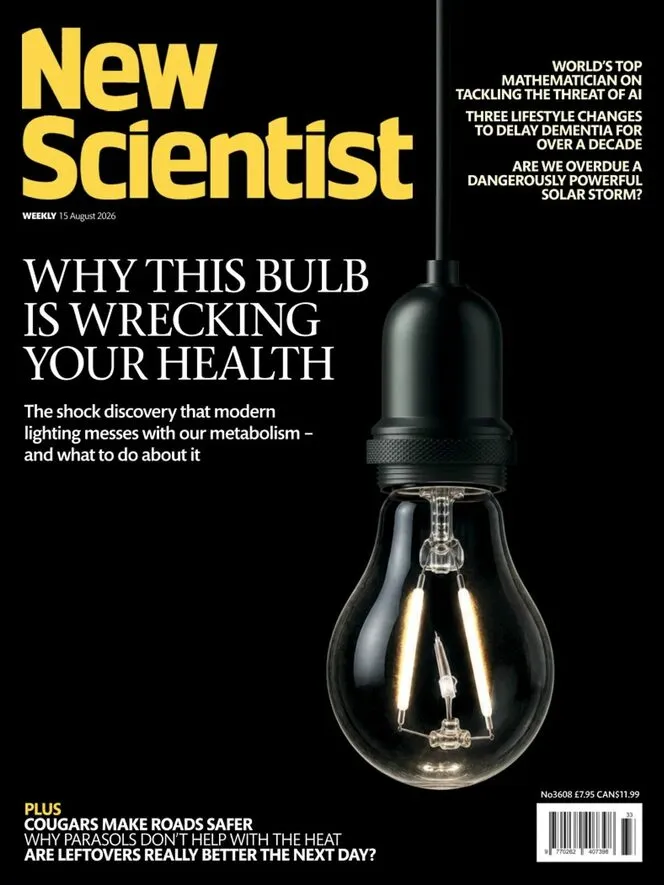
Summary
Vol 271 No 3608 (15 August 2026) puts a controversial headline on the cover: "Why this bulb is wrecking your health"—the shock discovery that narrow-spectrum modern lighting, especially LED bulbs lacking red wavelengths, is disrupting human metabolism and contributing to glucose intolerance and weight gain. The issue also reports a close-up image of the sun revealing a surprise feature (p.5), a weight-loss supplement using dead bacteria (p.8), and an ancient Egyptian dam (p.11).
Four features run: the lighting-metabolism cover (p.30), a mega solar storm overdue from ancient tree-ring data (p.34), mathematicians reimagining the field in the face of AI (p.38), and black holes with no temperature (p.42). News includes three lifestyle changes that delay dementia by over a decade (p.7), carnivorous confirmation of Charles Darwin's plant hunch (p.15), and why parasols don't help with the heat (p.15).
The back pages explore the optimal way to ice a cocktail, and Feedback inspects shapewear's effect on risk-taking.
—————
Content Guide
▸ Cover Story / Health & Metabolism
p.30 · Red-light starvation — Narrowing the spectrum of light we are exposed to is affecting our metabolism
The feature reports that blue-rich, red-poor LED spectra suppress mitochondrial cytochrome c oxidase activity, reducing ATP production in retinal and subcutaneous cells. A controlled trial found that participants who spent 8 hours per day under standard 4000K LEDs showed a 12 percent decrease in insulin sensitivity after 4 weeks, compared with those under full-spectrum light. The prescription: use red-enriched bulbs in the evening, get 15 minutes of outdoor daylight before noon, and avoid white LEDs after 8 pm. A spectral-comparison chart accompanies the piece.
p.8 · Weight-loss supplement — A pill containing dead bacteria could offer an alternative to existing weight-loss drugs
Heat-killed Akkermansia muciniphila given as a daily capsule produced a 2.8 kg average weight loss over 12 weeks in a placebo-controlled trial, without the gastrointestinal side effects of GLP-1 agonists. The mechanism: the bacterial cell walls stimulate intestinal tight-junction repair, reducing low-grade inflammation.
▸ Solar / Climate
p.34 · Storm warning — Ancient tree rings show our sun is capable of mega solar storms – and one may be due
Radiocarbon spikes in tree rings dated to 664 BCE and 5259 BCE indicate solar proton events far larger than the 1859 Carrington event. A modern mega-storm could knock out power grids across entire continents. The article profiles the Space Weather Prediction Center's response protocols. A timeline shows the recurrence interval: roughly 1,000 years, meaning we are statistically due.
p.5 · Spectacular solar snap — Close-up image of the sun reveals surprising feature
The Solar Orbiter spacecraft captured a detailed image of a Kelvin-Helmholtz instability in the solar corona, resolving a 50-year theoretical prediction. The wave structures span 300,000 km.
▸ Technology / AI
p.38 · Maths' identity crisis — In the face of AI, mathematicians need to reimagine the field
A profile of the world's top mathematician who argues that AI-generated proofs will force mathematics to shift from theorem-proving to theory-building. The piece quotes Terence Tao, who recently joined OpenAI's advisory board. It raises the question: if AI can prove theorems faster than humans, what is the mathematician's job?
p.42 · Impossible horizons — Could black holes with no temperature exist?
Theoretical work suggests that "extremal" black holes—those with maximum charge or spin—could have zero Hawking temperature, making them essentially eternal and black. The article explains why detecting them would require a new generation of gravitational-wave observatories.
▸ Regulars
p.45 · Puzzles — Try our crossword, puzzle and quick quiz
The quick quiz includes a question about the wavelength range of red-enriched bulbs recommended in the cover feature.
p.46 · Almost the last word — What is the optimal way to ice a cocktail?
A reader's question produces a physics-backed answer: large ice cubes melt slower and dilute drinks less; the optimal ice-to-liquid ratio is 2:1 by volume for a 3-minute serving window.
—————
Editor's Take
The red-light starvation cover is a genuine public-health story hiding inside a science magazine—the metabolic effects of LED spectra are underappreciated, and this feature makes the case accessibly and prescriptively. The mega-solar-storm piece (p.34) is gripping, though it repeats material the magazine has run twice in the past three years. The weight-loss supplement news (p.8) is solid but overhyped on the cover. Weakest item: "Impossible horizons" (p.42) is 4 pages of speculation on a phenomenon that has never been observed and may not exist. Best for anyone concerned about metabolic health, screen time, and the physical environment.
Strengths
• Red-light-spectrum health impact: new, prescriptive, actionable
• Mega-solar-storm reporting: data-rich, historically grounded
• Lighting spectral chart is a practical takeaway
Weaknesses
• "Impossible horizons" speculates on unobserved phenomena for 4 pages
• Weight-loss supplement news is overplayed on the cover
Verdict: Recommended — The lighting-metabolism cover is a sleeper hit; read for the circadian health advice, skip the black-hole speculation.
