
New Scientist International Edition – 2 July 2026
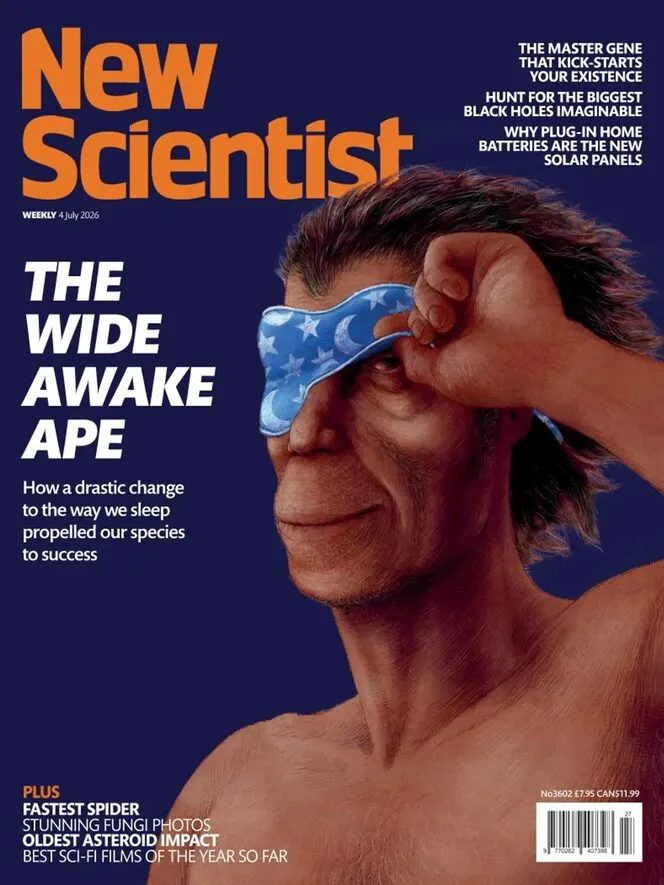
Summary
New Scientist Vol 271 No 3602 (4 July 2026) puts sleep evolution on the cover with "The wide awake ape," arguing that a drastic shift in human slumber—shorter, more REM-dense, biphasic—propelled our species out of the trees and into dominance. The cover image of a crouched, alert primate sets the tone for an issue that also hunts stupendous black holes (p.41), tracks the Thwaites glacier collapse (p.36), and asks why plug-in home batteries are the new solar panels (p.10).
Three features carry the weight: the sleep-and-success cover story (p.30), a "Doomsday glacier" update from Antarctica (p.36), and a search for black holes larger than galaxies (p.41). News leads with ancient human DNA found in a cave painting (p.7), a cyborg cockroach diving suit (p.9), and Roman scrolls deciphered by AI (p.15). Helen Thomson covers a "fusogenic" neurosurgery stirring head-transplant debates (p.19), and Annalee Newitz imagines alien Earths (p.20).
The back pages offer puzzles, a moon-food hypothetical in "Almost the last word," Tom Gauld's cartoon, and Feedback on skin-microbiome marketing. The leader, headlined "Rising heat," warns that Europe's heatwave coverage must stay on the news agenda.
—————
Content Guide
▸ Cover Story / Evolution
p.30 · The sleepless ape — Humans' unusual and daring sleep habits could be the secret to our success
The feature argues that Homo sapiens evolved shorter total sleep time, higher REM proportion, and a biphasic pattern (a night sleep plus a midday nap) that freed up waking hours for social learning and tool innovation. It cites comparative primate sleep data showing humans sleep 7 hours on average versus 10-15 hours in great apes. Readers finish with one actionable take: a short afternoon nap may boost cognitive flexibility more than caffeine.
▸ Climate / Environment
p.36 · Doomsday glacier — Thwaites glacier is collapsing, with huge consequences for the future of our planet
Updated fieldwork shows the last intact ice shelf in front of Thwaites could break away within months, not years. The article explains how warm circumpolar water is undercutting the glacier from below, and what a full collapse—contributing 65 cm to global sea level—would do to coastal cities. A time-lapse satellite graphic compresses 10 years of retreat into 15 seconds.
p.6 · Oldest asteroid impact
Geologists have identified a crater in Western Australia's Pilbara region dated to 3.5 billion years old, 1.2 billion years older than any known impact site. The find reshapes theories of early Earth crust formation and the origins of plate tectonics.
▸ Technology
p.10 · Why plug-in home batteries are the new solar panels
Falling lithium-ion prices (down 40 percent since 2024) and new grid-export tariffs have made stationary home batteries a faster payback investment than rooftop PV in several UK and Australian markets. The article compares four commercially available units—Tesla Powerwall 3, GivEnergy, Sonnen, and BYD—by cost per kWh cycled.
p.15 · AI deciphers scrolls — Roman scrolls that were carbonised by a volcanic eruption have been read
Machine-learning models trained on micro-CT scans have extracted 5,000 characters from Herculaneum papyri without unrolling them. The newly readable text includes previously unknown passages from a lost Epicurean philosopher. The piece walks through how the AI was trained on phantom-letter shapes.
▸ Space
p.41 · Stupendous black holes — The search is on for black holes bigger than galaxies
Astronomers are using pulsar timing arrays to detect gravitational wave signals that could reveal black holes with masses of 100 billion suns. The feature explains how such "stupendous" black holes might have formed from direct-collapse gas clouds in the early universe, and why they challenge current galaxy-formation models.
p.16 · Space delivery service — Starfall aims to carry cargo back to Earth
A startup has tested a small re-entry capsule that can return microgravity-manufactured materials from orbit at one-tenth the cost of SpaceX Dragon rideshare. The first commercial customer is a pharmaceutical company producing protein crystals in microgravity.
▸ Regulars
p.45 · Puzzles — Try our crossword, puzzle and quick quiz
This week's logic puzzle challenges readers to schedule six telescope observations given constraints of weather window, instrument availability, and moon phase—a genuine test for data-savvy readers.
p.46 · Almost the last word — Could any plants and creatures be a viable food source on the moon?
A reader question produces surprising answers: duckweed (Lemna minor), mealworms, and mushrooms could form the base of a lunar life-support loop. The calculations suggest 20 square metres of duckweed could supply one person's daily protein.
—————
Editor's Take
The "wide awake ape" cover delivers a genuinely fresh angle on human evolution—specific, data-rich, and counterintuitive. It is the best single feature in the July cohort. The Thwaites update (p.36) and black-hole search (p.41) are both strong, but the issue feels front-loaded: from page 20 onward, the energy dips. "Alien Earth" (p.20) is too short to develop its premise, and the fusogenic neurosurgery column (p.19) leans sensationalist without enough clinical evidence. The advertising ratio is higher than usual—three four-page ad inserts in the first 20 pages. Best for undergraduate biology and astronomy readers; less suitable for readers seeking deep climate policy analysis.
Strengths
• Sleep-evolution thesis: specific, comparative, actionable
• Thwaites update with imminent-timeline satellite graphics
• Cyborg cockroach news item is weirdly fascinating
Weaknesses
• "Fusogenic" neurosurgery column overclaims on thin evidence
• Heavy ad density in first 20 pages
Verdict: Recommended — The cover feature alone justifies the purchase; skip the opinion pages.
